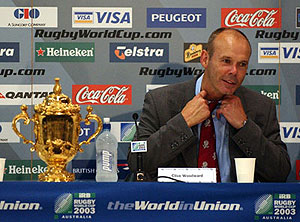
RWC: WoodWard’s 10 Commandments on Winning
By Spiro Zavos, 7 Sep 2007 Spiro Zavos is a Roar Expert

Clive Woodward is one of only five coaches who worked out how to win the Rugby World Cup.
In ‘The Times’ he has given his 10 Commandments on ‘How To Win The World Cup.’
1. You need the whole game behind you. 2. Try to arrive as favourites. 3. Experience. 4. Playing in your own hemisphere and particularly your own country 5. A settled team. 6. A tried and trusted way of playing. 7. Leadership 8. The need for world class people in support of the players. 9. Deal with the energy sappers and the termites. 10. Totally understand your opposition.
These 10 Commandments are very similar to the 7 Factors that I described in ‘Watching The Rugby World Cup‘: Home ground advantage, Capabilities of the Coach, Chemistry of the side, Quality of the first five-eighth, Leadership qualities of the captain, Kind of game played, Momentum.
Woodward points to the build-up by the All Blacks, 38 wins out of their last 43 tests as being similar to that of England in 2003 with their 35 test wins in their 40 games going into the 2003 RWC, as the factor that makes them favourites to win the Webb Ellis trophy: ‘In most sports, favourites tend to win.’
However, he says that being favourites does put a team under huge pressure: ‘I await with interest to see whether New Zealand can withstand it.’
‘The big danger,’ Woodward suggests, ‘comes from France.’ And also the Wallabies: ‘Australia will not be afraid of New Zealand on neutral ground so an All Black triumph is not a foregone conclusion.’
Spiro Zavos, a founding writer on The Roar, was long time editorial writer on the Sydney Morning Herald, where he started a rugby column that has run for nearly 30 years. Spiro has written 12 books: fiction, biography, politics and histories of Australian, New Zealand, British and South African rugby. He is regarded as one of the foremost writers on rugby throughout the world.
Looking to join The Roar team? We're searching for an experienced Group Sales Manager to lead our team in Sydney. Yes, this does mean you get to work with the site all day long! If you're a digital media sales star, we want to hear from you. Apply now.
![]()
Passionate about your union? Then sign up to The Roar's brand new daily union email, delivering Roaring articles directly to you day-in, day-out. You'll love it!
Click here to join now!
The Crowd Says (5) | Page 1 of Comments
Have Your Say
- Explore:


September 7th 2007 @ 1:49pm
swifty said | September 7th 2007 @ 1:49pm | Report comment
I wonder if he has any insights on how to win a lions series …
Sorry but I’ve got lots of time for reading the things he said before he won the world cup but the success obviously got to his head and as he showed in New Zealand in 2005 he had no intention of moving passed his 2003 game plan.
September 7th 2007 @ 5:55pm
jools-usa said | September 7th 2007 @ 5:55pm | Report comment
Is Sir Clive part of the Guscott group who says Australia play dull rugby?
Hope not, as after all, they DID manage one try in RWC 2003 final.
Jools-USA
September 9th 2007 @ 1:51pm
stu said | September 9th 2007 @ 1:51pm | Report comment
Hey jools both teams scored a try in the 2003 rwc final.
September 10th 2007 @ 12:01pm
Julian Evans said | September 10th 2007 @ 12:01pm | Report comment
Sir Clive’s 10 points for winning the world cup are OK, accept they should be supplemented by an 11th point – do not overr coach or over emphasise the role of the coach. Players win the world cup not coaches. A bad game plan with godd players might lose a world cup, but a good game plan with bad players won’t win you anything. There was nothing wrong with the NZ game plan in 2003, 1999 or 1995. 1995 was just an occassion when the team on the day (SA) played above iself with the emotion of it all and won. However, in 2003 and 1999 the AB had a fine game plan, just not the quality of players to actually win it. Both teams suffered from not having a dominant pack and both teams just didn’t have enough class in enough positions to make the right moves at the right times. Whereas England in 2003 had the most dominant pack in Rugby History and would have won no matter who they played. The fact is if they had a game plan like Australia or NZ they would have won by a lot more. Sad to say they were overcoached and fluffed their lines in the final, only just winning a game they actually dominated. Australia in 1999 had the best game plan, and marginally the better players, but the question remains did they have enough to have beaten the ABs in the final? Unquestionably, Australia had the best team and players in 1991, and it was only their toughness and skill that ultimately won them the final against a home-town Engliand. The contrast with the 1995 ABs in how to win against the home-town team is instructive. While the 1987 All Blacks had both the players and the game plan to be the most dominant team in any RWC. So Sir Clive, it’s all well and good to list a huge number of reasons why, but in the end its the players skills and their mental toughness that count. Coaching doesn’t add much more than polish when you get it right, and can detract from it when you get it wrong
September 10th 2007 @ 2:45pm
Pfitzy said | September 10th 2007 @ 2:45pm | Report comment
Clive was somewhere between coach and manager – a supreme facilitator who got the RFU to fulfill his demands in order to make a good team successful. By the time they arrived at RWC2003, England were ready to beat anyone, despite assurances from the All Blacks that they would have won that final if they’d gotten past the Wallabies. The mere fact that they didn’t get close to us on the day shows the ABs were going to be no match for England.