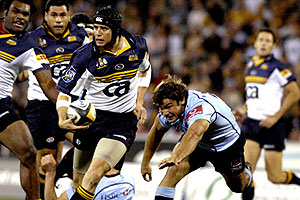
By Garth Hamilton
October 29th 2007 @ 7:20am
Stephen Larkham: Remembering Bernie

In the post John Eales era there have been few players that Australia have relied more upon to deliver them success than Stephen Larkham.
He has defined the way Australia play for the best part of a decade and for long periods of his career he set the standard internationally for fly half play. For a player who has influenced the outcome of so many games during his career it was tragic to see him retire without touching a ball after the ‘Miracle at Marseilles’.
To look back on Larkham’s career is to look back on the rise and fall of the Wallabies at the turn of the millennium. If rugby indeed is played in cycles then Larkham’s career spanned a full one. From the depths of the 1997 defeat to Argentina to the highs of the 1999 World Cup and the first series defeat of the Lions in 2001, Larkham helped guide the Wallabies rise and fought to hold off the regrettable fall that resulted in the notoriously poor tour of the northern hemisphere in 2005.
A superb playmaker who always attacked the advantage line, Larkham perfectly fitted the bill as the fly half to orchestrate new coach, MacQueen’s multiphase game play. A rugged and willing defender, Larkham was also the right man to step up to John Muggleton’s disciplined defensive structure. This defence famously held against all comers in the world cup bar the United States as the Wallabies marched on to victory and Muggleton’s work is credited with starting the world wide improvement in this area of the game.
The first game of the 2000 Bledisloe Cup saw perhaps the best game of Larkham’s career. Having conceded 3 tries in the space of 7 minutes the Wallabies could have been expected to take in the shock that filled their supporters at the ground and in bars and lounge rooms around the world. Instead Larkham got down to business. With the first good ball the Wallabies had seen the fly half made a gap in the defence where there wasn’t one. Whatever the All Blacks could throw at them, Larkham refused to lose his head or concede an early defeat. As a playmaker this defiance was inspiring.
Replays show there was only the slightest of misalignments in the All Black’s defensive line as Larkham loped towards them. With little more than a feint show of the ball and a shift of his shoulders he was passed the first line of defence and the game was alive. The play combined the two great traits that became synonymous with Larkham’s game; the ghosting run described above and the long flat pass, this time perfectly fed to a young Stirling Mortlock who raced away to finish the move with a try.
That game, won at the death by a Jonah Lomu try, remains the best of the professional era and was arguably the last of its kind at an international level – when attack outweighed defence – before England made ten man rugby successful again. The 2001 Lions tour was the turning point for world rugby as phase play slowly gave way to the forward based game. Critical to the success of the British and Irish team was negating Larkham’s attacking threats. They set about achieving this with an aggressive attitude and a series of late challenges, memorably delivered through the elbow of Scott Quinnell, that took a heavy blow on Larkham and largely succeeded in taking him out of the series. Parallels were drawn with the bodyline tactics of yesteryear as attacking flair was sacrificed at the altar of success at all costs. Fortunately for Australia these tactics failed but the die was cast.
At this point in Larkham’s career, with his importance to the success of his team so obviously acknowledged by the northern hemisphere teams, Australian rugby began its slow downward spiral. The departure of MacQueen and many of the team’s stalwarts was not well managed and nowhere was this more obvious than in the forwards. As the world rugby landscape changed Australia stood still, tenaciously clinging to the multiphase game plan as their opposition became bigger and stronger at the set piece.
The criticality of Larkham’s role was further exasperated by Australia’s relatively small playing pool and lack of competition. By comparison, New Zealand, during the course of Larkham’s career, based teams around three vastly different world class fly halves; Carlos Spencer, Andrew Mehrtens and Daniel Carter. Snapping at the heals of these All Black greats were very competitive challengers like Tony Brown, Luke McAllister and Nick Evans amongst others. Larkham’s nearest competitor was the solid and reliable Elton Flatley, a player whose style was better adapted to the field position game preferred by England’s Clive Woodward and Flatley’s first Queensland Coach, John Connolly.
As the trophies left the cabinet and the Wallabies lost their competitive edge Larkham slowly began to show that the years of wear and tear were taking their toll. The ghosting runs and cross-field passes were still their but they had lost their edge. Unfortunately, as his forward pack’s strength receded the tiring playmaker found himself under increasing pressure with less time to work the ball and no momentum to roll back the defensive line.
Australian selectors foolishly positioned themselves between a rock and hard place. With a forward pack that were struggling to win possession it became more and more important that Larkham take the field to lead the backs but with Larkham always taking the field it allowed no opportunity for a successor to be trialled and a competitive environment at fly half to be established. The result was inevitable.
The import of outside backs from rugby league did little to alter the downfall and was the equivalent of treating cancer with a handful of smarties. Bad ball became worse until finally, against Wales and England in 2005, the trickle was dammed completely and the Wallabies were humbled by teams with vastly inferior backlines but, more importantly, with vastly superior forward packs.
The embarrassment of that tour prompted the events that led to the appointment of Connolly as Australian coach. This had the surprising flow on effect, given the Queenslander’s stated aim of focusing on the forwards, of reinvigorating Larkham’s rugby career.
Connolly’s policy of creating competition for every jersey was to a large degree compromised by the pressure he felt to succeed at the world cup. The subject of much criticism, Connolly was however very successful in reigniting the careers of some of Australia’s older generation who had become too comfortable in their selections. Larkham and his long time partner in the halves, George Gregan, were perhaps the two Wallabies who benefited most from this competition within the team and both players went into the world cup deserving their selection on form and no longer just on reputation.
Entering his last world cup Larkham looked to have risen for one last glorious push. A victory over clear favourites New Zealand earlier in the year gave Australia hope but such hopes rested on one qualification; “we can win” the punters said, “but only if Larkham’s fit”. The surprising rise of Berrick Barnes during the campaign, so happily received by the Wallabies and their supporters, feels in some strange way an inadequate substitute for the opportunity of seeing one of our greatest and most influential Wallabies leave the international stage without being able to play his last hand.
Like the departure of Ian Healy from cricket’s international arena, Larkham’s exit leaves us with an empty feeling and has robbed his many fans of the opportunity to acknowledge his contribution to Australian rugby in a fitting manner. Not in a tickertape parade of victory or even the bested efforts of a hard fought defeat will we remember his last moments in the green and gold but as a mere onlooker like the rest of us.
As clichéd and over hyped as it may be, I will always remember Larkham for ‘that’ drop kick. Like Shane Warne’s ‘Gatting Ball’, Larkham’s field goal against South Africa in the 1999 rugby world cup will remain forever tied to any memories of his career. Although not representative of what made him the great player he was, it was the play that made him.
From then on he was and will always remain a great Wallaby.
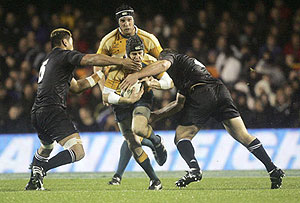
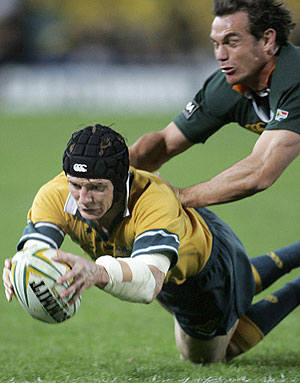
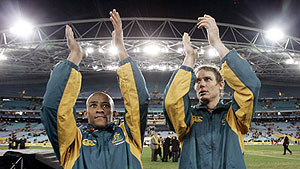
The Roar’s photo gallery of Stephen ‘Bernie’ Larkham

—
Enjoy this article? We encourage you to send it to a few friends and spread the word.
Free Email updates:
Our daily emails are only sent if there is content for the sport or that author. You can subscribe to multiple daily emails; or get the daily Roar email with all our content in it. We value privacy. More...


(58)
mudskipper said | October 29th 2007 @ 8:24am | Report comment
Thanks for the article Garth. Steven ‘Bernie’ Larkham was a magnificent player and will be remembered by many rugby fans who watched his dominance as a play maker.
At his last home game with the Brumbies when the game was finished and the Brumbies won against the Crusaders. As a mark of respect the Crusaders’ Captain Richie McCaw and team stayed on the ground for 40 minutes after the game to listen to the farewell speeches to pay respect to Steve Larkham, George Gregan and Jeremy Paul.
To be paid this respect by their greatest adversaries when you retire you know you have truly earned it.
Pfitzy said | October 29th 2007 @ 8:37am | Report comment
An absolute star of the professional era who will be long remembered.
The second edge to this sword is that the continued selection of Larkham and Gregan stunted so many potential careers and left Australian rugby in a black hole. Gregan especially was not the worthiest contender for two or three seasons but got picked on reputation - this is something that hopefully stops now we have a clean slate.
I’d take issue with the supposed decline of our forward pack though - it must be remembered that during the Macqueen era, the contest at scrum and ruck was nearly nonexistent, with attacking sides given advantage on most occasions and contest for the ball reduced. I’d suggest the forwards we had from 98-2001 were not really better than the cattle we can muster now, just that the rules and the interpretation thereof moved on and left us exposed. Due to the dominance of coaches like Eddie Jones at provincial level and then national level, we kept selecting the players performing “Brumbieleague” rugby and didn’t face a few hard truths. Time catches up with you.
P.S. a couple of edits there: “Snapping at the heals” and “The ghosting runs and cross-field passes were still their “
stillmissit said | October 29th 2007 @ 8:48am | Report comment
Larkham was a sensation when McQueen moved him from full back and simply got better. The punishment he took was as much to do with the guts and determination of the man as some of the damaging late stuff oppositions threw at him. Mind you there was plenty of that and no complaints or O’Driscoll ‘onics’ from Bernie.
If I wanted to sum his career up in a phrase, I would say he embodied everything that is great about Australian sportspeople. He was skillful had a never say die attitud, put himself on the line and had an unmatchable desire to win.
My thought is that after the retirement of Eales he should have been our captain. Solid, intelligent with well thought out considered statements and always going to hold his spot and the respect of his teamates.
He (contrary to what Sheek thinks) is Australian rugby’s second greatest fly half and our greatest exponent of guts and determination with a solid smattering of guile.
His place in our rugby history is set in concrete.
sheek said | October 29th 2007 @ 8:54am | Report comment
Well done Garth.
I remember back in 1987-88 when Dennis Lillee had a one-season not overly succesful comeback with Tasmania. Lillee had retired in 1983-84 but now 4 years later & 38 years of age, his comeback was met with mixed response.
Many wanted to remember him as the great fast bowler he was. Others responded that it wasn’t Lillee’s fault if people had a bad memory (alluding to the fact he might not set the world on fire in his comeback).
As discussed with you elsewhere, this is the connumdrum of Larkham’s career. I have to make a conscious effort to remember when he was truly great, & I usually have to go back to 2003 & beyond to remember his great deeds.
By vivid contrast, Mark Ella retired at the absolute peak of his powers. We were spared the sad sight of witnessing a declining genius where Ella was concerned. By his own hand, he went out on top.
By my reckoning, Larkham & Gregan added little value to the Wallabies post 2003. Apart from building their record of test appearances & fattening their superannuation retirement funds. Also, they stunted the development of players who might have satisfactorily replaced them sooner, as Pfitzy aludes to above. But we’ll never know.
This is probably harsh, but it’s sad when great players hang on too long. Players themselves, especially in the professional era, don’t know when it’s time for them to exit stage left. That tough decision must be made by officials.
When the dust settles, I’ll remember Larkham for his great deeds. But with the sadness that he hung around too long for both his own, & his country’s, good.
sheek said | October 29th 2007 @ 8:59am | Report comment
Stillmissit,
There was a time, around 2001-03, when I thought Larkham was close to the equal of Ella, & with the physicality of the modern game, might have briefly considered Larkham superior to Ella.
But gee, that was 3-4 years ago now. By my reckoning, Larkham’s been in a slow, steady free-fall since then, admittedly not all his own doing. But perhaps my memory’s the problem.
stillmissit said | October 29th 2007 @ 9:16am | Report comment
Sheek I agree with you to a point but as you stated in your post above it is up to the officials to pull the plug not wait for a player to make the call. Can you imagine industry if they only let staff go when they wanted to go?
Larkham’s great games did reduce after 2003 mainly due to injuries but you always knew his heart was in the right place and his performances on field were often enough to make us wonder. Gregan, by contrast, always appeared to be about making his own career last as long as possible on the field by avoiding the hard stuff and thereby amass the maximum $$’s.
Larkham should have been gone after the 2003 world cup along with Gregan and we should have bitten the bullet. I wanted that at the time (I was already very sick of Gregan) but there was little support for this approach, particulary where it counted with the coaches, selectors and the ARU.
Larkham is an untarnished ambassador for all I want to see in an Australian rugby player. Give us 12 good and 3 great players with Bernie’s heart, soul and determination and we would be up there again, assuming we can find a coach to bring a team together.
stillmissit said | October 29th 2007 @ 9:27am | Report comment
Sheek one more thing if Larkham had retired in 2000 4 years after starting in the Wallabies as did Mark Ella we would have, been denied some of the best of him ie both the Bledisloe cup series and the Lions tour in 2001 just before McQueen and Eales retired.
BTW I got a list from the ARU librarian of all the Wallabies since 1946 with there starting year and number of tests. She said that she is working on this as it has never been on the ARU website. If you would like a copy let me know. 0411 266 144 and leave your email address.
gforce said | October 29th 2007 @ 11:45am | Report comment
I would agree Larkham is a great Wallaby and always will be.
Up to 2003 he was the best going around. Beyond that , he was still very important for the Wallabies but started to not have the consistent impact on the game that we had gotten used to .
One of the features of full blown professionalism is that it is human nature to hold on for one more season. When someone wants to to give you $750K to go around again, it is very easy to be convinced - especially if there is nothing pressing you want to get on with in your post playing career.
The Aussie cricketers are in the same boat. - seeing guys in their mid to late 30’s still hanging around , even though their “special days” are getting fewer and less frequent makes you wonder how the next crop ever get the chance to have a go.
This is where a strong coaching hand is required. Be very clinical, get the sentimentality out of it and move the past heroes on and make way for the next crop to really shine. It is a hard thing to do but it needs to be done. We now have the situation in Oz rugby where the next crop of 9’s and 10’s are 20 years old ( Holmes, Barnes, Cooper, Beale). We are going from 35 year olds to 20 year olds. It is a big ask and a credit to the young guys that they more often than not step up.
Don’t get me wrong, Larkham was still very good and did some great things even towards the end, it is just that by perservering to the very end of a career leaves a huge whole and stunts the aspirations of many other prospects. I suspect though in Larkhams case, not many others really screamed out fo r a chance by their efforts in the S14.
The AB’s seem less inclined to let sentimentality get in the way - but maybe the talent pool has got something to do with this.
Chris Beck said | October 29th 2007 @ 11:58am | Report comment
By the time I had been introduced to rugby union, Larkham had been playing at #10 for some time.
Can someone who remembers please describe Larkham the fullback, in terms of how good he was at #15 when Macqueen implemented the switch, as well as how good he might have been had the switch never taken place?
Either way, Larkham has always been my favorite player to watch. Even when I was just picking up the sport, it was always obvious to me that he was something special.
spiro zavos said | October 29th 2007 @ 1:07pm | Report comment
Two statistics from Stephen Larkham’s career stand out for me. The Wallabies won 71 per cent of their tests when he was playing and only 56 per cent in the time he was playing when he was unavailable. And at the 1999 RWC World Cup he topped the tackle count for all the backs in all the sides in the tournament.
In other words, he was a match winner, an attacker of courage and falir and a defender who rarely missed a chance to nail his opponents.
I always thought that he played five-eighths like a running fullback/centre he used to be before Rod Macqueen had the brainwave of putting him at first receiver.
Inidentally, Macqueen was well ahead of his time in this thinking. The Pumas did well at the RWC tournament because they moved their best ball-playing back Juan Martin Herandez from fullback to five-eights. I think Ireland would have done better in the RWC tournament is Eddie Sullivan had made the same sort of move with Brian O’Driscoll.
Modern rugby requires the five-eighth who can handle the ball up to 40 times in a game to be the best ball-playing back in the side. Great players change the nature and perception of their positions. This is Stephen Larkham’s great contribution to five-eighths play.
sheek said | October 29th 2007 @ 2:35pm | Report comment
Very wisely spoken Spiro.
Richard said | October 29th 2007 @ 3:07pm | Report comment
Yes, good information Spiro, it counts for a bit more than some of these contributors’ hazy memories.
I thought a couple of Larkham’s great assets were his ability to accelerate and change direction without apparently doing anything obvious, and his extraordinary ability to fire long passes using mainly his fingers and wrists. Consequently, he could maintain good pace right up to the defenders faces, and defenders never knew if he was going to throw a pop pass or a long pass until it left his hands, and he didn’t put his running off balance by big arm swings. Contrast that with the leaguie style of propping and passing (”shovelling it on” seems to be the commentators cliche of choice), or Sam Norton-Knight who does a 180 degree swing of his arms to pass long. Pity Sam plays under a coach who wouldn’t have noticed that…or noticed him at all!
The issue of retirements is difficult. Of course the players want to stay in the game as long as possible, but gee, the administrators, especially from NSW have made some blunders cutting Matt Burke, Nathan Grey, Scott Staniforth and others, and replaced them with the ilk of the loyal Sam Harris.
Glenn Condell said | October 29th 2007 @ 3:57pm | Report comment
‘Can someone who remembers please describe Larkham the fullback, in terms of how good he was at #15 when Macqueen implemented the switch, as well as how good he might have been had the switch never taken place?’
It’s hazy (sorry Richard) but my memory is of a rather hot/cold fullback, epitomised by a very early Test at Murrayfield, where he had a first half shocker, then came out and scored two of the freakiest individual tries you’ll see to get us home. He beat abobut 7 players for one of them. The Scot coach (can’t recall if it was Telfer or Geech) waxed lyrical at the time about his evasive skills. When he was recently mooted to go to Edinburgh, Gregor Townsend said some very nice things about him in the local press; basically that he is the template of how a modern flyhalf should play. Perhaps all the respect in Scotland was one reason he was keen to head over there. He actually started as a halfback, and first met Gregan after outpointing him in a junior game.
‘Great players change the nature and perception of their positions’
Larkham broke the mould, with Macqueen’s help. Opposition defensive coaches earned their keep preparing for games against the Wallabies, and attack coaches too would have gleaned a lot from him.
‘and his extraordinary ability to fire long passes using mainly his fingers and wrists.’
I’ve always thought him the best passer I’ve seen in union, with only Johns and perhaps Lewis in league to compare. I admit to occasionally longing to see him get front foot ball from a dominant pack and a fast-passing halfback, neither of which he had the luxury of very often in a long career. Imagine what he could have done with some of the ball Wilko got the other week. Imagine him operating outside Farr-Jones, let alone Hipwell and Catchpole. I saw him lead the Brumbies to a rout over NSW this year in Canberra and it was a pleasure to see that loping run and glorious passing one last time. And I’m a Tah supporter.
All the best Bernie; if the Beales and Coopers and Barneses contribute half as much as you have to Australian rugby and give half as much pleasure to it’s supporters, they’ll have gone pretty well.
andrew said | October 29th 2007 @ 4:13pm | Report comment
Well done from me too Garth - Larkham has been one of Australia’s finest players and one of the greatest outside halves I’ve seen. I don’t know who was the best and it doesn’t matter but he is there with Mark Ella, Michael Lynagh and the great Welsh outside half factory; Phil Bennet, Jonathan Davies and the legendary Barry John.
The greatest contribution you could make in your retirement Bernie is to teach Australia’s backs how to pass the ball better.It is a continuing mystery to me why in the professional era some basic skills like passing have if anything declined almost everywhere.
Stu said | October 29th 2007 @ 5:31pm | Report comment
Don’t forget Bernie’s heart!
Melbourne 1998 in the first test against the AB’s - Steve Larkham did something i have never seen at the international level - he charged down a Mehrtens goal kick. That is only one of the many awesome things he achieved in his 101 tests. But it wasn’t always the big things, it was the little things that made him such a sublime exponent and definer of his position.
To my mind he has been without doubt he has been the most influential wallaby players since the game went professional. We never deserved to make 2003 final - if he had not been taken out early in that game, we may well have won.
The guy was a freak.
sheek said | October 29th 2007 @ 6:42pm | Report comment
Spiro’s stats were illuminating. But as they say - there are “stats, damned stats & lies”. Or more appropriately, stats can be read & interpreted in many different ways. The following info was derived from ’sporting-heroes.net/rugby-heroes’, if anyone is interested in perusing same.
Larkham’s career is divided into 3 x 4 year cycles: 1996-99, 2000-03, 2004-07. The breakdown is as follows:
Span P W D L W% NZP W% SAP W%
96-99 30 22 1 7 73.33 6 50.00 5 40.00
00-03 35 22 1 12 62.86 9 55.56 8 62.83
04-07 37 24 1 12 64.86 7 29.86 10 50.00
Total 102 68 3 31 66.67 22 45.45 23 52.17
Larkham’s most successful era was 1996-99, when he was surrounded by many great other players. Interestingly, his win ratio for era 2004-07 is slightly better than 2000-03, which surprised me, considering the falloff in the Wallabies’ overall standards. His performance against the All Blacks fell off, while he remained steady against the Boks.
Ella played 25 tests 1980-84, for 13 wins, a draw & 11 losses. His win ratio was 52%. He played the All Blacks 10 times for 4 wins & a win ratio of 40%. Ella only played behind a dominant pack in 1984. Also, goalkicking was inconsistent for the Wallabies 1980-84. Ella never played against the Boks.
How much does an individual influence his team? How much is an individual constrained by the quality of players around him? Ultimately, who we prefer is a matter of highly subjective taste.
One thing we can all agree on - Larkham & Ella are two of the greatest flyhalfs Australian rugby has been blessed to call its own.
jools-usa said | October 30th 2007 @ 12:14am | Report comment
It has been a pleasure to watch & savour Larkham (& Gregan) these past years.
Worth getting up in the wee hours to tape games (never could work the timer), and to relish the “real” rugby
he and the W’s offered.
When you think of his slight build in todays era of “beefcake”, he never hesitated to find gaps AND tackled with abandon.
That’s a great, great athlete.
God bless you Bernie, and thanks.
Jools-USA:
ohtani's jacket said | October 30th 2007 @ 12:19am | Report comment
As a Kiwi, when I first saw Larkham play first five, I thought he was the most unorthodox first five I had ever seen. I didn’t really think it would work. Well, the next five years were worse than all of our World Cup exits combined… I’ll never forget that pass to Kefu in 2001 as long as I live. If he comes to Japan, hopefully I’ll get to see him at a club game.
Stu said | October 30th 2007 @ 4:36am | Report comment
Hey Sheek
Thanks for your analysis but think that you probably should remove his first 12 or so test from your equation as in 96/97 he was a peripherel player and played a number of outside back positions. Best start from 98-2000 etc when he first played 10.
spiro zavos said | October 30th 2007 @ 4:43am | Report comment
Sheek’s statistics are revealing. This is outstanding analysis and extremely helpful in assessing Stephen Larkham’s career as a Wallaby.
They show what a dominant five-eighths Stephen Larkham was most of the time, and how dominant Mark Ella would have been with a decent pack. The 1984 Wallaby Grand Slam, with Ella scoring a try in every test, an unprecedented achievement, showed just how good an attacking player he was. He was also, like Larkham, a strong defender.
I saw Mark Ella cocme out of retirement and play for Randwick against Bath, then the top Englis club side. His opposing five-eighth was Barnes, then England’s five-eighth at the height of his powers, and now a television commentator. Despite being out of condition Ella totally outplayed Barnes and steered Randwick to a victory.
Two great five-eights, one the classical passing and occasional running player (Ella) and the other an aggressive running player who attacked the advantage line either forcing the tackle (or missed tackle) and pulling the line through to run on to a variety of gorgeously weighted passes.
Great Australian five-eights tended to come about every decade-plus or so: Dr John Solomon/Phil Hawthorn, Mark Ella/Michael Lynagh/ and Stephen Larkham. Who is the next Wallaby magician?
onside said | October 30th 2007 @ 5:12am | Report comment
Larkham wore headgear. Most people would not have recognised him in the street.
Ella didn’t wear headgear. He’s as easy to recognise now as he was back then.
Eric said | October 30th 2007 @ 5:40am | Report comment
I don’t doubt Ella was out of condition, but Stuart Barnes was the fattest back I can remember. Any other nominations?
And what is your point Onside?
stillmissit said | October 30th 2007 @ 10:44am | Report comment
Spiro
You also have to keep in mind where Australia was in Ella’s day. A win over the All Blacks, any win, was the holy grail. We had been flogged for years by them and they just about owned the Bledisloe a bit like the America’s Cup on the USA. Maybe it should have been called the New Zealand Cup.
So to have a team and particularly a 5/8 who was capable of bettering the AB’s was unbelieveable. I played 1st grade club rugby in the late 70’s and early 80’s and the misery every time we played the All Blacks was so thick it was edible. Some of our clubs Wallabies had never won a game against the All Blacks. Their touring teams ran up cricket scores against us and I remember an Australian School boys tour that lost all games and tests mostly by cricket scores.
The golden era that Larkham shone in was paved by the likes of Ella, Farr-Jones, Lynagh, Horan and Campese.
Greg Russell said | October 30th 2007 @ 11:49am | Report comment
Thanks to Garth for the article and to everyone for the interesting discussion. I would like to add two points:
1. It’s curious to me how rugby followers dump on their own champions, and often one only gets a very different (more balanced?) perspective on champions by going to other countries. The basic thread of the above discussion is that Gregan and Larkham were champions up until about 2003, but since then have been well past their best. The general feeling in NZ is nothing like this, in fact Kiwis have watched on in bemusement all year as the Wallabies have attempted at various times to shift these players aside - certainly Gregan and Larkham have remained the two Australians that the All Blacks and their supporters most fear.
2. I think everyone’s discussion on Larkham is oversimplified in that it ignores a simple truth: for the last few years there have been two Steve Larkhams, the one who remained a magician on Australian shores, and on the other hand the guy who barely played a good match away from home. This drove Eddie Jones to distraction, with Jones famously saying he had statistical evidence that Larkham had played “badly” in 16 out of Australia’s last 18 overseas tests (I think this was said some time in 2005). This wasn’t just for the Wallabies, but it was also very evident in Super 12/14, in which the Brumbies have played poorly overseas for many years now. And yet through all this Larkham continued to produce command performances at home, for example the 2004 Super 12 final and the 2006 thrashing by 49-0 of the World Champions-in-waiting in Brisbane. I have no idea why Larkham assumed this Jekyll and Hyde nature. When Australian supporters talk of Larkham’s decline in recent years, I suspect they are mostly expressing exasperation at his disappointing performances overseas.
sheek said | October 30th 2007 @ 12:02pm | Report comment
Stillmissit,
You make a valid point. Back in the 70-80s, playing the All Blacks was akin to facing aliens from another planet. The mental barrier was massive. It had to be broken down in graduations by the Wallabies, with such wins as the 30-16 win in 1978, one-off 12-6 win in 1979 & series wins in 1980, 86 & 92. Ella & co helped brack down those barriers.
By the time Larkham & co came along, the ABs were just another very good team that had to be overcome. But they were no longer considered demi-gods. Again, this is not to put Larkham down, but perhaps help some people better appreciate Ella.
BPM said | October 30th 2007 @ 12:49pm | Report comment
One thing Steve Larkham had over Mark Ella - longevity, a mark of a champion player! In my opinion Ella’s Wallaby career has too many what ifs surrounding it…
stillmissit said | October 30th 2007 @ 1:01pm | Report comment
Greg Russell
You Kiwi’s always amuse us with this constant support of Gregan which generally we dont understand.
Our conviction is that every Kiwi wanted George to play for ever so that the slowest pass in the west and the avoider of tough situations would continue along with All Black victories.
Please compare his abilities in this area with any of the last 3 AB half backs and particularly Justin Marshall who played all over him for years. Oh! how one great tackle has built a rock on which Australian Rugby foundered.
I hadn’t noticed Larkhams poor away record for Australia. Blinded by the drop goal in the WC most probably. I always thought he played pretty well in SA in losing teams under Eddie Jones and less so in NZ generally. Having said that I havent seen too many of our 5/8ths play well in NZ. Alas I have none of our Eddie’s ability and access to amazing statistics that mostly pointed to great success and ended in abject failure.
I come here only to praise Larkham and bury Gregan. To stuff an old piece of Shakespeare.
onside said | October 30th 2007 @ 1:39pm | Report comment
Eric,
Larkham deserved to be more recognisable. He was the Thiery Henry of rugby.Larkham was very quick
but always created the illusion he was pacing himself .Thiery Henry is not disimilar, he always has a little
bit left to beat his man ,or make a pass.A split second of timing that made things look far simpler than was
actually the case. Larkham like all great champions always appeared to have two options when others
struggled to find one.
But this genius played in headgear. A disguise. He was unrecognisable to the broader population,yet
was a true Australian sporting champion. Mark Ellas picture would be recognised by sports lovers
across many interests and codes.I think the ARU realised people struggled to relate to rugby players
and recently started showing photos of players without headgear so they could be identified .This is
a recent innovation.
Steve Larkhams photo without headgear has been used recently because of the RWC and his retirement
from the Wallabies.For many years though ,at a time when Larkham was in his prime , all photos of him
were action shots in headgear.
The point I am still struggling to make is this: Steve Larkham would have been even more famous had people
known what he looked like. For most of his career he could walk down the street and people would have no
idea who he was .Everybody knows what Mark Ella and Thiery Henry look like.
It appears the ACB have recently addressed a similar problem.Key batsman with helmets.Viewers cannot see
their face. Then they field in floppy hats.In the last year a lot more attention has been given to showing photos
of players without headgear.
ohtani's jacket said | October 30th 2007 @ 2:36pm | Report comment
In retrospect those four more years weren’t so kind to George, not that we Kiwis can gloat so much. Larkham didn’t really strike the fear of God into us, either, but he was the best Australia had & if he’d had better ball Australia would’ve won more of those Tests.
stillmissit said | October 30th 2007 @ 2:47pm | Report comment
ohtani’s jacket
Yeah when he made that call we thought how cute to copy Steve Waugh in the cricket and take it out on the Kiwi’s.
Had we known the call of “4 More Years Boys” was referring to himself and not the Kiwi’s we would have died of apoplexy!
arghhhhhhhh!
andrew said | October 30th 2007 @ 3:20pm | Report comment
Sheek and Stillmisit, you’re quite right that Australian rugby was transformed in the late 70’s and early 80’s. As an example I remember Australia playing Wales at Cardiff in ‘76 and getting a right old lathering in a match orchestrated by Gareth Edwards. I think the score was 28-6.Australia was in the 2nd division. By 1984 only eight years later Australia were on their grand slam tour and dominated Wales at Cardiff including a wonderfully executed try scored by Michael Lynagh ( I think ).Australia had moved into the 1st division and haven’t looked back ( well, a couple of glances over the shoulder recently perhaps!) The guys who played in that era were responsible for the one of the most significant changes in Australian rugby .
matty p said | October 31st 2007 @ 1:02am | Report comment
Chris, Bernie at #15 was brilliant, the problem was that Matt Burke OWNED that spot for the Wallabies. Bernie was showing his genious for the Brumbies, but it created a problem question for McQueen. I remember arguing this out at the time - should Australia go with the tried and tested Burked or the new maestro Larkham (my vote was, and always is, you pick the guy with the form not the past form). Anyway, Australia had no stand out fly half, so McQueen’s stroke of genious was to take the best (in form on paper) fullback and slot him at fly half. The rest is history and I will miss watching Bernie play, I always felt the wobblies had a chance with him there…
Bumper said | October 31st 2007 @ 2:12am | Report comment
Berie Larkham was without any shadow of a doubt one of tthe three greatest Wallabies of the modern era. The measure of that being whether he would slot into a world XV. At their peak, Larkham, Eales and Smith would be three standouts.
Interestingly for all of Bernies genius one thing I think that he was not as strong at was his tactical kicking. While he kicked a marvellous match-winning, world-cup winning drop goal the reality was that was sheer luck, never to be repeated.
But in terms of the Pantheon of Australia’s 5/8ths my view would be that while Ella is generally regarded as the best I would put Bernie ever so slightly ahead of him only because of the brevity of Mark’s career. Noddy would be 3rd. Interestingly Noddy would I suspect be rated by most people as the better kicker out of hand primarily because of his QLD background. Bernie coming from the ACT had his instincts honed on passing and kicking.
Perhaps the best development experience for the next crop of 5/8ths Beale Coopetr and Barnes is to make sure they spend some development time in each others States to focus on those skills which do not come as “naturally”?
PS: Greg is not a Kiwi..he’s an Aussie living in NZ…hope I haven’t put your life in danger mate!!
Bumper said | October 31st 2007 @ 2:15am | Report comment
Berie Larkham was without any shadow of a doubt one of the three greatest Wallabies of the modern era…the measure of that being whether he would slot into a world XV. At their peak, Larkham, Eales and Smith would be three standouts. Latham is a potential 4th.
Interestingly for all of Bernies genius one thing I think that he was not as strong at was his tactical kicking. While he kicked a marvellous match-winning, even world-cup winning, drop goal the reality was that was sheer luck, never to be repeated.
But in terms of the Pantheon of Australia’s 5/8ths my view would be that while Ella is generally regarded as the best I would put Bernie ever so slightly ahead of him only because of the brevity of Mark’s career. Noddy would be 3rd. Interestingly Noddy would I suspect be rated by most people as the better kicker out of hand primarily because of his QLD background. Bernie coming from the ACT had his instincts honed on passing and running
Perhaps the best development experience for the next crop of 5/8ths Beale, Cooper and Barnes is to make sure they spend some development time in each others States to focus on those skills which do not come as “naturally” as in their home state? Or better still send them offshore for a year or two to develop (while still being eligible for Australian selection).
PS: Greg is not a Kiwi..he’s an Aussie living in NZ…hope I haven’t put your life in danger mate!!
Pfitzy said | October 31st 2007 @ 5:07am | Report comment
matty p - I think you’re romanticising Bernie’s stint at fullback. No doubt in broken field play or on the kick return he was excellent, but you simply can’t put aside Burke’s proven record at all levels as an attacking fullback, defensive fullback, or points scoring machine. His boot was the difference in a lot of games and we missed it in others e.g. Bledisloe #1 2000 where Mortlock shanked the points that could have won the game.
Richard Eldershaw said | October 31st 2007 @ 11:18am | Report comment
Gee, Burke missed a couple of crucial sitters. One, if my memory serves, cost the Waratahs a S12 finals berth. Nevertheless, he was too good for NSW to let go, as his three outstanding seasons with Newcastle England confirm.
Pfitzy said | October 31st 2007 @ 11:30am | Report comment
That kick only cost NSW a berth because they failed to beat a 14-man Highlanders outfit. He missed the kick but they should have been put away long before that. But the long and windy discussion on the Waratahs’ problems is another discussion. The basic fact is Burke proved he was the best Wallaby fullback in the pro era (with Latham now snapping on his heels) while Larkham doesn’t have enough time in the spot at Test level to challenge. Bernie’s the best flyhalf we’ve had in the last decade (and the only real contender
) and a challenger to guys like Noddy and Ella for best ever. You can’t compare eras but everyone can agree that blokes like Larkham, Burke, Ella, Lynagh are greats of the game.
Pfitzy said | October 31st 2007 @ 11:32am | Report comment
Addendum: three good seasons at Newcastle from all reports, but let’s not pretend that the European competition - particularly within England - is close to S14 for backline play. Guys like Pat Howard ripped it up - albeit playing in a good Tigers outfit - then came back and struggled to make his mark with the Brumbies.
Greg Russell said | October 31st 2007 @ 11:47am | Report comment
Taking the risk of appearing churlish, but why this dogma that Lynagh was such a great player? I guess if one regards Johnny Wilkinson as a great player, then maybe there is a case for Lynagh (my estimation would be that he was about 90% of a JW). But personally I don’t regard JW as a great player, for the simple reason that he never showed any ability to “ignite” a backline in an attacking sense, which is surely the prime role of a 10.
There is a distinction between greatness and complete competence.
Glenn Condell said | October 31st 2007 @ 12:21pm | Report comment
Pfitzy
I’m sure I’m not alone in rating Latham over Burke, who I don’t think ever really delivered on the promise (certainly in terms of attacking threat) of his early pre-Wallaby years, while Latham just kept improving. Lots of northerners rate Latho the best 15 of recent years.
Greg, agree about both Wilko and Noddy, who played more freely as a 12. I do think Wilko was a good distributing 5/8th for the Lions in 01, but apart from that he’s a kicker and a tackler, and close to the best in his position at both of them.
Pfitzy said | October 31st 2007 @ 1:00pm | Report comment
I’m sure I’m not alone in thinking you’re a QLD supporter Glenn
I find it hard to argue with your point that Latham “kept improving”, simply because he started from a much lower branch of the tree as far as expectation goes. Your argument revolves around looking at a player over a series of years, so let’s delve into history:
Burke was the absolute pinnacle of schoolboy rugby in his time - no mean feat when you’re part of the Joey’s production line of Wallabies - and at Eastwood club level was skipped straight out of the Colts program into seniors where he also excelled. For the Australian Schoolboys and NSW he also proved his worth, despite the state’s poor record in the S12. In Test rugby he had every gift you could want from any of your backs, plus the ability to kick for points as well. If you don’t think he delivered on his attacking potential, you never saw him play - I recommend you get a copy of the 1996 Bledisloe Test in Brisbane and watch Burke run from his 22, dodge the entire Kiwi back row, outsmart Cullen, outsprint Lomu, and then stride out into the corner ahead of the fast-closing Jeff Wilson for one of the greatest individual tries in Bledisloe history. That’s just one example - Matt Burke 24 - All Blacks 16 in Melbourne in 1998 being another. Look at his contributions to some famous games without scoring tries: 23 of the 28 points in Sydney 1999; 24 points against the Boks in the 99 semi; 25 against the French in the final.
He picked up a few injuries after this, but was still a great player, with winning kicks in Bledisloe matches and try scoring on NH tours. Within a couple of years he was forced into other positions at provincial and Test level to accommodate others (including Latham). I also note that after 2001 - basically the last time Burke played fullback, Australian rugby went into a fairly well-documented decline, in part because we started picking players out of position all over the field. Thanks Eddie Jones!
As a contrast, Latham took longer to peak than Burke because expectations were much lower. His pre-Wallaby days amount to barely anything in terms of potential because he went to a state school and didn’t take up rugby until much later, when after a stint with Randwick he was put in to NSW on the wing. Rightly, he found that unsatisfactory, and made the move to QLD where his pro rugby life kicked off. Certainly he is a brilliant attacking player, but these last three Test years of Latham’s ascendancy have been under a different coaching regime than Burke’s best work (Macqueen was a noted conservative, believing rightly that defence wins Tests), and with no serious competition for the spot should be commended for pushing himself. Latham is a fabulous counter-attacking fullback and his clearance kicks are phenomenal, but his defence has necessarily been dragged to a professional level since his shocking start to the 2000 Bledisloe in Sydney, abject failure in the first 2001 Test against the Lions, as well as some poor positional work in 2003 against a rampaging England.
Certainly his peers rate Latham highly when it comes to S12/14 but is his success in winning awards a product of his being a shining light in an ordinary QLD team? I can safely say that while Latham is a brilliant and exciting attacking player, and is now one of the top fullbacks we’ve ever had, as Test level player I’d rather have Burke, because over his career he scored a bucket of points and did a magnificent duty preventing the opposition from scoring theirs.
A debate that will rage for years to come I’m sure
Glenn Condell said | October 31st 2007 @ 1:19pm | Report comment
Well said Pfitzy
I’m a Tah supporter, but not so one-eyed that I’d pick Burke over Latham. After all, Latham is really a NS Welshman anyway and I have a great deal of respect for Matt Burke. I might even pick Burke to play for my life, but I’d go with Latham if choosing a team I’d prefer to watch. The goals are a big plus for Burke to be sure, but I think Latham has scored a lot of tries in the last few years that Burke would not have - the amount of work that goes into his finishing shows it’s not just brilliance, it’s sheer determination too.
As for defence, I agree Burke was phenomenal and raised the bar for a 15’s defence. But Latham has been rock solid since 2002 and if you’ll recall, in that first Lions test in 01, after Macqueen hooked Latho for mising Robinson, Brian O’Driscoll ran straight into Matt Burke, who missed him and let in another try.
But as you say, debate will rage. Getting back to the topic, I can’t see either of them being able to adapt to 10 as Bernie did.
stillmissit said | October 31st 2007 @ 1:28pm | Report comment
Pfitzy and Glenn
I think the raging debate over best full back between Burke and Latham could be over this afternoon if you 2 keep at it!
Larkham was a good full back and a superb 5/8 end of story.
Burke and Gould were Australia’s best full backs in my 30 years of watching. Latham has built himself into a great full back but there were many in the early years who thought he would never make it off the wing. I have prayed for his demise due to his Campese style full back play on several occasions and finally he has proved many people including me wrong.
spiro zavos said | October 31st 2007 @ 2:50pm | Report comment
The object of rugby, as it is with most sports, is to win. When we talk about great players we really mean players who propell their teams to victories by their presence on the field and their play. It’s a bonus if they are elegant and beautiful to watch, like, say, Barry John, the original five-eighths who like Stephen Larkham had the ability to ghost through brick-wall defences.
I put Michael Lynagh in the category of great players because like Jonny Wilkinson and Grant Fox, whose play resembled his, he was a winner: the 1984 Grand Slam, 1986 Bledisloe Cup win in NZ and the 1999 RWC triumph.
I was always critical of his style of play, though. At one point, in 1994 I think I suggested it was time he was dropped for David Knox who was playing inventive and winning rugby. The manager of the Walloabies, Peter Falk, approached me around this time and told me: ‘Michael is upset over your comments on his play.’
‘But what about Knoxie,’ I replied, ‘he must be happy with them.’
Subsequently I interviewed Michael Lynagh after he had retired and he confirmed that the comments were hurtful. He was a particularly decent person and all I could do was mutter something about journalists having to do what they think is the right thing.
jools-usa said | October 31st 2007 @ 5:15pm | Report comment
Greg:
Totally agree re Jonny W. Can’t ever remember him igniting the backline a la Bernie, Carter, Lynagh……………..and (hopefully)
Giteau soon.
Maybe I’m “overserved” with Wilko legend. Sure, right man at right time for last two RWC, but a statue in Trafalgar Square?
What’s next - a Peerage?
Enough please.
Jools-USA
matty p said | October 31st 2007 @ 5:34pm | Report comment
Pfitzy - I don’t think I am romanticising - will have to go to the tapes - but my recollection of the 96 Super 12s was that Larkham was the form Australian fullback and that there was a feeling that Burke was picked more on past endeavours (and, if you were not a NSWelshman, because Bourke was). I didn’t mean this in any way to detract from Burke’s status as a fullback par excellence. Burkey obviously stepped up and proved his worth time and again. I guess the point was that, in order to answer the question how good was Larkham at fullback - we will never know how good he could have been, but in his limited time there with the Brumbies, he was good enough to at least put some pressure on Burke’s positioin and that in itself speaks volumes for his talent.
stillmissit said | November 1st 2007 @ 5:46am | Report comment
Spiro
David Knox was the Peter Hewat of his day. Great skills combined with an ability to be missing when the hard defensive work had to be done.
Michael Lynagh was not my favourite either in his early days but then he grew in stature and proved to be one of the bravest 5/8ths we have ever had. He would put himself into tackles and situations that no 5/8 should ever be in. I would say that the amount he improved and changed in a Wallaby jersey reminds me of Chris Latham.
Funny how some players grow in the team and others shrink?
andrew said | November 1st 2007 @ 6:20am | Report comment
Hi Spiro,
“The object of rugby is to win”.We need to remember this the next time we criticise the Poms for being “boring” etc.But another object of rugby has to be to entertain otherwise the punters will drift away and so will the kids ( tomorow’s players)
One of my favourite stories about Barry John also relates to Stillmisit’s comment above.He was not big on tackling or indeed training flat out.On one occasion in the Lions ‘71 tour of NZ it was discovered that rather than turn up for training he had gone back to his room for a siesta.Some of the players were understandably annoyed at this ,but Carwyn James,who only ever spoke quietly, turned to them and said that if having a siesta helps him to play the way he’s done since we arrived I suggest we let him do it. They all muttered and moved on.
I know, I know, but handling “star” players is a big challenge.The Welsh have completely stuffed up handling Gavin Henson, who ( in my opinion) has enormous potential.I wrote to them and said that the next coach should spend a week with Alec Ferguson - now there’s a guy who knows how to handle “stars” ( not the Carwyn James way I suspect!)
stillmissit said | November 1st 2007 @ 6:30am | Report comment
Andrew, great story about Barry John.
Handlilng current players huge ego’s is our biggest issue in Australian rugby today and there are not a lot of players that are like Larkham.
How do you hand out the tough decisions to highly paid players who are prepared to go behind your back (a la Nucifora) and attempt to knife the coach to a bunch of spineless administrators who are happy to listen and, possibly act on, this kind of political assasination?
We need to have player input into how to win but player power is putting the patients in charge of the Asylum.
spiro zavos said | November 1st 2007 @ 7:56am | Report comment
Carwyn James understood the mentality of the gifted Welsh flyhalf because he was one plaing for Newport, I think, in its glory days. He should have coached Wales but never got the chance possibly because he was gay. He died in a flea-bitten hotel room in Rome a broken man with unrealised rugby dreams, except for the glorious tour of NZ by his 1971 Lions side, the only Lions side to win a series in New Zealand.
andrew said | November 1st 2007 @ 10:10am | Report comment
Thanks Spiro, Carwyn also coached Llanelli to a famous victory over the All Blacks in 1972 and four consecutive victories in the Welsh Cup.Gerald Davies called him the ‘philosopher king of the rugby world’
andrew said | November 1st 2007 @ 8:46pm | Report comment
Extraordinary given our exchanges about Carwyn James yesterday to read about the sad death of Ray Gravell one of his protegees in a very interesting obituary.
http://sport.guardian.co.uk/obituary/0,,2203459,00.html
Eric said | November 30th 2007 @ 7:11am | Report comment
I seem to recall a chocolate ad with Gravell..”Ray Gravell eats soft centres”
Marco said | February 15th 2008 @ 10:19am | Report comment
There will be no others fly-halves like him… he changed the way the flyhalf must play, maybe he changed something in the whole rugby.
He is a battle-planner, a mastermind… The (maybe few) things I can do on the pitch as flyhalf, I ought also to him! Watching him playing you can understand what “flyhalf on the run” means, you can see him attacking a line with 2 players beside him (Mortlock&Tuqiri? Giteau&Mitchell? Smith&Paul?) but he kick the ball gaining 50 meters! He takes running lines that only him can see! O_O
Poetry!
Cheers & best wishes to one of the greatests geometry teacher in the world!!!
greetings from Italy!
Marco
The Cougar said | February 15th 2008 @ 1:25pm | Report comment
Is that Marco Bergamasco, the big, hard-running Italian flanker?