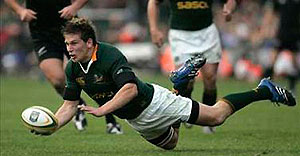
Tri-Nations, the annual RWC tournament
By Spiro Zavos, 4 Jul 2008 Spiro Zavos is a Roar Expert
Related coverage
- Rugby Union news
- Wallabies news
- Rugby World Cup 2011 news
- New Zealand All Blacks news
- South Africa Springboks news
- 2011 Wallabies squad news
- Rugby 2011 news
Some years ago I opined that it is harder to win the Tri-Nations tournament than the Rugby World Cup.
Now Nick Mallett, the coach of the Springboks during the record seventeen Test wins sequence in 1998/99 and the current coach of Italy, has made the same argument.
The reason I offered for my rather Southern Hemisphere triumphalist opinion (and Mallett’s reasons, too) were that the Tri-Nations teams (Australia, South Africa and New Zealand) have generally been the best teams in the world since the first RWC in 1987.
The exception was the period between October 2003 and June 2004 when England (which won the RWC in 2003) was the top ranked team for 35 weeks.
The current world rankings are: South Africa 90.18, New Zealand 89.79, Australia 84.56, Argentina 83.42, England 83.16, Wales 80,12, France 79.24, Ireland 77.18, Scotland 76.92, Fiji 76.77.
It is possible to win the RWC without playing a Tri-Nations side.
South Africa in 1995 is the only side to win the RWC and beat both other Tri-Nations sides in the process. New Zealand won the RWC without playing Australia, the strongest team in the world at that stage.
Australia won in 1991 with South Africa not being in the tournament. In 1999, Australia won the RWC without playing New Zealand. And in 2007, the Springboks won their second RWC, but this time they did not have to face either New Zealand or Australia.
To put the issue into a perspective, the Springboks won the 2007 RWC, but the All Blacks won the Tri-Nations tournamernt that year.
Who will win the Tri-Nations this year?
After the disaster of my 2007 RWC predictions, with the fearless prediction that South Africa could not win with its hopeless away record, I’m giving up predictions and going for indicative guesses.
My indicative guess is that the Wallabies are at least a year off being a formidable side, and of being capable of winning difficult matches outside of Australia. What they have going for them, though, is a talented coach in Robbie Deans, the best for the Wallabies since Rod Macqueen, and a tendency to play up to the level of the opposition with a terrific defensive system.
South Africa or New Zealand?
The Springboks are the current RWC champions and have kept most this side. They’ve won their last thirteen Tests.
Graham Henry calls the current Springboks a “10 out of 10 side.”
The question mark over the team is whether the new coach, Peter de Villiers, has the real stuff as a Test coach. Many are called and few are chosen.
The All Blacks have won 29 consecutive Tests in New Zealand. They are probably closer to the end of this run of success than the beginning. They’ve lost a number of senior players from last year. Richie McCaw is out, at least until the last few Tri-Nations matches, and Ali Williams, the only world-class lineout jumper the All Blacks have, is going to play with an injured ankle.
The opinion of Mark Keohane, a feisty and opiniated South African rugby writer who was the media man for Mallett, makes sense to me: “The reality is this. If a Bok team missing only Jacque Fourie and Fourie du Preez can’t beat an All Blacks team without Rokocoko, Mauger, Maclister, Kelleher, McCaw, Collins, Jack and Hayman, then they won’t win in New Zealand for another decade.”
Therefore, all three teams – the Wallabies, the Springboks and the All Blacks – have ‘everything to play for,’ as the cliche suggests.
Enjoy sports? Enjoy a bargain? All Sports Online has your favourite sporting brands at up to 70% off. Online only, premium quality sporting goods and merchandise at discounted prices. Get a deal now.


Tim said | July 4th 2008 @ 5:10am | Report comment
good article but england beat south africa in the group stages of the 2003 world cup.
Ben from Pretoria said | July 4th 2008 @ 5:43am | Report comment
It almost does not matter what All Black team gets chosen they are ALWAYS competitive if not dominant. I agree that this is SA’s(and the world’s) chance to see a beaten AB side at home but it is such a rare occurence that I will be very surprised if the Boks pull it off. The mental strength of the AB’s is so great especially at home that Henry and co would have made plans to counter anything the Boks might throw at them. I am sorry to say but 10plus to the AB’s
Zolton Zavos said | July 4th 2008 @ 6:26am | Report comment
Thanks Tim. We’ve adjusted that paragraph accordingly.
Jerry said | July 4th 2008 @ 8:25am | Report comment
I wouldn’t say it’s harder to win the TN, simply cause there’s only 3 teams and one will always end up winning. And more often than not, the winning team will have dropped a game. From memory, only in 96, 97, 98 and 03 has a team won the TN without dropping a game (which is now even harder that a team would have to win 6 games rather than 4). In 2004 SA lost their first two matches before winning the TN on bonus points which is the kind of second chance you don’t get in the knockout stages of the World Cup.
From a NZ perspective the TN rewards the consistency of the All Blacks – they may drop the odd game but the overall record usually ends up with them at the top of the table, whereas in the World Cup one bad day at the office and you’re gone – it’s a war of attrition.
Andrew Marks said | July 4th 2008 @ 10:01am | Report comment
Great article again Spiro!
This is what makes the World Cup so tantalising. No doubt the South Africans could not have believed their good fortune in not having to play the AB’s or the Wallabies on their way to glory in the last Cup and good luck to them! Even with this variable in play, the fact that the Southern Hemisphere has won 5 out of 6 World Cups is a true indication of the size of the gulf between the two hemispheres.
The Tri Nations is without doubt the toughest international competition in the world, I believe that the ELV’s will make it into a even better showpiece.
Peter K said | July 4th 2008 @ 10:35am | Report comment
I think the TN’s is tougher physically than the world cup. Since it is more harder games over a longer period.
However the world cup is significantly harder mentally and emotionally. I believe the world cup overall is a harder test.
Everyone builds and strives towards it, since it is only every 4 years.
Every team raises their game, the matches are played with more intensity than normal matches. Even in TN’s there have been many matches where players are just treating it as a job and going through the motions.
Once sudden death arrives how many times have you seen teams falter and break under the intense pressure? This unforgiving nature sorts out the champions from the chokers.
stuff happens said | July 4th 2008 @ 10:41am | Report comment
Ben for Pretoria – oh ye of little faith!
Yes ,it’s a rare occurrence, but it has been done before and will be done again. And here’s an early prediction for you. The All Blacks won’t win the RWC2011.
El Capitan said | July 4th 2008 @ 11:04am | Report comment
It will be intresting to see how the Boks go with the EVL’s. Perhaps it may take them a while to get used to a more flowing game?
I’m not saying that Australia will excel greatly, as IMHO it will take them at least a year under Robbie before we see much improvment against the Boks and Blacks.
The focus now, is how will teams adapt to the EVL’s in test rugby? I guess we will see that in the first Tri-nations game.
Terry Kidd said | July 4th 2008 @ 11:53am | Report comment
I tend to agree with El Capitan in that I want to see how the Boks go under the ELVs …. traditionally their strength lies in their forwards, not so much the backs and I wonder how they will perform.
I am looking forward to tomorrow’s test (and I’m a Wallaby supporter) because the ABs have the better backs but in this particular case the Boks have the better pack. I’m tending to believe that the Boks will aim for as many set pieces as they can possibly manufacture and look to attack from those with phase play drawing the ABs in and snarling them up before they go wide. Whereas I believe that the ABs will aim to hold the line in defence, force turnovers and counterattack wide, they will chip kick and kick long but not to put the ball out, when they run they will seek to support each other and run the Boks ragged.
I think it will be an enthralling contest that will be decided by fitness in the long term and how the referee enforces the ruck will be vital.
With regard to Wallabies v France I am intrigued to see how the Wallabies perform without Sharpe, not so much in the lineouts, but in tight and in the scrums. I predict that our scrum will be quite good and that our clean out will be better. I think that Notso Sharpe’s absence will be a blessing.
sheek said | July 4th 2008 @ 12:08pm | Report comment
The concept of the world cup is to beat whoever you are drawn to play against. For practical reasons, you are never going to be able to play everyone.
Looking at the history of the world cup, I would unhesitantly say every winner deserved their victory, even the Boks of 1995 & 2007, despite widespread belief the ABs were superior.
In the 1995 RWC final, the Boks outsmarted the ABs with a tactically superior gameplan. In 2007, the ABs imploded in ther QF against France, as they had done so in the SF of 1999 against the same team. In 1991 & 2003, the ABs were beaten by a better prepared Wallabies team on both occasions.
The regular failure of the ABs at the business end of many WCs demonstrates how tough this comp is mentally & emotionally, as Peter K suggests. The ABs have always had the artillery, but not always the wherewithall on how to use it effectively when it mattered most.
It wouldn’t be fair to say the 3N is superior to the RWC. I would certainly hope that wasn’t the case. Once the RWC reaches the quarterfinals knockout stage, where the safety net of defeat is removed, it’s amazing how this suddenly plays tricks on the minds of otherwise great players.
At the end of the day, sport is about the control of the mind, as it should be. And the RWC satisfies this criteria.