Dodgy cricket schedule, more headaches for players
By Brett McKay, 10 Nov 2009 Brett McKay is a Roar Expert
- Tagged:
- Australian Cricket, Cricket, International Cricket
Related coverage

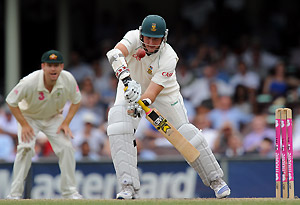
Injured South African captain Graeme Smith in action during the second innings on day five of their Third Test against Australia at the SCG in Sydney, Wednesday, Jan. 7, 2009. Smith retired hurt from the first innings with a broken finger. AAP Image/Paul Miller
The spectre of international cricket schedules has raised its ugly head again in recent weeks, not just because of, but certainly highlighted by, Australia’s suddenly chronic injury toll.
Fresh from losing several key players during the Ashes tour and Champions Trophy series in South Africa, five more Australian players have succumbed to injury during the current seven match one-day series in India.
Such has been the regularity of Australian cricketers departing from and arriving in India in the last two weeks, Qantas might have to put on extra flights.
The height of this inconceivable situation (hopefully) is that of Moises Henriques.
The young NSW all-rounder had just returned to Sydney from the Champions League Twenty20 tournament in India, had enjoyed a day at home, and was just getting around to unpacking when he got the call-up to replace the injured James Hopes.
Henriques’ return to India would barely have lasted a week. In his second game, Henriques tweaked his hamstring, and was promptly put back on the plane. Considering he was replacing a player who had also pinged a hammy, there really wasn’t a more ironic way to end Henriques’ series.
The logical link to all these injuries has been quickly established, and this is where the ludicrous nature of the current international cricket schedule fits in.
Never mind that Australia will play 13 Test Matches in 2009, where once they might have played seven or eight. In addition to this, Australia will play a record 40 One-Day Internationals, plus the Twenty20 World Cup as well.
40 ODIs in a calendar year doesn’t necessarily sound that strenuous on its own, but when you factor in that these games have been played all over Australia, South Africa, the UAE, England, Scotland and India, and the associated travel that comes with the one-day game, then you start to see the problem.
Already, it’s easy to see how the cycle of train-play-travel-train-play-travel might get a little tiresome too.
Add to that that Australia has already used well in excess of 30 players in ODIs this year, and remember too that there’s only 25 players on Cricket Australia contracts.
Of course, it’s not just Australia feeling the pinch of injuries.
India have had Zaheer Khan out for an extended period, have only just got Yuvraj Singh back in this current series, and both Virender Sehwag and Guatam Gambhir remain game-to-game prospects.
South Africa have lost captain Graeme Smith for chunks of this year, and likewise England with Paul Collingwood. Collingwood surprised plenty when he requested some time off in the middle of the one-day series that followed The Ashes, and then also wanted to pull out of the Champions League Twenty20, only to have his franchise, the Delhi Daredevils, declare him a required player. In the end, he missed the CLT20 because of injury anyway.
And to perhaps cap off how scheduling and injuries are making players rethink their priorities, this year we’ve also seen the first two instances of what I’ve dubbed the “modern retirement”, with England’s Andrew Flintoff and New Zealand’s Jacob Oram both retiring from Test cricket to focus on limited overs internationals and, undoubtedly, lucrative Twenty20 tournaments.
So how many more injuries will we have to see before the schedule is seriously rethought? Sadly, it’s probably plenty more.
Despite the International Cricket Council swearing they have player welfare and safety in mind, they still allow the scheduling of as much cricket as there are days in the calendar.
What’s worse, India, Australia, England and South Africa are looking to set up their own schedule-within-a-schedule, whereby these four major nations will host at least one of their money-spinning counterparts once every year in a four year cycle.
Apart from maximising revenue for these countries, and ensuring fewer unpopular series against lesser opposition, this plan will essentially create a quasi-tier setup within Test cricket, which I for one am dead against.
If the ICC was serious about cricket, and not just pandering to broadcasters, they wouldn’t even consider allowing this move.
And herein lies the crux the cricket scheduling problem: broadcast rights, and the millions they’re worth to the host nations. Simply, nations prefer to host opposition who can draw big crowds and massive television rights. Oh, did you think international cricket was still a sport?
But I can see a possible answer.
Admittedly, I don’t like its chances, because I can’t see cricket superpowers relinquishing their main revenue source.
In my mind, just as they retain the rights for World Cups, and Champions Trophy series, the ICC should retain all television broadcast rights to international cricket. Tests, ODIs, pointless T20Is, the lot.
Host and opposition countries can still take a large percentage of the revenue gained from the sale of these broadcast rights, but all in all, the ICC is the selling agent. Any prospective broadcasters should direct their enquires to the ICC, PO Box 1, Dubai (might not be their actual address).
This way, the ICC suddenly becomes the central controlling point for all international cricket, and not just the toothless tiger they are currently.
The host nations can still put forward their schedule requests as currently happens, but ultimately, the ICC determines how much international cricket is played. Or more importantly, how much isn’t played.
This radical move is the only way I can see some control and credibility brought back to cricket scheduling. I know this means that the nations lose their power and bargaining tool over the ICC, but in the end, does the ICC run the game or do the nations?
This is the ICC’s opportunity to wrest back control. And if it really has the players’ welfare and safety in mind, it has to look at this problem urgently, or the burnout and injury tolls will only climb.
Brett McKay is a former non-tackling scrumhalf and not-quite-1st Grade middle order stalwart. A rugby and cricket expert for The Roar since July 2009 (having joined in Sept 2008), Brett has written for Inside Rugby and Cricket Australia, and is also PLAY Canberra's rugby correspondent. He tweets from @BMcSport
- Explore:
- Australian Cricket, Cricket, International Cricket

November 10th 2009 @ 4:45am
Freud of Football said | November 10th 2009 @ 4:45am | Report comment
Brett, again I had to take a breather half way through, how do you get something so long on the Roar without the Editors swinging an axe through the middle?
Firstly regarding the injuries. It must certainly have to do with the amount of cricket being played, we mustn’t forget the amount of preparation that goes into each and every game, the nets sessions, the fielding practice etc. is all strain on already tired bodies and the games, 2-3 days apart often on the other side of whichever country the players are currently in, well it’s not a very good solution to say the least.
I would add though that soft-tissue injuries such as the one suffered be Henriques are generally caused by the playing surface (The Weagles had a real problem with the WACA back in the 90′s, I think they had 7-8 players out with Hamstring’s at one point) and it would be interesting if anyone knew what the players and curators thought of the surfaces (both pitch and field) in the current series as they mightn’t be bagging it in the press but I can’t imagine they’re very happy with the standards.
Also it’s very interesting to note just how many players Aus have used this year. Ricky Ponting has the number 123 emblazoned on his ODI cap which means in the 18 years before Ponting’s debut only 122 players represented Aus, 6.7 new players a year has risen almost 5 fold in 2009.
On to the crux of your argument. I’d have to say it’s one of the worst idea’s I’ve heard.
I for one wouldn’t be putting more money into the hands of the already corrupt (if not literally then most certainly morally) ICC, they are already funded up to the hilt, sitting in Dubai enjoying their tax-less, luxurious lives doing nothing for the sport and as we’ve already seen what FIFA has done to football, the last thing we need is cricket going down the same road.
The ICC needs a total overhaul and no more of these political jostlings that currently go on and as they are yet to find a ball that can retain its shape, seam and colour for 50 overs I certainly wouldn’t be handing these drongo’s TV rights worth hundreds of millions, who knows how much would get “lost”.
The big teams want to play each other because both the host and visiting nations get more money out of it and of course the players want to face the best opposition they can so this is understandable to me albeit slightly elitist. I want to see the Windies become a genuine cricketing force again and a tiered setup won’t help this, it probably would help some of the “lesser” countries eg. Zimbabwe as they’d get more cricket more often but inside a decade the gulf in class would be too big and cricket as we know it would be dead.
November 10th 2009 @ 5:55am
vinay verma said | November 10th 2009 @ 5:55am | Report comment
Freud..Its not so much that Brett’s idea is “one of the worst ideas ” you have heard. It is unrealistic given the honey pot in the possession of the BCCI. And all the B’s (boards) want a taste of it. Freud,I would replace your “drongos” with ” B’s”
I admire Brett’s passion to “protect” the lesser Nations and they have to be encouraged. Look at Sri Lanka. They started playing in the mid seventies and are now in the top 4. Bangladesh can emulate them. In time Ireland can also graduate.
The ICC is powerless unless India,Australia,England and South Africa cede some powers. The power to schedule,fine and sanction. This will not happen as long as India generates over 70% of all cricket revenue.
I can understand CA wanting to maximise its revenue from India as the oppurtinities in Australia are finite.Half the prize money from the Champions League went to Cricket NSW and this will help grass roots cricket in NSW. If I were CA I would ask all Australian players to give a percentage of their IPL earnings back to the Board so it can be channeled into grassroots. Afterall CA has invested in getting these cricketers to the stage where they are wanted in the IPL.
Will the players agree to this ? It will be interesting to see.
November 10th 2009 @ 9:04am
Freud of Football said | November 10th 2009 @ 9:04am | Report comment
Time-zones suck but as I expect this piece will take off overnight I thought I’d mention one point.
There was a piece on here at some point that asked whether AIS grad’s should repay their tuition fees, I think seeing as a HECS debt can be a huge burden there is no reason an international sports person who has received a fine, tax-payer funded education shouldn’t also pay back that debt.
Just a thought.
November 10th 2009 @ 5:46pm
Freud of Football said | November 10th 2009 @ 5:46pm | Report comment
I think Vinay made a very good point although I’m not sure where he got his stats from.
The BCCI generates more than 70% of all cricket revenue, a monopoly in itself but at least “the rest” still have the other 30% and can operate independently of Indian cricket (well most certainly Eng, Aus, SAF) and turn a good profit.
By handing over more responsibility to the ICC in its current form, the BCCI (which more or less controls the ICC at the moment as they always force the support of Sub-continent nations) will in effect takeover 100% of the revenues in cricket and I don’t see them distributing them any fairer than now.
It’s basically a socialist model and can anyone name a socialist organisation (whether it be a government or administrative body) that has worked for the greater good and avoided corruption?
Power must be de-centralised in cricket, I’m not saying I have the answer but I certainly don’t think the ICC is it, hence my “one of the worst ideas” comment. An overhaul of the ICC is needed if such a plan were to be implemented.
November 10th 2009 @ 8:43pm
Brett McKay said | November 10th 2009 @ 8:43pm | Report comment
Freud, the overhaul of the ICC would be paramount to a plan such as this coming to fruition. In it’s current form, I wouldn’t even entertain the thought.
Greg Russell below also likened the ICC to the UN, which is reasonably accurate in my opinion, and again for this plan to happen, we’d need the ICC to become more like the MCC, that is, an actual governing body that would then be in the position to act as the global rights holder and seller.
Oh and Freud, just to be clear, I’ve no issue with your comments today. I appreciate your honesty in actual fact!!
November 10th 2009 @ 7:50am
Brett McKay said | November 10th 2009 @ 7:50am | Report comment
Good morning gents – your comments have gone as I expect things will here, absolute disagreement or a pondering ‘maybe’. Happy to take either point of view, but either way it remains a discussion worth having.
Vinay, today’s column was partly inspired by your “..it behoths you as a columnist…” comment the other day to my suggestion that if CA can’t beat the BCCI, they may as well join them. I had a good hard think about a solution and came up with this.
Freud, Vinay has latched straight onto my point here. The ICC is absolutely POWERLESS until these major nations concede some ground. We can’t continue to have the situation where the rich get richer and the poor keep playing Bangladesh and Zimbabwe. From that side of things, I didn’t think this was too radical an idea.
Vinay mentions mentions my wanting to protect the lesser nations, and while “protect” isn’t quite the word I’d use, in my mind anyone that has had Test status granted has worked hard to get there. Sri Lanka are certainly among the elite now, and were once no better than Bangladesh or even Ireland. But then you look at Bangladesh – in the same time Bangladesh have had international status, SL had won a World Cup. Why haven’t Bangladesh improved even moderately? Ireland are in the process of applying for Test status, and I’d argue that if they got it, they would almost instantly be ranked higher than Bangladesh. How can an associate country be doing better than a Test nation?? (btw, Peter Roebuck has an interesting piece on Ireland’s quest for Test status on CricInfo). This is also where this piece comes from; helping these developing countries.
The main grounding for this is that there are already a number of “ICC sponsors” who seem to have signage and sponsorship in any series being played. Hero Honda and LG instantly come to mind. Now, if there are already global sponsors, is it really that big a stretch to global broadcast rights?
India make the most revenue, so it’s logical to use them in an example. Say NZ host India in a 3 Test + 3 ODI series (and even a token T20I, if we must, but you all know my thoughts on this). Would NZ make more or less money by having the ICC act as an international selling agent for the broadcast?? My thought is that they might make significantly more, just through the extra reach the ICC has with global broadcastors, rather than the smaller list of contacts NZC might have themselves. So in this scenario, NZ would still retain the lion’s share of broadcast revenue, India would naturally get some, but the ICC would also take some for future development.
I take all your points about the ICC needing an overhaul Freud, and again, I don’t really disagree with anything you’ve said. But the only way I can see something positive happening is if a radical move is forced. In Wayne Bennett’s words, if you always do what you’ve always done, you’ll always get what you’ve always got. How much worse could this situation get if the nations retain the power base and nothing changes??
As for the length of this piece (and even this reply now!), well that question deserves an answer of “because I’m a great writer!!” Truth is I’ve also learned to be a good self-editor, and obviously The Roar eds agree, because this is word-for-word as I submitted (apart from the heading, but mine was rubbish). It might seem to go on a bit, but it’s less than a thousand words, and less than two pages of a Word doc. As long as it all flows, and it’s all relevant, I’m not too worried about length. But I will consider including an intermission in the future
November 10th 2009 @ 4:00pm
vinay verma said | November 10th 2009 @ 4:00pm | Report comment
The word is “behoves” Brett..as I said a very worthwhile piece..the length and line are fine…and dont be so ready to agree with people.
The ICC has the Global TV rights for the World Cup,the Champions Trophy and Twenty20 World Cup. The rest is run by the member countries.
November 10th 2009 @ 8:39pm
Brett McKay said | November 10th 2009 @ 8:39pm | Report comment
Vinay, of course it is ‘behoves’, and I thought as soon as I wrote that this morning that I had it wrong. Unfortunately I couldn’t recall which thread it was on to find it and correct myself.
And you of all people know that I will happily disagree when required!!
November 10th 2009 @ 9:12am
Greg Russell said | November 10th 2009 @ 9:12am | Report comment
Brett, don’t worry about FoF’s comment about length … this article is short by my standards!
Two points:
1. I think Australia’s interminable schedule is a special case in some regards. (a) As the top dog in cricket, everyone wants longer series against us. Would England and India want to host 7-match ODI series against anyone else? I doubt it. The NZers have just played a 3 match ODI series in the Gulf against Pakistan where earlier this year we played 5. In NZ the problem if anything is too little international cricket, not too much. (b) As I have said before, it is the advent of T20 cricket that is crowding out the schedule – it is being included without any ODI or test cricket being given up. For example, Siddle has just returned home from 6 months away, but this includes both the T20 WC and the CLT20, events which previously weren’t on the calendar. Take these out and he would have had two breaks of about one month in this period. In particular, you should not consider either the CLT20 or IPL as part of Australia’s schedule, even if they may feel that way.
2. I am not a legal expert, but my firm understanding is that the ICC is not a body with independent authority (as is implicit in your argument), but rather is just a body that does what its constituent members tell it to do. In other words, the ICC is like the United Nations. Could you imagine the UN having any success in telling the USA what to do? That would have as much chance of succeeding as the ICC telling the BCCI what to do. The ICC can do nothing more than what its member states tell it to do. So it has no chance of gaining “all television broadcast rights to international cricket”.
How it is that organizations like FIFA have more genuine power in running their sport I do not know … that’s something for the legal experts to advise on. Whether the ICC could ever get its member countries to agree to it becoming more like FIFA in terms of power wielded is a dubious point.
November 10th 2009 @ 12:06pm
Brett McKay said | November 10th 2009 @ 12:06pm | Report comment
Ha, thanks Greg, I’ll keep that up my sleeve. If Freud raises the topic again, I can counter with “it’s no Greg Russell!!”
On your two points, I’ll tackle them in reverse. Your understanding of the ICC is in line with mine, and really just confirms what everyone already assumes. The ICC do whatever its members – particularly the member that makes the money – tells them to. I’ve obviously written this with the large assumption that the ICC would actually “run” the game.
for you first point, I’m c&p-ing a reply to a mate of mine today via email: I think the perception was starting to build that there was perhaps too many pointless three or four game ODI series cropping up prior to the advent of T20, and if anything, T20 has been smashed in on top of that. I don’t have any numbers, but my perception now is there’s less ODI cricket being played now than five years ago, mostly due to the inclusion of the IPL, CLT20, and endless T20WCs. More Tests, more T20, but less ODIs. Of course I could be completely wrong too (it occasionally happens).
He also mentioned FIFA (as did Freud at the top), but FIFA isn’t actually the body I was thinking of here, I was more leaning toward the IRB, who of course maintain and dictate the international rugby calendar. All in all, the rugby calendar is a pretty fair cycle, and of the top ten countries, they all host and tour each other with good regularity. There’s still some loopholes of course, and I can’t think of the last time Australia toured Argentina, for eg.
But the biggest hurdle here of course is the nations – particularly the four I’ve named – relinquishing power. I can’t even see CA doing that, never mind India…
November 10th 2009 @ 6:30pm
Freud of Football said | November 10th 2009 @ 6:30pm | Report comment
FIFA is a fascinating example. I of course have never had anything to do with the organisation as its a gents club that even the most well-known journos can rarely gain access to so my knowledge is limited to the array of literature available on the subject.
When you read about someone like Joao Havelange, Blatter’s predecessor and the corruption with which he was continually associated, well sorry but some (if not all) of it has to be true.
He basically bought his way in to power with money that he “borrowed” from the CBD (Brazilian Sports Federation) when he was the President there, he left a huge hole in their budget which was covered up by the military junta in Brazil at the time. He continually lies about his private wealth and got money from various other sources.
FIFA which is basically a collection of the most powerful men in football have the power as they have access. They have rights to WC’s to sell, both sponsorship an TV not to mention the youth tournaments (the kind of things sponsors love). Each nation uses FIFA as a tool for solidarity, the strength in such a tight market for which the demand is ever present is obvious.
Each federation can make their national teams available for all matter of things (advertisements (look at the Jogo Bonito commercials from Nike), public appearances etc.) and as they play on the biggest stage the money is ridiculous. Even minnow nations get a big slice of the profits for doing nothing as they are just “votes” that presidents need to get into power.
FIFA is about as corrupt an organisation as there is. It’s just a gents club that gets nothing done and while the ICC isn’t quite at that level I don’t think we should supply them with the vehicle (ie giving them control over all of the finances in cricket) to get there because given the chance, they will.
November 10th 2009 @ 9:34am
Brian said | November 10th 2009 @ 9:34am | Report comment
Ideally Brett is correct, if the ICC had the pwoer they could work for the good of the game however we are where we are and the big 4 won’t let that happen. I’ve always found it short-sighted that whilst other sports look for new markets CA have never bothered to support their sport in NZ where its already played. Nevertheless we need to assess the present.
A FIFA style will not be agreed to by the big boys so I think whats needed is a structure whereby the ICC control scheduling yet the boards get the revenue (Similar to the big futbol leagues in Europe). This way the ICC will be able to set a FIFA style calender so players do not have the country v IPL dilemma. Serious negotiations are needed where the BCCI may give up scheduling for 4 years in exchange for an IPL window. One key is not to be too ambitious the boards are more likely to agree to giving up some power for say 2-4 years than forever.
The matter is now urgent because Oram & Flintoff are clearly competent test players when fit. Cricket spent 70 years growing from 4 nations to 9. Zimbabwe have since been lost. It would be a shame if NZ, WI, Pak & SL went the same way but as the schedule currently stands the next Lara, Vettori & Jayasuriya will either not exist or spend their lives as IPL players. Well done Brett cause I have found few other Australian cricket writers/supporters who have ever cared about the opposition.
November 10th 2009 @ 12:12pm
Brett McKay said | November 10th 2009 @ 12:12pm | Report comment
Thanks Brian. I’ve mentioned on The Roar that a group of mates and I are New Years Test regulars, and along the way we’ve seen some brilliant and bloody ordinary cricket played. In the end though we just want value for our money, and the end result isn’t really a concern. We saw Steve Waugh smash his last-ball square drive in our very direction, yet Australia lost the Test. Winning Tests is great, but if we see a good day’s cricket we’re happy. So yeah, I guess I do want to look after the opposition.
Just to clarify something though, the ICC do actually maintain the current and future schedules, not the nations. There is a rough formula applied which says that everyone must play everyone in at least X Tests and ODIs home and away in a Y-year cycle (think it’s a four year cycle). But the nations can then request extra series in available windows. Theoretically, the ICC could say “no, there’s too much cricket being played”, but you know what the reality is..
Much like the reality of this idea, actually…
November 10th 2009 @ 3:28pm
Dave1 said | November 10th 2009 @ 3:28pm | Report comment
Henriques injury wasnt caused by too much cricket. Hes hardly played any at all
November 10th 2009 @ 8:49pm
Brett McKay said | November 10th 2009 @ 8:49pm | Report comment
Is that in your medical opinion Dave1??
I used the example of Henriques only to highlight how ridiculous the injury situation had become, and didn’t actually suggest it was from too much cricket in his case. Even if he hadn’t played much cricket – which I don’t really agree with anyway, because he played all of NSW’s CLT20 games in the previous fortnight – the quick turnaround for his return to India wouldn’t exactly be the ideal preparation for making your ODI debut. If it wasn’t cricket that caused his injury (and he was injured while playing), it was just as likely the logistics of international cricket..
November 10th 2009 @ 9:48pm
Freud of Football said | November 10th 2009 @ 9:48pm | Report comment
No Brett, it was likely the surface. As I said earlier, soft tissue injuries are predominantly caused by the playing surface, as there were a few of them the odds that I’m right have increased.
November 11th 2009 @ 7:54am
Brett McKay said | November 11th 2009 @ 7:54am | Report comment
very true Freud, the Indian grounds would be a fair bit harder than the SCG or any other Australian grounds..
November 11th 2009 @ 12:04pm
Dave1 said | November 11th 2009 @ 12:04pm | Report comment
Yes, in my medical opinion if a bloke bowls 16.3 in the champions league, he is a not suffering from too much cricket
If you think there are injuries caused by too much cricket he is a poor example to use.
November 10th 2009 @ 4:18pm
davido said | November 10th 2009 @ 4:18pm | Report comment
Good article but I have to disagree with conclusions re the ICC taking over control of international rights.
IF the ICC were not the Indian Cricket Council and IF the ICC behaved like thay did 25 years ago and put the sport first then ok.
But the ICC has been corrupted by it’s greed and incompetence.
November 10th 2009 @ 4:30pm
vinay verma said | November 10th 2009 @ 4:30pm | Report comment
Davido…If I am reading you correctly and you are saying that 25 years ago the ICC put the sport first then I must correct you.
The ICC,25 years ago,was a cosy little club where England and Australia ruled the roost and the others,the Asian bloc and NZ,WI,were treated like second class citizens. With the advent of Indian consumerism in the early 90′s and Dalmiya becoming the first Indian Pres. of the ICC the biggest TV rights deal was negotiated for the 1996 World Cup…and with the growing consumer market these TV deals have magnified and will continue to do so.
The MCC wants a Test Championship. Australia fought for it for two years..it is now on the back burner..and the sharing of TV revenue is the crux of the impasse.
India will not budge easily..and there is something of “payback” in this. Slights imagined or real linger for a long time. So make what you will of this.
November 10th 2009 @ 6:50pm
davido said | November 10th 2009 @ 6:50pm | Report comment
Maybe the perceived ‘cosy club’ was indeed perceived, maybe not. I tend to think everyone but the big two were treated as second class citizens. Perhaps the exception was the WI who were guests of honour. It is all credit to India to their ON Field playing that they have altered the paradigm.
But even if it wasnt, does not the inventor of the game have every right to do with it what they wanted? It is sort of like complaining that St Andrews sets the rules for golf!
In any event, my perception of the ICC is that if it were a person it would sell it’s own mother for 1kg of rice and 10 rupees.
November 10th 2009 @ 7:32pm
vinay verma said | November 10th 2009 @ 7:32pm | Report comment
Davido..just want to clarify a few things here…I am not in agreement with the direction the BCCI wants the game to take. They talk about the primacy of Test Cricket but are not promoting it the same way. The series next month against Sril lanka will tell us more. Television Networks in India rely on cricket as content to attract potential advertisers. The per spot prices paid for the current ODI series were higher than those paid for IPL2 and the Champions League. If the Sri Lanka Tests do not attract the same high paying rates then the BCCI will be even more reluctant to promote Test Cricket.
So for the BCCI it is not about the rules of cricket but the rules of the consumer market place. India,the BCCI ,must not make the mistake that the old ICC did. It has to demonstrate that it really has the future good of cricket at heart. This means more facilities for the poorest communities. And not just for window dressing but in a long term sustainable manner. Suburban grounds in India and the equivalent of First Grade clubs play on grounds no self respecting Church competition player in Australia would set foot on.
The academies and private coaching facilities are world class but the grassroots are grossly under nourished.
November 11th 2009 @ 4:21pm
Dave1 said | November 11th 2009 @ 4:21pm | Report comment
You are right. With the amount of money the BCCI makes, If they spent it correctly the results would be amazing.
November 10th 2009 @ 8:55pm
Brett McKay said | November 10th 2009 @ 8:55pm | Report comment
Davido, there’s no doubt in the world a major overhaul of the ICC and its’ operations would be required for this plan to eventuate. On that topic, we’re all in universal agreement.
November 10th 2009 @ 10:01pm
Ian Whitchurch said | November 10th 2009 @ 10:01pm | Report comment
Vinay Verma,
*giggle* I’m still trying to find dates for the alleged Indian Tour of Bangladesh in January 2010.
I keep hearing rumours, but I dont think the Mighty Bangladesh Tigers will be seeing Test cricket till the English show up in March.
November 11th 2009 @ 6:44am
vinay verma said | November 11th 2009 @ 6:44am | Report comment
Brett..this is an important piece and needs more debate. Now that I am done with BCCI and ICC bashing for the time being lets turn our attention to Cricket Australia.
We all lament the poor attendances in the Sheffield Shield (I refuse to call it the Weet Bix Shield). We all agree it is the breeding ground and the strongest domestic comp in the World. In that case why is it not promoted as such? Why is left to languish in the Dreamworld.? There was time when Fingleton and Brown had to jostle for the opening spot. Runs and wickets meant playing for Australia. It is rare for the Aussie elite to play in the Shield with the current schedules. In fact the next Shield game at the SCG may be the only time Ponting plays for Tasmania this year. I would pay to see Ponting face upto Lee,Bollinger and Cockley.
Why would a Broadcaster want to televise when the leading players dont play? It is time CA looked at restoring the eminence of the Shield. I would rather quality Shield matches than seeing a mediocre Windies.
November 11th 2009 @ 6:51pm
Dave1 said | November 11th 2009 @ 6:51pm | Report comment
When Fingleton and Brown jostled for the opening spots (the 1930′s) there were only 4 seasons of international cricket in Australia
1930-31
1931-32
1932-33
1936-37
In1935/36 Australia toured South Africa from December to March
So, no I don’t want to return to the days when The national team was out of Australia the whole summer or weren’t playing International cricket at all.
November 12th 2009 @ 6:49am
vinay verma said | November 12th 2009 @ 6:49am | Report comment
Dave1…Those were the days of the “long boats” The sailing time to England or South Africa was months. In this day and age you can be in Los Angeles yesterday.
So you dont have to worry about the National Team being away for the whole summer unless of course they happen to be on the Ocean Viking.
November 13th 2009 @ 6:47pm
Dave1 said | November 13th 2009 @ 6:47pm | Report comment
They were in South Africa from December to March. That doesn’t include time they weren’t in South Africa travelling on boats.
Brown and Fingleton were on that tour so you wouldn’t have seen them play shield cricket that season
What I’m saying about the 30’s was there was no international cricket in Australia. I don’t want to go back too that. I want to see England, South Africa and India each tour Australia every 4 years.
November 11th 2009 @ 7:48am
Brett McKay said | November 11th 2009 @ 7:48am | Report comment
Vinay, quite right. A mate and I were discussing this very topic the other day, about why the Shield games are ignored wholesale, and in the end we concluded that it too comes back to the too much interntational cricket on offer.
A cricket lover in Sydney or Melbourne (or the other capitals) can see some outstanding First Class cricket for not much cost, or they can sit at home with their own beverages and snacks, in their own chair, and watch the national team playing which ever format it is this week in where ever it is we’re playing it.
And so it goes for the CA marketing dept. They can’t restore it to its former gloary without the international players, and the international players just aren’t available. You mention Ricky Ponting above – Cricinfo’s stats say he hasn’t played a Shield game in the last two years, and I’ve had to dig much further on the Tassie website to find that his last game was v SA in 2007/08. And that was his only Shield game for that season (did alright though, made 96 & 124!!)
So CA are on a hiding to nothing, essentially. That all said, I happen to think they’ve got it right. They don’t do a lot of promotion, but cricket fans know when there’s a game on, and who’s playing. They’ve done well to restore the Sheffield Shield name, and in securing the sponsorship of Weetbix, it’s not a complete drain on CA revenue. Fox Sports shows the Final each season, and have done for a few seasons now, whereas I can’t recall a Shield Final being broadcast since Michael Slater batted his way onto an Ashes tour in ’93.
In all honesty, I really don’t know what more CA can do. Restoring the eminence of the Shield might be harder than resolving the interntaional schedule AND overhauling the ICC..
(btw, I wanted to put you at ease about your Weetbix Shield comment – the CA website seems to refer to it as the “Weetbix Sheffield Shield” AND the “Sheffield Shield Presented by Weetbix”, so it seems we can still call it the Sheffield Shield and be right. Thankfully, they’ve learned the lesson of the milk cup..)
November 11th 2009 @ 8:10am
Freud of Football said | November 11th 2009 @ 8:10am | Report comment
I think the best way to rekindle some interest in the domestic game would be:
A) getting some FTA broadcaster, like the ABC to broadcast one or two games a week (not a money making exercise, a “brand building” one). People love cricket enough that they will watch it in any form but when people see just how high the quality is in the Australian domestic leagues it might get a few people motivated to head down to the grounds.
B) Selections – Force teams to have X amount of under 21/23 players. That is what the sheffield shield has always been about, the next crop of young players, make sure they are getting their chances and when the papers write about the next wonderkid, they can tune into the ABC to check him out.
C) Keep the states for the Sheffield Shield but for the shorter formats bring in “franchises”. NSW is strong enough that they could field three teams without much of a problem and generally QLD and WA could field two, Victoria fluctuates too much perhaps but that is the way the game is moving anyway, why not move with it? Of course this would cause selection headaches but I’m sure if there’s a will, there’s a way.
D) Become trendsetters for the rules. Find ways to cut down the slow over rates. Finally get a ball that can hold its shape and seam etc.
For mine, being a CA Administrator would be a dream job, you’ve got a public who are split in the winter months but consider the cricket team as their “international team”, you’ve got buckets and buckets of talent, sponsors who would be climbing over one another to get themselves promoted, some of the most picturesque grounds in the world, the perfect climate…
Literally everything they could wish for is there, someone just needs to make something of it. Anyone got the phone number of Mr. Sutherland, I think I might apply myself.
November 11th 2009 @ 11:06am
Brett McKay said | November 11th 2009 @ 11:06am | Report comment
Freud, some quick thoughts on your points, which are great on the whole..
A: Domestically, CA and Fox Sports have only just renewed their agreement at the start of this season. So as good as your idea is, it’s probably not a commercial reality.
That said, and I’ve mentioned this in the past, CA and the FFA both have a massive opportunity to capture the Friday night FTA timeslots vacant over spring and summer after the footy seasons conclude. The sooner this slot contains a live domestic T20 or A-League game, the better. And whoever wins the race will ensure a ratings winner, and increased revenues to boot. As both CA and FFA are tied to pay TV though, it’s not as simple as it sounds. But how good would that be?!?
B: If you look at the Shield teams now, most have several guys in that U23 bracket anyway. Also, with the old CA Cup (2nd XIs) converting to the Futures League for U23s (+ 3 overage), we will over time see an organic decrease in the average age of State squads anyway. As these U23 players graduate into the Shield side over time, the fringe players in their late 20s or early 30s will make way.
Ultimately, this will filter to the Australian side too, although just this year we’ve already seen Tim Paine, Phillip Hughes, Moises Henrigues – all under 23 – in Australian colours.
C: As I said below to Vinay, the SPL T20 is still a plan with franchise teams, but the IPL and CLT20 might also be the extent of these types of competitions. In the meantime, if it doesn’t get up, we’ll see more marquee players in the Big Bash, and I think that’s a good thing.
If the ECB’s move to 40 over one-dayers works, that could materialise down here too.
D: I think this has always been the case anyway. The current Powerplay system derived from a similar system used in DLO games here, which in turn derived from a second fielding restriction in the 16-30 over bracket. Kookaburra has led the way in ball research over the years, and will continue to do so. By the way (and Ben Conkey pointed this out in a piece I wrote back a while about the ECB move), 40 over one-dayers would eliminate the need to change the ball at 34. Or they could just use two balls like used to domestically at one stage..
I’m with you though, working for CA would be great. When you get the gig, I’ll be your No.2!!
And speaking of addresses, while I completely made up “PO Box 1, Dubai” as the ICCs address in the column, my curiosity made me look up the actual address:
International Cricket Council
PO Box 500 070
Dubai, UAE.
So close!!