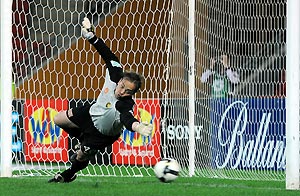
A possible replacement for penalty shootouts?
By AndyRoo, 10 Mar 2010 AndyRoo is a Roar Rookie
- Tagged:
- football, Mark Schwarzer, penalties, penalty shootouts

Central Coast Mariners goal keeper Mark Bosnich fails to stop a direct penalty in the second half of the Round 3, A-League match between the Central Coast Mariners and the Queensland Roar at Suncorp Stadium in Brisbane, Aug. 31st, 2008. AAP Image/Dave Hunt
Many articles in recent years have spent time trying to come up with a better way to decide a game than by using penalty shootouts.
Less players on the field and counting corner kicks have all been credible suggestions worthy of discussion over the second or third beer at a pub, but not quite credible enough to be brought up before then.
Personally, I have no problem with the drama of a penalty shootout – as long as my team win’s, it’s a fine system!
That bias may, however, be influenced by the fact we have Mark Schwarzer in goals for the Socceroos at the moment. He seems to relish the chance to win a game as opposed to most goalkeeper’s who become the villains by trying not to “stuff up”.
The timing of this article couldn’t be worse, though, as the A-League has just witnessed two dramatic and satisfying penalty shootouts which led to Newcastle playing Wellington in front of a full house.
But as sure as day becomes night, Italy will win another penalty shootout while they bore the neutrals to death, and the calls for a better system will follow.
My proposal is that the goal-line referee (themselves not quite established in the rules yet) keep track of the number of times the goalkeeper handles the ball. This tally would then be used as a tiebreaker if the match is a draw at the conclusion of full-time or extra-time. The side whose keeper handled the ball the most loses. If the tally is tied then the team whose goalkeeper handled the ball last is the loser. Handling would count as a tip over the bar, punching the ball from a cross or a catch.
A goalkeeper touching the ball in the same way an outfielder can would not attract any tally points. The hope (and without seeing a trial it’s very much just a hope) is that it encourages goalkeepers to play more like outfielders, perhaps to the point where they no longer have to spend most of their training in the corner away from the other players.
Would these scores be public? I would expect the goal-line referee to have a clear way of indicating the touch (wave a flag or such) so that a 4th official or the other goal-line ref can also keep track of the tally (and scoreboard attendant, too).
From a theoretical point of view, here is my list of positives and negatives. Feel free to add your own in the comments section.
Negatives:
- Teams playing for the tally could lead to even more aerial balls, defenders camped on the goal-line and such. A change like this influences how the game is played rather than other suggestions that just decide the outcome and don’t effect the 90 minutes proper.
- Could lead to more injuries, especially amongst goalkeepers. There is a certain balance in the battle between the keepers and strikers in that once the keeper picks up the ball they’re safe. If keepers become reluctant to do that angry strikers could run riot.
- The goalkeeper becomes even more important and, perhaps, disproportionately so.
- Another area for officials to make a dud decision on.
- Penalty shootouts are great theatre, and is this tally method any less arbitrary?
- Involves change. Change for change’s sake is a waste of resources so it would have to be carefully investigated whether this system is clearly better.
- The goal-line ref may spend too much time watching the keeper and not whether the ball goes over the line, which is his primary purpose.
- Would create a difference between the amateur level, who would likely continue to play with penalties due to lack of goal-line officials, and the professional level.
- A dubious red card would put you at a massive disadvantage as having fewer players is even worse under this proposal.
Positives:
- Hopefully rewards the quality of shots on goal as a harmless lob from 40m out wouldn’t need to be handled. If your general play results in more clear cut chances on goal, then you will likely force the other team’s goalkeeper to touch the ball. This is generally considered good play and enjoyed by most spectators, so hopefully rewarding this activity leads to more of it in a game.
- Removes playing for penalties as stacking the box isn’t a great ploy to avoid the use of your goalkeeper.
- Encourages goalkeepers to use more outfield skills and makes it a less distinct position.
- Would remove the “I am not going to pick it up come and get it” routine between goalkeeper and opposing striker that takes up a good deal of time in a match.
- Gives the goal-line referee something to do to justify his existence as there are many matches that are decided without the need to decide whether a ball went over the line or not.
- Helps set a more concrete finish time for an event for broadcasters that absolutely can’t delay the start of Today Tonight at any cost.
- May lead to more goalkeepers like René Higuita.
I don’t know if this proposal solves the problem, or even if penalty shootouts are really a problem (I think they are a dud way to decide the World Cup final, though) but I thought it was an idea worthy of debate.
It would be great if the stats man kept track of it so we could see what percentage of games were won by a team whose goalkeeper handled the ball more than the opposition, or if any teams generated more shots on target but lost the tally count.
The later is certainly important because if there is a correlation between shots on goal and winning, I would be confident in the concept’s success.
Enjoy sports? Enjoy a bargain? All Sports Online has your favourite sporting brands at up to 70% off. Online only, premium quality sporting goods and merchandise at discounted prices. Get a deal now.
Do you have what it takes to become a sports writer? Write for the roar
Football articles
- Phoenix need more than flash in the pan crowds (133)
- ‘New football’ fans may help save the game in Australia (124)
- Does Tasmania have a case for A-League inclusion? (119)
- What happened in Port Said was not a football riot (118)
- Magilton struggling to make a mark (68)
- Does the A-League need an injection of humour? (44)
- Socceroos screwed over by FIFA, again (41)
- Heavy-handed Bernstein the trouble for English football
- Victory, Mariners deliver hope, glory and entertainment
- Sydney and Perth eye A-League crunch game
- Victory beat Mariners with Kewell winner
- Melbourne Victory vs Central Coast Mariners: A-League live scores, blog (97)
- Liam Miller: Bargain buy of the A-League season? (9)
- Zambia plays Cup of Nations final in memory of their fallen (7)
- Heavy-handed Bernstein the trouble for English football (0)
- Melbourne Victory vs Central Coast Mariners: A-League live scores, blog (97)
- Liam Miller: Bargain buy of the A-League season? (9)
- Zambia plays Cup of Nations final in memory of their fallen (7)
- Capello’s resignation ends an awkward marriage (8)
- Redknapp the best bet to clean up Capello’s England mess (2)
- Melbourne derby reveals tale of two journeys (3)
- Explore:
- football, Mark Schwarzer, penalties, penalty shootouts

Savvas Tzionis said | March 10th 2010 @ 6:47am | Report comment
I stopped reading the article after this….
“But as sure as day becomes night, Italy will win another penalty shootout while they bore the neutrals to death, and the calls for a better system will follow.”
Typical Australian comment who does not understand the World Game. And not based on any facts.
Italy (until the 2006 tournament) had lost the 1990 WC SF, the 1994 WC Final, and the 1998 WC QF ON PENALTIES!!!!!!!!
whiskeymac said | March 10th 2010 @ 8:16am | Report comment
“Typical Australian comment who does not understand the World Game”
lighten up. have read a lot of his posts before and have to conclude that this is way off the mark. there is a general perception, and not just in this country, that italia play a boring defensive game. that’s hardly a shocking “opinion”. the fact they have lost a few games on penalties – for me its the germans who always win on penalties (but am sure there are wiki facts to dispute that too) – doesnt detract from the perception they “always win” this way.
Dogz R Barkn said | March 10th 2010 @ 8:33am | Report comment
The fact is that the World Cup experienced its first penalty shoot out in 1982, 52 years after its inception.
And now they are as common as muck.
The time has certainly come to dispense with pens as a means of deciding important games – but incredibly, soccer fans appear wedded to a concept that in fact has no tradition in the game, and then accuse others of not understanding the World Game!!
AndyRoo said | March 10th 2010 @ 10:14am | Report comment
Thanks Whiskeymac
Savvas I was having a joke, it’s not hard to predict Daily Telegraph headlines in advance. As soon as an African team (who I assume the neutrals will cheer for) lose to one of the European power houses in a penalty shootout we will get the anti shootout articles.
stevo said | March 10th 2010 @ 7:56am | Report comment
sure penalties are a bad way to lose a game, but they are usually a pretty good way to win one (anyone remember australias penalty shootout in 05?). if 2 teams cant be separated after 120 minutes (210 for home and away ties) i have no problems resorting to penalties,:its great theatre, full of emotion and pressure
and yes, italy dont always score as many goals as brazil but as a neutral watching italy play i usually find their games very entertaining, especially at world cup level (any football fan who can watch a game featuring the passing genius of pirlo and be bored should consult a mortician). and as mentioned above, their penalty record isnt good enough to suggest they go out playing for penalties, if anything that seems to be the game plan australia will use in south africa (assuming three 0-0 draws will get us into the round of 16)
Dogz R Barkn said | March 10th 2010 @ 8:37am | Report comment
But here is the crucial difference between the Aust vs Uruguay pens and the 2006 Italy vs France pens: the former was merely to qualify for a tournament the latter was for hte most prized trophy in world sport!!
Once upon a time, and this has occurred in the past, teams were given a qualifying spot by drawing straws, so it’s hard to argue against pens being a far better option than that.
But when you’re handing out a trophy to decide the World Champion – and that’s decided in a manner separate to actually playing the game, well, one is right to ask whether that is appropriate.
It’s also worth pointing out that as late as 1982, FIFA actually allowed an additional date for a replay of the final itself – but at some point between 1982 and 1994, FIFA dispensed with that.
Fivehole said | March 10th 2010 @ 8:03am | Report comment
An interesting idea, and you’ve obviously put some thought into it. For me i think it would change the game too radically as too many long balls would be pumped at the keeper when it looks like a draw is imminent.
Other possibilities are removing the keeper after extra time is over, and penalties like ice hockey with 10 seconds to score from half way. Both these also have negatives, so i don’t think there is an obvious answer to this one!
whiskeymac said | March 10th 2010 @ 8:30am | Report comment
am actually a fan of the current extra time followed by penalties format. the introduction of silver/ golden goals etc and then the drama of shots, saves and misses is hard to beat. its not necessarily fair but its certainly, imo, a good drama and spectacle. and in many respects the losing team can awlays hide behind the excuse that they only lost on penalties and such a system is a lottery (whereas in fact i think there is more to it than just luck but its a slef comforting excuse).
Dogz R Barkn said | March 10th 2010 @ 8:44am | Report comment
I’m not a fan of penalty shoot outs determining major trophies, I think it demeans the trophy that it can’t be handed to the best performed team of the day or tournament, which should be the intent.
However, ideas like counting corners or counting goalkeeper touches are not the solutions. A means must be determined by splitting the teams by actually playing the game, by the game’s normal on-field rules.
This means toying with ideas about the number of palyers, and/or increasing substitutions alllowed, perhaps even introducing a 3rd period of extra time, where subs are unlimited, and the game continues until someone scores.
Tom said | March 10th 2010 @ 8:47am | Report comment
No.
The end of games would descend into a farce.
Teams that are clearly ahead on the count would play like they’re a goal up. When teams are even they’d resort to hoofing the ball long and high and having the strikers chase it to pressure the keeper. The latter scenario would look nothing like a regular game of football and wouldn’t reward footballing skill.
The penalty shoot-out isn’t such a bad system. The truth is that if neither side can win a game in 120 minutes they must at least be close enough that a tie-breaker system with some randomness isn’t too much of a problem.
AndyRoo said | March 10th 2010 @ 9:53am | Report comment
Teams that are clearly ahead on the count would play like they’re a goal up.
I don’t think it’s the end of the world if a team goes into their shell a bit for the last 20 mins after dominating the play (the opposition only have to score 1 goal to change all that). I wonder though if you still played extra time would it remove the conscious playing for the tally as 120 mins without scoring more goals is just too hard.
When teams are even they’d resort to hoofing the ball long and high and having the strikers chase it to pressure the keeper. The latter scenario would look nothing like a regular game of football and wouldn’t reward footballing skill.
Pretty much if that happened it would be enough to sink the whole idea. And I think that’s one of the advantages of penalties is that it doesn’t have a huge effect on how teams play the first 90 mins.
It’s a scary enough thought to abandon the idea though. The thought of defenders practicing the art of getting “hang time” on their hoofs upfield gives me shivers.
I guess that’s no Fifa junket to South Africa for me …. Oh well perhaps there is the chance the Bin Hammam is reading and ignores the obvious cons (we have a neutral final for the ACL after all) and I get a free trip to Qatar when they bring this system in for the 2011 Asian cup.
Before sending this article I did check to make sure that it hasn’t been something widely discussed before and I just missed it (since debates about penalty shootouts seem to come up after every tournament), then I would look like a dill for claiming I thought it up.
The closest I came was this article http://www.penaltyshootouts.co.uk/alternatives.html
It does mention counting Goal Keeper touches but doesn’t differentiate between using their hands or not and I think that was the clear difference that would eliminate the speculative shots, but unfortunately not enough of a change to avoid the up and unders (even more ugly than long range shots).
Their comments
But the drawbacks are obvious. It would have a profound effect on the nature of the game with players doing everything to avoid involvement from their goalkeeper and to cause their opponent’s keeper to get involved such as speculative shots from a long way out. There would be other occasions when indecision would cause mistakes.
Savvas Tzionis said | March 10th 2010 @ 8:50am | Report comment
The solution is simple.
8 World Cup groups of 4. The top team in each group go through to another 2 roudn robin groups.
And the top 2 teams play off in final. And final has a replay built in. If no result, then ultimately, a penalty shoot out is required.
Dogz R Barkn said | March 10th 2010 @ 9:03am | Report comment
The 1978 WC (and maybe even the 1974 one) operated on a similar basis where 4 groups became 2 groups and the top teams then played off in the final.
The problem in those days was that teams continued to play cautiously during a second group phase, producing plenty of dud games.
However, having said that – it’s become increasingly clear in the modern era that many teams will play just as cautiously in a knock out game, hoping to jag a 1-0 result or at worst, take it to pens.
So the options aren’t all that many.
Savvas Tzionis said | March 10th 2010 @ 9:08am | Report comment
ok… now we are on the same page.
Also, the problem is that the last game in the group stage may be meaningless for the two bottom placed teams if the they are playing each other, as happened in those 2 World Cups.
And one team may have nothing to play for if they are out of it. Argentina v Peru (1978).
With a knockout system all games are alive.
But at the end of the day, for me personally, these are not reason enough to warrant the continuation of our current system.
Dogz R Barkn said | March 10th 2010 @ 9:05am | Report comment
You do remind me of another idea, that teams are ranked after the group phase, dependent on how they went (pts, goal difference, goals scored, etc), and that ranking comes into play each time a draw occurs after extra time in a knock out game.
This puts a lot of pressure on the lower ranked team to go for a win – and that’s a good thing in my view.
Also, it makes every group game quite meaningful, and will force all teams to really go for it to get as high a ranking as they can manage.
Savvas Tzionis said | March 10th 2010 @ 9:11am | Report comment
I think that is a good idea and ensures the early rounds have meaning as well. But it could mean the top team just plays for a draw. Hmmm….
I also think from an organisational point of view for the host nation (and particiapting teams), it makes it easier to have a round robin tournament in second stage.
The remaining teams are known well in advance and everyone can organise themselves far more easily.
Dogz R Barkn said | March 10th 2010 @ 9:16am | Report comment
Yes – it can mean the top team playing for a draw – but that’s better than two teams playing for a draw!!
Savvas Tzionis said | March 10th 2010 @ 9:19am | Report comment
Thats funny because its true!!
Maybe this years World Cup will bring the issue to a head.
I think the line up, except for Russia, is the strongest ever, and with all the big African nations qualified for their ‘own’ cup, there is no excuse for a poor show by the teams.
Dogz R Barkn said | March 10th 2010 @ 9:34am | Report comment
The good thing about the African teams, especially on their own continent, is that you can rarely accuse them of playing too defensively!!
It’s always worthwhile watching their games – you never what you’ll get, and that’ sort of unpredictability is a good thing.
AndyRoo said | March 10th 2010 @ 10:00am | Report comment
The good thing about the African teams, especially on their own continent, is that you can rarely accuse them of playing too defensively!!
That’s true, though Ghana seemed to play for penalties in the later stages of the U20 world cup final.
Looking back through recent world cups I don’t really have a problem with the vast majority of knock out games being decided by penalties, after writing an article about alternatives I have finally started to cotton on to the positives of penalties.
I do think the World Cup final should be a replay after extra time, that is one tournament where we can surely make a bit of an effort to schedule another match if required. For pretty much everything else penalties seems to be doing the job.
Australian Football said | March 10th 2010 @ 9:40am | Report comment
Andyroo,
the last penalty shootout I observed was between the GCU FC v Newcastle Jets FC. I was at the goal end close, where the shootout took place and where the Beach kids congregate, close enough to feel the tension and drama. Even tho my team lost the penalty count––I wouldn’t have it any other way. This method is the only way to break the dead lock fairly with full transparency––knowing that your team was either good or not good enough to win on the day with superior nerve and character.
Some may say it’s a lottery, but I think managers should pay much more attention with the possibility of their team who may have to face one after 120min of football. So they should work on their player’s nerve not to break when it ultimately counts. I wouldn’t change a thing and let them take place to see whose team’s players can rise to the occasion on a one on one contest.
~~~~~~
AF
Michael C said | March 10th 2010 @ 9:46am | Report comment
AndyRoo -
I see your article you referred to yesterday. I will make only the one comment – and in keeping with the standards you yourself set I hope people will not jump down my throat (whilst others will have seen my views before anyway)
My preference is always that the GAME itself should decide itself…and so I hate tie breakers in tennis as it becomes a microcosm of the game……sure, it’s theatre, and can be great….but, it’s a different game.
So, my preference is for a scoring system to do the work.
If often admitted that from my Australian Football perspective, that it can well be argued that a team with less goals should not be able to win a match…that behinds ought only be used on count back should goals be level at the end of the game.
The Australian Football ‘behind’ is effectively the same as if soccer were to tally ‘short corners’ (i.e. a corner generated within perhaps the bounds of the kick off box.).
Primary concept – is a secondary score, either to do 1 of two things -
A. a count back if goals a level
B. a ‘live tally’ to allow ‘offset’ scoring, i.e. if Soccer scores were 1.3 vs 1.2 then there is a clear leader, and the next goal scored provides a clear change in leader, 1.3 to 2.2, followed again by a clear change in leader with a goal 2.3 to 2.2. This is something missing in modern soccer as well as hockey, netball etc. Not missing in games like Rugby, American/Australian/Gaelic Football and basketball.
C. install a qualitative parameter on soccer goals…..i.e. a deflected strike is worth 0.5, a clean strike 1, an own goal -2???
Niether of the above absolutely removes the potential for a drawn result but certainly it reduces the likelihood and certainly it reduces the ‘ease’ with which a draw can be strategically played for. (obviously a combination of the above reduces more greatly the likelihood).
Certainly I prefer the Ernie Merrick public position that they never play for a draw, he’d rather play for a win, that way, the possible outcomes are win, draw, lose, compared to playing for a draw where you effectively remove a ‘win’ from the possible outcomes. Reminds me of an article about an English cricketer in line for a call up who credits Shane Warne with being his inspiration – having played under him at Hampshire, Warne’s approach is to work out ways you can win from ANY position. You don’t play for a draw, you instead find ways to win. That to me is what I always thought great sports people were about – - the ones who more often were able to pull victory from the jaws of defeat.
aubgraham said | March 10th 2010 @ 11:05am | Report comment
First a side-note.: I don’t think in general draws are a bad thing. Sport is competitive by nature, but sometimes teams do not do enough to separate themselves. All perfectly reasonable for league play, but for a knockout tournament you obviously need a W/L result.
I think Michael C’s post is a pretty good way of thinking about the problem. In general, people want the result to be decided on regular game play. Of course, fans, in general, like the way the game is played. This is a conundrum – in futbol, since there is relatively little scoring, there is much greater chance of draws than in other sports – I would hasten to guess that, of ‘popular’ sports, it is the sport with the most draws. But if you increase the chance of a goal then you will alter the way the game is played. Is there a good way to increase the scoring in some fashion that reflects current game play but will not significantly change the way the game is played.
I always regretted the fact that FIFA killed off the idea of increases the size of the goal. After all, average heights today are about 5cm more than 100 years ago. A small increase in the size of the goal would do little to change game play but by increasing the probability of scoring it would reduce the need for an alternative ending to the game.
So, if we cannot have larger goals, a secondary tally that reflects game play could be used. I do not like Andy Roo’s suggestions because I think it changes the game play too much. Why not use the number of time the ball hits the goal post. This secondary tally would only be used at the end of extra time. If it is still even then we need penalties. (hitting the post is not that much different from a point in Australian Rules football, I guess) . On review I see that Andy’s link above mentions the idea, so I guess I am not so original, but still, perhaps, an idea worthy of consideration before the first drink at the bar .
AndyRoo said | March 10th 2010 @ 11:16am | Report comment
Why not use the number of time the ball hits the goal post. This secondary tally would only be used at the end of extra time. If it is still even then we need penalties
That’s actually a really good one, as it’s imposible to manipulate.
aubgraham said | March 10th 2010 @ 11:21am | Report comment
Well, not impossible, but if you think you’re good enough to hit the bar, then why not score a goal.
AndyRoo said | March 10th 2010 @ 11:35am | Report comment
I could actually imagine Miren Blieberg creating a set piece routine to hit the wood work…. before someone points out if we aim 3 inches to the left we will score an actual goal
aubgraham said | March 10th 2010 @ 11:27am | Report comment
Actually, going even further, if woodwork touches are counted, in the event of even touches, the team that touches first is the winner. Substantial incentive for attacking play I think.
Dogz R Barkn said | March 10th 2010 @ 2:14pm | Report comment
Another terrific idea – right – I’m nominating you on the FIFA rules committee!!
Dogz R Barkn said | March 10th 2010 @ 11:23am | Report comment
Fantastic idea, afterall, to have hit the post you have obviously beaten the keeper and got quite close to scoring – that’s worth a whole lot more than a corner or a keeper’s save.
And yes, it has the following advantages:
1. can’t be manipulated (afterall it’s virtually impossible to have a game plan around hitting the upright!); and
2. does not change the way the game is played – not in the least – it is a by-product of playing the game as normal.
Disadvantages:
1. Just this one – very occasionally it is unclear whether the ball has brushed the bar – but I see that as a relatively minor disadvantage, and certainly it’s more likely the officials will get this right than they will get a close offside call right!!
Dogz R Barkn said | March 10th 2010 @ 11:28am | Report comment
An additional point to support some of the points that aubgraham has made: the WCs of the 1950s averaged something like 5.75 goals per game, whereas in the last two or three WCs, that average has dropped to something like 2.3 goals per game.
Clearly the game has changed irrevocably in the last 50 years, and far, far more draws are occuring at WC level than was the case back then.
If we reach a stage where every 2nd knock out game is decided on pens, including the final itself, then it all becomes quite farcical.
aubgraham said | March 10th 2010 @ 11:59am | Report comment
Right, a little bit of mathematics that I won’t bore you with shows that if you increase average goals scored from 1/team to 3/team, then need for a penalty shoot out decreases from 17.5% to 5%.
Rob said | March 10th 2010 @ 2:07pm | Report comment
Michael C,
Interesting, but in the very early days of football, there existed a system of “behinds” (called “rogues”, which were part of a system of scoring that is remarkably similar to the AFL system:
“At the time (1860s), football goalposts stood only four yards apart with the crossbar nine feet from the ground. Four yards outside each vertical post stood a further “rouge” post, and if a shot passed between these ‘inner’ and ‘outer’ goalposts, then a rouge was scored. If any game finished level in terms of goals scored, then the team who had achieved the most rouges were counted as the winners. However, this rather eccentric system was abolished within the year when the frame of football goalposts was amended to the now-regulation size of eight yards wide by eight feet high.” (from Sheffield Wednesday website: http://www.swfc.co.uk/page/CompleteHistory/0,,10304~65717,00.html)
The system has been tried and discarded by football, and while the notion of corners having some kind of decisive outcome on a drawn score to me seems just as unfair as any other method – I have seen games where the team who had far less possession, and far fewer shots on goal has had more corners.
Shots striking posts is a more reasonable measure, but comes back to awarding teams for failing to score a goal, something I find displeasing about AFL, and this is said with no disrespect to you. you say the provision for behinds is “missing” in football, but as I pointed out, it is something that football, and for that matter hockey and netball and others has simply chosen not to include, or has consigned to history the reward for missing the target.
Simply put, I am a fan of the penalty shootout as a decider, because taking penalties is a skill required in the game, and the ability to save a penalty, whether by luck or by ability, for keepers, is also a skill the game demands. In that way, the penalty shootout is of the game, and a fair way to determine the result of a game when all other options have been exhausted. I am in favour of replays, but in the case of a two-legged playoff/final, if there is a draw on aggregate and away goals, penalties are a fair means of deciding things.
Australian Football said | March 10th 2010 @ 2:21pm | Report comment
Hear, hear.
Country Victoria said | March 15th 2010 @ 11:57am | Report comment
Ya Rob, you changed my thinking at penalities, ‘Keep’ penalities shootouts.
rovingto2011 said | March 10th 2010 @ 10:17am | Report comment
Penalty shootouts aren’t that bad, its part of cup football. But counting goalkeeper touches? For real????
Football is pretty stable with its rules. I’d hate to see FIFA introducing new gimmicks every year like some sports do. Draws and tactical games are part of the sport. No point trying to change it. Billions love the game for what it is.
Dogz R Barkn said | March 10th 2010 @ 11:25am | Report comment
As I said in an earlier post – the first ever pen shoot out in a World Cup occurred as recently as 1982.