FFA now faces its greatest test
By Adrian Musolino, 11 Apr 2012 Adrian Musolino is a Roar Expert
- Tagged:
- A-League, A-League expansion, FFA, football, Football Australia, Football Federation Australia, Gold Coast United, hunter sports group, Nathan Tinkler, Newcastle Jets, Newcastle Knights, North Queensland Fury, Western Sydney A-League
121 Have your say
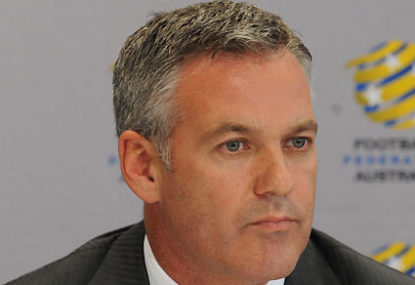
Football Federation of Australia CEO Ben Buckley holds a media press conference. AAP Image/Dean Lewins
Related coverage
- Newcastle Jets news
- Gold Coast United news
- North Queensland Fury news
- Newcastle Knights news
- Football news
- A-League news
Another week, another A-League club facing extinction. As the A-League finals series plays out in the background, reminding us that yes, in fact, there’s a sporting component to the league, off field matters continue to dominate as we again question the viability of the league.
With Nathan Tinkler’s Hunter Sports Group (HSG) handing back its licence to run the Newcastle Jets, “unable to resolve a variety of issues with the FFA”, the governing body is faced with bankrolling yet another club to guarantee the 10-team competition it desperately needs for the new television rights deal next season.
Only last week the FFA committed around $15 million to underwrite the new as yet unnamed Western Sydney franchise that will replace the culled Gold Coast United to lock in the much-needed 10 teams. This after FFA head honcho Frank Lowy recently said the FFA was “not a bloody bank”, having dipped into its accounts on numerous occasions to fund clubs, sending the governing body further into the red.
Why Tinkler walked:
Some will pigeonhole Tinkler in the Clive Palmer (Gold Coast United) category – a billionaire who simple lost interest in or patience with the A-League.
The business partners and chums were undoubtedly connected after Palmer, in his tirade against the governing body over his licence, highlighted the discrepancy in the amount Tinkler paid for the Jets relative to other owners for the right to run an A-League club.
Others will point to the growing speculation over Tinkler’s financial situation, which is set to become clearer in the coming days and in the legal proceedings the FFA is launching over his decision to terminate his 10-year contract in only its second year.
Like Palmer on the Gold Coast, some will suggest Tinkler just needed an excuse to cut the Jets from his budget; sick of losing money on a club which seemingly became the poorer, uglier sibling to the Newcastle Knights, the National Rugby League (NRL) HSG acquired soon after it was handed the Jets. After all, Tinkler has other investments that seemingly take precedent over his football interests. And many will point to his recent track record in Australian sport as a sign of his instability when it comes to his sporting interests.
He’s has had a colourful and sometimes controversial background in the racing industry, where he has ploughed a reported $240 million into building his stable; his negotiations to acquire the Knights with the NRL generated plenty of headlines for the right and wrong reasons; his last-minute call to pullout of a deal to buy a half share in the Dick Johnson Racing V8 Supercars team a bitter blow for the outfit; and his recent decision to walk away from the Newcastle Jets seemingly puts to bed his idea of uniting and expanding the region’s sporting clubs into one umbrella organisation.
Others suggest that like his dealings with the NRL over the Knights, he is merely bargaining with the FFA to get the concessions he wants; possibly to get a refund on the controversial $3 million acquisition fee he paid for the Jets.
All are plausible reasons for Tinkler’s walkout. But the FFA cannot continue to scapegoat disgruntled owners for the current malaise around the A-League, which, if Newcastle isn’t saved, could see three clubs perish in two seasons.
Why the FFA is also to blame:
Tinkler and Palmer may have acted irresponsibly in their handling of their licences, with Tinkler seemingly in breach of his 10-year contract with the FFA that, according to reports, could cost him $80 million in damages. But what of the system that allows such owners into the game, holding the fate of the clubs and the young league in their untrustworthy, unsteady and disinterested hands?
“You can’t just walk away from contracts,” said FFA CEO Ben Buckley on Tinkler’s walkout. “You can’t just hand back licences. You have to do the right thing by fans who have supported the team.
“Individuals who take on a licence, who sign contracts, who sign players, who make a commitment to fans, who make a commitment to football communities in their regions, have an absolute obligation to fulfill those obligations and commitments.”
Should the same sentiments also apply to the governing body and the contracts they sign with clubs, the fans who support those teams, and the communities in those regions?
There is a real hypocrisy in culling Gold Coast United and North Queensland Fury, stripping licences at will, while insisting HSG under no circumstances can walk away from their deal – a deal both parties agreed to and signed.
How can a code build a loyal supporter base when fans are put through this sort of treatment? Why should they invest their time and emotional support into something that will be taken away from them without a say?
Yet this is the environment the FFA has fostered. In the attempt to cash in on the interest of billionaire investors, it has ignored the very foundations needed to guarantee a club can survive beyond its sugar daddy; protected in the hands of a group of investors or its members.
Flawed model:
The A-League now resembles the league it replaced and was meant to improve on, the National Soccer League, where there was a revolving door of clubs entering and leaving; poorly handled clubs replaced by haphazard expansion moves. Sound familiar?
Worrying is the repeated messages from the FFA lambasting the outgoing owners while insisting all’s well with the A-League. The private ownership model is clearly unsustainable.
Clubs such as Perth Glory, Adelaide United, Gold Coast United, Brisbane Roar, North Queensland Fury, New Zealand Knights, Newcastle Jets and Wellington Phoenix have had ownership changes with the majority relying on the governing body to keep them going. Adelaide, Wellington, Brisbane and Newcastle, for example, could very easily have been lost to the league already.
Questions now abound over the Central Coast Mariners’ reported Russian ownership takeover, while new Brisbane Roar owners, led by controversial Indonesian tycoon Aburizal Bakrie, have raised a few eyebrows.
With only nine clubs for next season, should the Jets be left to die, and Western Sydney bankrolled by the governing body, it would only take another walkout to raise serious doubts over the viability of the A-League.
Surely there are now question marks around Perth Glory owner Tony Sage, who has much in common with fellow mining magnates Tinkler and Palmer and also has a hole in his wallet thanks to his A-League club.
Having already scraped the Glory’s women and youth sides from the W-League and National Youth League respectively, only his club’s recent form on the field, which will see a long awaited crack at the Asian Champions League next season, could tempt him to stay.
Nevertheless, like Tinkler and Palmer, he didn’t make his fortune by holding onto investments that consistently lose money. And when you start factoring in the number of potential investors, sponsors and more put off by the ongoing off-field soap opera that is the A-League, untold damage is being inflicted on the league at such a critical juncture.
Where to from here?:
The FFA’s greatest test is thus to stop the bleeding immediately. In the coming months the future of the Jets must be decided, the foundations built for the new club in Western Sydney with only six months until their debut, the next television rights deal negotiations must be stepped up irrespective of the gloomy climate, and other club owners persuaded to keep faith.
The recently created Joint A-League Strategic Committee (JALSC) between FFA and clubs to address policy and strategic matters affecting the national competition is a step in the right direction. But is a bi-monthly meeting between the parties enough to unite and help the clubs have their say, or is it a toothless tiger?
Relations between club owners and FFA must be strengthened for positive reform to take place. They showed faith in the Lowy leadership when they didn’t back another candidate for the role of chairman of the FFA last year. They know there is no alternative to the FFA, certainly not Palmer’s disgruntled Football Australia body, whatever purpose it hopes to serve.
Those immense challenges await a governing body that has overseen a disastrous expansion phase with two new clubs killed off with seemingly no sign it has learned from those mistakes given the lack of changes in key personnel.
The FFA must immediately guarantee the future of the Jets, a different proposition to North Queensland Fury and Gold Coast United. It’s a foundation A-League club with history, pedigree and success.
Newcastle had the third highest crowd average in the 2011-12 season, ahead of the likes of Sydney FC, Central Coast Mariners, Perth Glory and Adelaide United; improving by 4000 on the previous season thanks to family-friendly membership packages, investment in junior development and other community engagement initiatives by HSG.
Worryingly it seems the FFA is putting the onus on running the Jets solely on HSG. A matter for the courts undoubtedly, there still needs to be a guarantee that the FFA will field a Jets team next season, if the FFA “bank” can afford to run two clubs, that is.
But at what point does the FFA stop blaming club owners and accepts that very real change is required to stop the rot? How many more clubs must die? There could be nothing left to save if Newcastle isn’t saved.
The next six months are, therefore, decisive for the league. At best, the Jets survive, Western Sydney is born and the A-League stabilises at 10 teams with the governing body reforming the structure of the league to ensure its survival. At worst, the Jets fold, Western Sydney follows the path of Gold Coast United and North Queensland Fury and the A-League becomes unsustainable.
The FFA should remember the A-League is Australian football’s second chance after the demise of the National Soccer League. It shouldn’t bank on a third chance if it can’t make the A-League work.
Adrian Musolino is editor of V8X Magazine, and has written as an expert on The Roar since 2008, cementing himself as a key writer who can see the big picture in sport. He freelances on other forms of motorsport, football, cycling and more.
![]()
Passionate about your football? Then sign up to The Roar's brand new daily football email, delivering Roaring articles directly to you day-in, day-out. You'll love it!
Click here to join now!
Looking to join The Roar team? We're searching for an experienced Group Sales Manager to lead our team in Sydney. Yes, this does mean you get to work with the site all day long! If you're a digital media sales star, we want to hear from you. Apply now.


April 11th 2012 @ 11:53am
Gweeds said | April 11th 2012 @ 11:53am | Report comment
I don’t know about chair, but there is a person who would make a great CEO. And that is Brendan Schwab. He is a football person having being involved with the sport since the old NSL days. I’ve seen him at matches with his kid. He’s also on the was also the vice president of the AFL Richmond, but unlike that other AFL administrator, Buckley who probably had never seen a round ball since he was appointed, Brendan loves football and wants it to succeed. And being involved in the AFL is a plus. Also being at Richmond he would have seen a few crises!
April 11th 2012 @ 12:25pm
Kasey said | April 11th 2012 @ 12:25pm | Report comment
I have been impressed by Schwab in his dealings with the many crises that are presented to him as the player’s rep. I would support his appointment over BB tomorrow if it were my decision. BB is apparently being kept on to deliver the Media deal. What do we do if he fails?
April 11th 2012 @ 12:15pm
Fussball ist unser leben said | April 11th 2012 @ 12:15pm | Report comment
“… the clubs are really supportive of the new committee structure which came out of the recent owner’s meeting with FFA. We all (HAL club owners) saw this as a big step forward and it has addressed a lot of our concerns. I am positive on the league going forward. Somebody will take on Newcastle for sure – I am absolutely certain of that.”
Tony Sage, owner of Perth Glory FC
Unlike the chubby billionaire owners of GCU & NUJ, Tony Sage loves football.
April 11th 2012 @ 12:20pm
Kasey said | April 11th 2012 @ 12:20pm | Report comment
When and in what medium was that comment made please? Finally some good news for football:) Looks like the doomsayers(Glory next then Heart types) can get back in their box until the inevitable next crisis in footballk kicks off.
Funny, when the Storm crisis broke in 2010 I don’t remember too many bloggers predicting the end of RL(and the NRL) as we know it despite the tennuous grasp on solvency many of those clubs retain especially based on Poker machines as it is.
April 11th 2012 @ 12:21pm
Tigranes said | April 11th 2012 @ 12:21pm | Report comment
Kasey
there were plenty of people who wanted the Storm kicked out the comp in relation to the salary cap scandal – people may not have predicted the end of the NRL, but many were clamouring for the Storm to get booted.
April 11th 2012 @ 12:53pm
Fussball ist unser leben said | April 11th 2012 @ 12:53pm | Report comment
Kasey
TWG website: http://theworldgame.sbs.com.au/news/1101101/Sage-shocked-by-Tinkler-decision
April 11th 2012 @ 1:07pm
Kasey said | April 11th 2012 @ 1:07pm | Report comment
Thank you that certainly is a welcome viewpoint. What now for the “Perth are next then Heart” doomsayers? In today’s Advertiser, AU chairman Rob Gerard has similar to Mr Sage come out in support of the HAL and the way forward pledging his ongoing commitment to the Reds and the fans. wish I could find a link…I read it in the old fashioned way, by holding the newspaper with my hands:)
oops, spoke too soon:
Hours after billionaire Nathan Tinkler ‘s Hunter Sports Group company announced it would no longer fund Newcastle Jets and would hand the licence to the A-League, Gerard said his consortium’s stance on keeping the Reds long term was not in any danger.
“I’m absolutely confident with the game,” said Gerard, who was on an ocean cruise near Dubai yesterday.
“We have no problems.”
Looks like many more years of the Cross Border rivalry we both love so much:)
“Keep Calm and Love United, Hate the Victory”
http://www.adelaidenow.com.au/sport/soccer/philanthropist-guarantees-adelaide-uniteds-a-league-future/story-e6frectc-1226323273392
April 11th 2012 @ 3:41pm
whiskeymac said | April 11th 2012 @ 3:41pm | Report comment
Sage by name, sage by …well you know. He comes across as the most level headed of the mining magnates.
Seeing as it seems fashionable to nominate names as FFA gen next how about Sage (or Turnbull of CCM – his passion and commitment to the game is unquestionable).
April 11th 2012 @ 12:19pm
Nix said | April 11th 2012 @ 12:19pm | Report comment
LOL at Kasey’s Cockerill quote. Cockerill didn’t give a damn about “right benefactors” when he wrote this article http://www.stuff.co.nz/sport/football/5749598/Investors-banking-on-A-League-potential . All he cared about was filthy rich money men. Cockerill has no credibility.
April 11th 2012 @ 1:08pm
The Cattery said | April 11th 2012 @ 1:08pm | Report comment
Nix
I suspect many soccer fans have come full circle in relation to private ownership. Only a couple of years ago, most were applauding the fact that the richest men in Australia were involved in owning soccer teams, AFL fans knew better, but it’s hard to enter such discussions without being accused of starting a code war, but the fact is that we do know better.
So it’s no surprise that today, given the events of not just the past week, but the past 18 months or so, that most soccer fans have gone cold on private ownership, or at least that puts the ownership of a club entirely in the hands of one individual.
Old blokes like me have been around long enough to know and understand that someone can be a billionaire today, and be bankrupt tomorrow.
Now this is something to ponder: if the some wealthy individuals are about to face financial difficulties after the longest and richest mining boom in Australian history – can any of you foresee anyone having the money to fund a hobby to the tune of millions of dollars per annum in the near future?
It’s time for a complete re-think, and I have offered a suggestion on another thread – squds of 23, with 15 players having to under 21 at the start of the season, with fixed minimum wages for players U18. Lots of benefits can flow out of such a structure for both the development of future socceroos and a structure that is financially viable.
April 11th 2012 @ 1:17pm
nordster said | April 11th 2012 @ 1:17pm | Report comment
the quality of the rich benefactor depends on their love of football. They aren’t all the same.
I like your suggestion on squads in your last par. But this need not apply to all clubs … the ones who can afford a full setup should do so. The rest can be build from the base you’re describing where they need to. ‘One size fits all’ does not work for all sports.
April 11th 2012 @ 4:03pm
The Cattery said | April 11th 2012 @ 4:03pm | Report comment
Also, we saw what GCU achieved under trying circumstances with a lot of teenagers, so it’s possible for clubs to be competitive in that sort of model – that’s the key.
April 11th 2012 @ 12:26pm
Kasey said | April 11th 2012 @ 12:26pm | Report comment
Tigranes, that maybe so, but it seems to be only football that attracts the “see you are all wasting your time on that sh*t ‘sport’ ” type of trolling on t’interwebz. A crisis in football always has to be framed as potentially bringing the sport down, rather than just a crisis to be managed and a problem to be solved before we get on with the playing of the games as in other sports. Once again the double standard applied to football is in open view.
April 11th 2012 @ 5:48pm
cliffclavin said | April 11th 2012 @ 5:48pm | Report comment
I agree Kasey. well said.
Can someone with AFL knowledge explain how the members ownership model works and how it can be applied to football.
Is it like the Wollongong Hawks where fans bought shares in the club at something like a $1000 each ….??
Cheers
Cliff
April 11th 2012 @ 6:03pm
jamesb said | April 11th 2012 @ 6:03pm | Report comment
Don’t forget Cliff
Mat Campbell played a huge part in the Hawks survival.
BTW: give my regards to Norm from me.
April 11th 2012 @ 6:08pm
The Cattery said | April 11th 2012 @ 6:08pm | Report comment
cliff
for the Victorian clubs, you are talking about clubs that have existed since pre-Federation, that came into existence as “clubs”, and have remained clubs. What I’m trying to say is that we’re talking about entities that don’t have to start from scratch and have reserves to cover 10 years of operating losses.
With that qualifier said, except for the Dockers and Eagles (owned by the WAFL), and maybe the Crows (not sure about them), the clubs are owned by the members, i.e. those who have paid the membership fees in any one season.
Up to a certain grade of membership, members can vote directors in and out, and the President of the club as well at the annual general meetings, very similar to such mutual bodies as the NRMA, RACV and some credit unions, etc.
The one thing that stops the A-League clubs from changing to a membership structure is that seeing they are starting from scratch, there are start up costs, and it would be almost impossible for any new club to cover these, meaning they are vulnerable to going broke very quickly, the revenue base just isn’t there to sustain them on an ongoing basis.
This is why the FFA is experimenting with funding the new Sydney club, I suspect that their strategy is to keep it going for 5 years or so, and then hand it over to the members at a point where revenue is covering annual expenses, more or less (a similar model to the Suns and Giants, which Buckley mentioned at one point).
Note also that at one point the AFL took over the Swans and Bears and then handed the clubs over to the members as viable entities (more or less).
The thing stopping the Jets from becoming a members owned club is not lack of members, they have a decent membership base, it’s taking something on that’s making losses with no cash reserves – the FFA could try risking playing guarantor (like the AFL is doing with the Suns and Giants), hoping that the club would quickly stand on its feet as a members based club, but if that didn’t work out quickly enough, they could be stuck holding the can for a lot of money.
One thing about members based clubs that works in the AFL (as evidenced by large memberships), is that people buy memberships in order to belong fully to the club, to have a claim on the club beyond cheering from the sidelines – and you are far more likely to do that for a members owned club than for something that looks and smells like a rich man’s play thing.
April 11th 2012 @ 12:26pm
Neil said | April 11th 2012 @ 12:26pm | Report comment
I am sick of this FFA bashing, keeping a professional football league in Australia’s tough sporting landscape is no easy task. My beloved game is in a better state now than any other time during my life and I am well into my 50′s. We have access to a reasonable professional football league, a national team that is competitive on the world stage, etc. etc.. The FFA has made a few bad calls, but so what they got more right than they got wrong.
The bad calls were the calibre of people who got the franchises namely Palmer and Tinkler, I believe it will be another 5 or 6 years until this competition beds down and becomes stable. I believe Tinkler deliberately timed his announcement for dramatical effect, the night of the A League awards, my opinion of him is not printable.
The FFA so far have overcome all the obstacles, deliberate ones (Palmer and Tinkler), franchises that have failed and a disappointing tilt at the World Cup but Australia got the Asian cup finals. I am sure they have the ability to overcome this bout of back stabbing from ego driven mining billionaires who can dig, but have no staying power for creating, Sage being an exception.
We must measure the game against where it was a start of the century and where it is now, I say it has come a long way. The next challenge is getting the Euro snobs to support the local game.
April 11th 2012 @ 12:31pm
Gweeds said | April 11th 2012 @ 12:31pm | Report comment
Another reason why Tinkler may have dumped Newcastle Jets so quickly is that he has run out of money.
Interesting article.
http://matthewhatton.id.au/?p=954
April 11th 2012 @ 1:10pm
The Cattery said | April 11th 2012 @ 1:10pm | Report comment
Interesting link.
I don’t know if it’s true or not, but I do know this, it’s only 20 years ago (going back into the late 80s) where we were able to witness blokes who were billionaires one day, and bank rupt the next – as the mining boom crawls to a stop, as all mining booms do, be prepared for a complete shift in the economy just round the corner.
April 11th 2012 @ 1:19pm
nordster said | April 11th 2012 @ 1:19pm | Report comment
especially the ones who loaded up on debt in the good times!
April 11th 2012 @ 1:20pm
Kasey said | April 11th 2012 @ 1:20pm | Report comment
It is a truism that all empires fall. I understand that private ownership was viewed as a necesary evil to bring in a large injection of capital the start-up league, which is why I suspect the FFA went down this route rather than just blindly aping the way Euro football is run. Unfortunately the plan to have hese individuals fund everything for the 1030 years required to build membership bases able to sustain the teams AFL style has appeared to have fallen short. Lucky my team has a well credentialed philanthropist on the record as recently as today guaranteeing our future in the HAL. More time to build that sustainable base for an eventual transfer of power to the people(God I sound like a damned bolshy!)
Hours after billionaire Nathan Tinkler ‘s Hunter Sports Group company announced it would no longer fund Newcastle Jets and would hand the licence to the A-League, Gerard said his consortium’s stance on keeping the Reds long term was not in any danger.
“I’m absolutely confident with the game,” said Gerard, who was on an ocean cruise near Dubai yesterday.
“We have no problems.”
http://www.adelaidenow.com.au/sport/soccer/philanthropist-guarantees-adelaide-uniteds-a-league-future/story-e6frectc-1226323273392
April 11th 2012 @ 6:07pm
PeterK said | April 11th 2012 @ 6:07pm | Report comment
Good point Gweeds. It’s what happened to us at Fury, when our benefactor went broke in the GFC.
April 11th 2012 @ 1:24pm
Realfootball said | April 11th 2012 @ 1:24pm | Report comment
Adrian, your points about the axing of GCU and NQ Fury are so spurious they are absurd. You are simply adjusting the facts to support your wider argument.
April 11th 2012 @ 1:31pm
AGO74 said | April 11th 2012 @ 1:31pm | Report comment
For people blaming the FFA, you do realise that 18 months ago Newcastle Jets were hours away from ceasing to exist. The FFA had the sum total of zero options re Jets future. Very late on in the piece FFA found a potential buyer and negotiated an agreed price where the buyer’s stated reason for purchasing was not necessarily borne of his love of football but his love of his community and his desire to create a community based club with large memberships. I am not an FFA devotee and they have erred seriously on occasion but can somebody please tell me how FFA should have acted differently at this time?
April 11th 2012 @ 2:27pm
Fussball ist unser leben said | April 11th 2012 @ 2:27pm | Report comment
There’s absolutely nothing wrong with private ownership of football clubs.
The problems we’ve seen with GCU & NUJ are two fold:
1. concentrated ownership – i.e. only 1 owner
2. ownership of a football club by persons, who don’t like or understand the Game
Rich people like spending money on sports they love:
* if they love fast cars, they may buy a Formula 1 racing team
* if they love sailing, they may buy racing yachts
* if they love polo, they may buy a polo team
* if they love football, they may buy a football team.
None of the above purchases make money & the owners don’t buy them to make money. They buy them to engage with the sport they love.
As one of the owners of MVFC told me recently: I haven’t invested millions of my own dollars in this club to make money. I’m investing millions of dollars in MVFC b/c I love football & I love this club. When MVFC does make a profit, the owners don’t extract a dividend. Rather, all 25+ owners willingly reinvest the profits back into the club.
If the FFA limits itself to finding investors, who love the Game – warts and all – then there’s absolutely no reason for shunning private investment in the HAL.
The thing to avoid are Aussies from other sports, who have no interest in the Game, but want to be involved with Football b/c they realise all the other professional team sports in Australia don’t give them any bragging rights in the business world.
April 11th 2012 @ 3:27pm
whiskeymac said | April 11th 2012 @ 3:27pm | Report comment
well if ffa was spruiking West Sydney to have community ownership as a future model, here’s their chance – good team, good crowds and missing one fat controller.
Feel sorry for the players and the fans – hopefully this will be resolved with the team remaining- good luck to them.
Maybe Frank could invest in the Jets =)