With night Test matches, the times really are a changin’
By Glenn Mitchell, 1 Nov 2012 Glenn Mitchell is a Roar Expert
- Tagged:
- Cricket, Cricket Australia, ICC, Test cricket
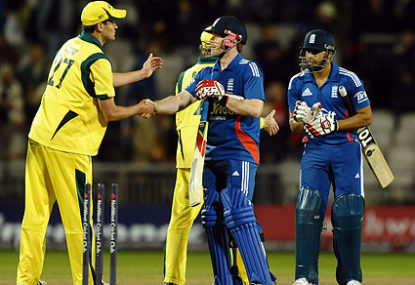
England's Eoin Morgan and Ravi Bopara shake hands with Australian cricketers. AFP PHOTO/PAUL ELLIS
Related coverage
Test cricket is potentially to undergo one of the most dramatic changes in its 135-year history. After being lobbied, principally by Cricket Australia, the ICC has agreed to the concept of day-night Test cricket.
A media release from the ICC’s Dubai headquarters yesterday paved the way for the most traditional form of the sport to be time shifted.
In part, the release stated that:
“Participating countries may agree to play day/night Test matches. The home and visiting boards will decide on the hours of play which will be six hours of scheduled play per day while the two boards will also decide on the precise brand, type and colour of ball to be used for the match.”
The rationale for the move, as pushed for by Cricket Australia, is to try and bolster dwindling Test crowds by shifting the playing hours to include more post-work friendly times.
CA can also see a potential financial windfall as well.
Not surprisingly, the long-term TV broadcaster of the sport in Australia, the Nine Network, is delighted with the ICC’s latest pronouncement.
Nine has been pressing the issue with CA for many a year with their focus purely on the cash register.
Each summer the network gets effectively one day-night Test for its east coast audience with the staging of the Perth Test.
As Nine’s Head of Sport, Steve Crawley, said yesterday, “We always enjoy the Perth Test because it comes back into the eastern states in prime time, and I have always thought it’s only a matter of time. I can’t see a downside to it from an entertainment point of view”.
But what sort of entertainment will it be?
One of the major holdbacks for the switch to day-night Tests has been the availability of a suitable match ball.
Over the years, various prototypes of different hues have been trialled.
Pink and fluorescent orange balls have been trialled at various times in Australia in recent years but were found to be unsuitable.
Last season, CA experimented with twilight Sheffield Shield matches with playing times adjusted for an 8pm finish.
Given the lack of a suitable ball, CA decided to use the traditional red ball even when the floodlights became the dominant light source.
It was primarily the ball and its associated problems that saw the twilight Shield fixtures abandoned after just one season with players sensitive to the difficulties of using the red ball under lights.
CA CEO James Sutherland said yesterday that, “Finding a Test ball that is as easily visible in the day as it is at night is still a technical work in progress that the ICC is now leading and it has not yet been possible to predict when such a ball might be available”.
One of the other negatives that has been put forward about the transition to day-night fixtures at Test level is the perceived lack of equality during the twilight period.
It has long been espoused that the most difficult period to bat during a day-night one-dayer is the twilight period with the transition from day to night.
With that in mind, one would hope that the playing times would be programmed to allow the 40-minute ‘dinner’ break to absorb the majority of that time, thus removing the potential disadvantage that would be experienced by the batting side.
The start time of Test matches around the world varies significantly at present.
In Australia the standard start time is 10.30am; in India 9.30am; in England 11am.
But the thought of commencing a match in mid-afternoon is breaking new ground.
One of the problems when it comes to the brokering by a TV network during the rights negotiation period (as is currently occurring in Australia with the present seven-year broadcast deal expiring at the end of this season) is the fact that there will be tremendous uncertainty as to what the future holds.
Even if a ball is able to be developed there is no guarantee it will be used as both teams need to agree to a series being played in the day-night format.
The current TV deal between CA and Nine is valued at $315m over seven years.
Understandably, CA sees the possibility of extracting considerably more money should day-night Tests become part of the landscape.
CA may well want to stage matches on a day-night basis as soon as a suitable ball has been developed.
But their desire for a time change may not be agreed upon by the touring nation or nations each season.
Thus, for the establishment of a TV rights deal one would imagine it will have to contain an inbuilt sliding scale depending upon what is agreed for each series during the period of the agreement.
Should the advent of day-night Test matches become widespread there is likely to be a push for another change in playing conditions – namely the reduction of the total time over which a match is played.
Former Australian captain, Ian Chappell has long supported the trimming of Tests from five days to four and he is not alone in this area.
There may be a push from the TV networks as well to trim the game by one day (and night) to cause less disruption to its normal programme schedule.
Interesting times are ahead for the most traditional and entrenched form of the sport. Test cricket has often been seen as sacrosanct by the game’s traditionalists.
They had better keep a firm hand on their gin and tonics in the future as they face what they would see as a seismic shift in their beloved game.
After 21 years as a sports broadcaster with the ABC, since mid-2011 Glenn Mitchell has been freelancing in the electronic and written media. He is an ambassador for mental health in Australia, and tweets from @mitchellglenn.
Sport, all day long. Does this sound too good to be true? We're searching for a Group Sales Manager to lead our team in Sydney. If you're a sales star who doesn't mind a hit, kick, throw, or cycle, we want to hear from you. Apply now.
- Explore:
- Cricket, Cricket Australia, ICC, Test cricket

November 1st 2012 @ 1:39am
sheek said | November 1st 2012 @ 1:39am | Report comment
I’m one hundred percent behind day/night cricket tests. Make that 500%.
Already the nay-sayers are jumping in, but this just makes me boil. Over the past 5 years we’ve witnessed the rise of T20 & the resources being poured into that format & the obscene money to be made from it.
Consequently, test cricket has been shoved aside for lack of loving care & attention. I began to wonder if authorities around the world had any incentive or even desire to preserve test cricket.
A quick history lesson. International day/night test cricket has happened before – during WSC in 1978/79. That’s 34 seasons ago!
Also, seven hour days for first-class games is not new. When the Aussies toured South Africa in 1970, their first-class games were played over 3 x 7 1/2 days. That is, 3 x 2 1/2 sessions each day.
My suggestion therefore, which is based on past experience, is for 4 x 7 hour day/night tests. This translates to a net loss of only two hours (28 vs 30) while shaving a whole day off proceedings. This must be seen as a positive.
Similarly, first-class matches would reduce to 3 x 7 hour day/night matches, which would see a net loss of only 3 hours (21 vs 24). Plus a whole day saved.
Floodlighting will add to the cost of staging a test or first-class match, so sparing a day of ground hire costs is a practical exercise.
While finding the right coloured ball remains a problem, evening dew is another problem that will need addressing. Perhaps underground heating will need to be considered at major cricket grounds.
Whatever we do, we must do something. If many people still care about test cricket, as they say they do, then changes are necessary to bring test cricket into line with modern attitudes & habits.
If we continue to do nothing, test cricket will die because the economies of scale are all heading towards T20.
It’s really as simple as that.
November 1st 2012 @ 8:26am
A1 said | November 1st 2012 @ 8:26am | Report comment
Shaving a whole day off proceedings means shaving a whole day off of gate-takings, won’t it? Administrators would never agree to that, would they?
November 1st 2012 @ 9:19am
sheek said | November 1st 2012 @ 9:19am | Report comment
Fair call A1.
Well, the way I see it is that 5 day tests are mostly poorly attended now as it is.
Day/night tests is actually more lifestyle friendly.
Well marketed, so what you lose on the swings you (hopefully) pick up on the merry-go-round.
November 3rd 2012 @ 11:51am
Bakkies said | November 3rd 2012 @ 11:51am | Report comment
Some tests don’t charge admission for Day 5
November 1st 2012 @ 11:06am
Timmuh said | November 1st 2012 @ 11:06am | Report comment
I don’t think moving to night will make any significant difference to attendance. TV,maybe.
Its a format that people will follow, but not so many watch for hours on end. Its getting a bit like the Sydney-Hobart, or golf, people want the scores and to know what happened; but don’t feel interested enough to watch it all.
Going to day/night won’t change that. It certainly had no impact when trialled at the instigation of C7 in the Sheffeild Shield in the mid-90s. Administrators will still prefer the quick bucks to be made from the easily digestible T20, the Maccas of cricket – cheap, quick, and lots of consumers.
November 1st 2012 @ 3:27am
Johnno said | November 1st 2012 @ 3:27am | Report comment
Out of sports I can think of or formats test cricket, is going to have to go through the most and fascinating upheavals and changes.
Night tests, maybe cutting down to 4 day tests.
Either way tradionislists are in for a bumpy ride. But either way you look whenever tradionislists moan i always think traditionalists are the minority a lot of the time.
Reality is test cricket is losing fans, there is no such thing as a large state cricket fan base if shield crowds figures are the judge.
I am still torn on the 4 day game over 5. My only issue with switching to a 4 day game. Is if the pitches are dustbwols, or if you are the weaker team you can play out for a draw so it encourages negative tactics, and not declaring.
Also if you go down to 4 days, spin in test cricket will be lost more. No more situations like chasing 200 on the last day at the SCG with 10 wickets in hand, with a heavily cracked and turning pitch or chasing 150 with 10 wickets in hand, with a guy like warney bowling.
I don’t want to see attacks be made up of 4 quicks all the time, spin is the great variety, but spin needs help. like cracked pitches and the grass taken off the pitch.
One thing i would advocate if it went to 4 days is keep the covers of the pitch. That’s right like the 1940′s have no covers it will really swing the ball up and be handful for batsmen. This way it improves the chance of a result.
SOme of my most enjoyable cricket has been watching pitches effected by the wet. 1992/3 ODI match at the SCG when Mark Taylor took 5 catches in wettened SCG pitch. Very exciting and gritty batting from australia to a modest total and taking the catches heaped them win.
And other day 5 memories i have in test cricket when Australia were chasing 120 odd vs STH Africa in 1993/4 and Fanie De Villiers had the match of his life. And Martyo and billy couldn’t bring the match home. All those sort of nailbiting moments gone.
As the Hobart test last year Aus VS NZ. Day 5 thrillers gone. Yes they may not rate well, but those matches are so exciting day 5, it is what makes test cricket exciting and gripping. ANd the Aust VS WI Adleaide oval 1992/3, Aussie slowing by 1 run after AMbrose and Walsh steamrolled them.
So keep 5 day tests. One thing i would bring in is a subs rule, to keep fast bowlers fresh, as so many break down and i blame long hours spent in the outfield chasing singles in the hot sun. 5 subs per innings and you can come off and not have to wait in the field before eye can bowl again or maybe only have to wait 5 overs or 3 overs.
But either way the bowlers have to come into test cricket more , and batting powers reduced.
Best test where something in it for everybody was the ASHES Perth test 2010/11 , Mitch johnson had the game of his life. That to me low scores good batting and bowling was the best advertisement for test cricket i had seen something in it for everyone.
So yes i support night tests. if the ball is right bring it on.
ANd I would also be open to teams being allowed an extra fielder on the park , especially in the outfield or an extra slip. maybe a rule where you can have 1 permeant slip or something if you wish on the field.
But they have to try things as test cricket is in trouble only 8 teams globally in reality are employing test cricket, not enough to go forwad long term, and with T20 only going ot eat up more of the schedule and 6ixes cricket eg like the HK sixes test cricket has to be innovative. i would like coloured clothing or pyjama cricket ,and big commercialised logos all over coloured clothing for tests. Anything to appeal to fans more. But test cricket has to commercialise more.
Heck bring in batting power players , and call batsman batters baseball americanisation style like in T20, anything to appeal to a younger more commericlaised wanting audience. SO things for example like the old Adelaide oval scoreboard have no place in modern cricket for example. Test cricket just has to think as modern as possible and any traditions and sentiments should be crushed, it has ot be modern and forwad thing and remnant of the past crushed.
Coz only 8 teams are playing test cricket and there were some awful test cricket crowds in India. And in west Indies too, and in NZ.
SO more innovations and scrap traditions more and more and think modern .
November 1st 2012 @ 5:34am
Brendon said | November 1st 2012 @ 5:34am | Report comment
I would like to see night tests but would not like to see day tests abandoned totally.
Four day tests. Plain stupid idea.
November 1st 2012 @ 7:12am
Red Block said | November 1st 2012 @ 7:12am | Report comment
Did the bloke from 9 say they always enjoyed the Perth test because it is prime time? What about all the Ashes series where 9 refused to broadcast the first session because it clashed with ACA. It was even worse in Qld for the ODI, with daylight saving, often 9 would return with second innings half over. One year Gilchrist made 114 but in Qld we didn’t see one ball of it.
Hope the ACB gets it tv deal right and flicks 9!
November 1st 2012 @ 8:11am
Poita said | November 1st 2012 @ 8:11am | Report comment
Regardless of who is holding Gin & Tonics if it is up to the boards to decide I wouldn’t hold your breath.
Remember that teams were dragged kicking and screaming int using flood lights at Test matches in the event of bad light.
The DRS is not used universally and due to the BCCI holding out will probably never find favour.
So if a ball can be found ( and this doesn’t look likely even after many years of trying) and the boards agree ( see above) their could be day night test matches.
As far as channel 9 – would they stop the hour of “news” and ACA? I don’t think so lets face it Channel 9 treat viewers with gross disrespect so their thoughts on the matter should be tempered.
November 1st 2012 @ 9:11am
Winston said | November 1st 2012 @ 9:11am | Report comment
Channel 9 may well have been pushing for it for cash, but it makes a lot of sense for those people who go to work. Night cricket means I can watch some rather than be stuck at work reading live scores. If Channel 9 starts a rally I for one will go behind them!
November 1st 2012 @ 9:52am
Brett McKay said | November 1st 2012 @ 9:52am | Report comment
Realistically Glenn, I can only see day/night Tests being played in the southern hemisphere, maybe only in South Africa and Australia, and even then only at a few grounds, just because of the weather variables.
For instance, you wouldn’t go to night Tests in Perth, because the timezone is already a winner for prime-time cricket on the east coast. You could play them in Adelaide easily, it’s a dry heat over there in summer. You could play them in Brisbane and Sydney, but you’d have to get the time of the year right, otherwise you have the summer evening storms, and maybe even due to contend with. Due would certainly be an issue in Hobart (and NZ), too, it often already is in BBL games down there. And Melbourne should be left alone unless Boxing Day is renamed ‘Boxing Night’.
There is, however, some nice shiny new lights going up at Manuka Oval, though
Similar summer weather to Adelaide, just not quite as hot. Everyone* wins!!
* I win…
November 1st 2012 @ 11:28am
Russ said | November 1st 2012 @ 11:28am | Report comment
Brett, I’ve never got the dew argument? How is it different to intermittent wind, rain and heat; or a changing pitch? It makes fielding harder, batting easier, but not unplayable. Same for both sides, and just one more aspect of the tapestry.
I’d hope too, that the playing hours can actually be flexible. That is, on the weekend, play would run from 11-6 and on a weekday 2:30-9:30. The players would have a relatively short rest from Friday to Saturday, but not horrific – it is hardly a midnight to 9am switch.
On another note, why does the ICC need to allow Day-Night tests? Given hours of play have always been fairly flexible, at what point did they ever legislate against them?
November 1st 2012 @ 11:54am
Brett McKay said | November 1st 2012 @ 11:54am | Report comment
Russ, it’s purely for what it does the ball; makes it difficult for bowling, batting, and fielding. But your point is not without relevance, I’ll concede (as opposed to my spelling of ‘dew’, of course..)
The playing hours, the colour of the ball, most of the ‘mere details’ actually, will be left in the hands of the competing nations, actually, so there will be a degree of flexibiltiy. In fact, all the ICC have really done is take the same approach to night Tests as they have with DRS – left it up to the two nations to decide..
November 1st 2012 @ 1:30pm
Brett McKay said | November 1st 2012 @ 1:30pm | Report comment
Russ, you may or may not be surprised to hear the BCCI have already expressed their lukewarm interest in the idea of night Tests, all based on the unhappy experience of their one and only First Class trial 15 years ago..
http://www.smh.com.au/sport/cricket/india-not-enthusiastic-about-daynight-tests-20121031-28kps.html
(Article also mentions issues with evening dew, for what it’s worth..)
November 1st 2012 @ 3:01pm
Russ said | November 1st 2012 @ 3:01pm | Report comment
Yes, it would definitely have been the dew and not the shirt-front of a pitch and negative cricket that characterises Ranji trophy knockouts. The BCCI never like anything until they can make money and then they are all-in. This won’t be any different.
The ball is going to be the problem. Has always been the problem. South African tests weren’t positive with the pink one and we are a good decade and a bit past the Australian experiments with orange/yellow with no improvement in visibility or longevity. Will be a short-lived experiment if they can’t get it right.
November 2nd 2012 @ 1:05am
Brendon said | November 2nd 2012 @ 1:05am | Report comment
Dew would be less of an issue in a 5 day (or 4 day) match because the team batting first would have to deal with the twilight/shadow problem and then bat through the dew. With each team batting 2 innings, most often than not longer than 50 overs, and with start/finish of each innings not fixed like in 50/20 over matches you cant really predict who will face dew problems.
November 1st 2012 @ 12:22pm
Tlux said | November 1st 2012 @ 12:22pm | Report comment
It’s time for day/night tests.
I think the day’s play just needs to be ‘shifted’ one session forward. That is, start session 1 at the time we currently start session 2. This will result in a final 30 over session starting at about 6pm going until about 8:30.
I am totally against 4 day tests however. Personally don’t care how that affects channel 9’s schedule, that’s their problem, not ours. The 5th day is the ultimate moderator of the game. It ensures that players are truly tested in their technique and physical fitness (Shaun Tait for example, incredibly lethal in short bursts, but over 5 days, the batsmen will win out). It makes triple centuries and bowling figures of 6-for possible because captains don’t have to declare to ensure a result all the time.
November 1st 2012 @ 12:56pm
Rixy said | November 1st 2012 @ 12:56pm | Report comment
Four day tests would be a disaster. Encourages defensive play. Teams know they only have to bat for 2 days and a result is almost gone.
I quite liked the idea of a 6 day test when Australia played World XI in ’05. Although the Aussies cleaned it up in 4 days, both teams knew they had to be playing for a win as a draw was very unlikely.
Would love to see Warnie bowling on a day 6 deck!
November 1st 2012 @ 5:11pm
Rhys said | November 1st 2012 @ 5:11pm | Report comment
If they can’t arrive at a workable option with a coloured ball, why not consider adopting the white ball. I know it wears differently and ‘greys’ up, but it’s been used in day/night cricket for 35 years.
Playing conditions will surely be affected in some way by shifting to day/night Tests, so why not try to incorporate the properties of the white ball by some additional mods. Players wear coloured pads/gloves – no big deal. Balls are changed after say 35 overs, or two white balls used (one from each end). Players are used to batting/bowling/fielding with the white ball, so any adjustments to their game could be handled with little drama.
Would be interested to hear from people what potential problems the white ball option would present. Is it at all feasible?
November 1st 2012 @ 11:31pm
Neuen said | November 1st 2012 @ 11:31pm | Report comment
White balls do not behave different because of the color.The only difference between the two balls is in the coating. With the conventional red bali, the leather is dyed red, greased and polished with a shellac topcoat. This final polish disappears very quickly during play and it is the grease in the leather that produces the shine when polished by the bowler. The finish applied to the white bali is somewhat different. The leather is sprayed with a polyurethane white paint-like fluid and then heat-treated so that it bonds to the leather like a hard skin. As a final treatment, one coat of clear polyurethane-based topcoat is applied to further protect the white surface so that it does not get dirty easily. As far as the aerodynamics is concerned, the additional topcoat covers up the quarter seam and the effective roughness due to it is therefore reduced.
November 1st 2012 @ 11:18pm
Neuen said | November 1st 2012 @ 11:18pm | Report comment
People go watch test cricket because you can go sit a day in the sun and enjoy the cricket entertainment have a picnic etc etc. Who wants to go do that under the night sky with dew and tv deciding cut off time is at 23:00 test match over. Don’t even think a pitch will last for 5 nights as the wear and tear on it especially with moisture and due softening it up, is going to create a pit of death.