Rotate sports scientists, not players
By Cameron Rose, 6 Feb 2013 Cameron Rose is a Roar Expert
- Tagged:
- Australia cricket, Cricket, Test cricket
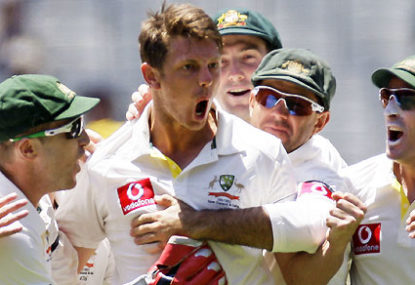
Australian cricketers embrace James Pattinson, but he won't bowl again during the Test cricket season through another injury (AAP Image/Julian Smith)
Related coverage
Rotation policy. Informed Player Management. The idea of the first causes many to rise up in furious anger. The mention of the second by anyone associated with Cricket Australia makes all of us die a little inside.
Are they one and the same? Does the first even exist? Should the second?
Behind these new age expressions and questions lingers the suspicion that the oft-mentioned but rarely seen sports scientists, apparently infused with the wisdom of a thousand Dumbledores and owners of Harry Potter’s invisible cloak, are selecting Australian cricket teams, or at the very least dictating who should be available, for how long, and how much ‘loading’ their fragile bodies can take.
Apart from anything else, there’s no evidence to confirm these people, with seemingly enough power in sporting organisations to give God an inferiority complex, know what they’re doing.
James Pattinson injured himself in three separate Tests in 2012, forcing him to miss eight matches. Ben Hilfenhaus was ‘player managed’ out of the Perth test this summer, only to injure himself in Hobart eleven days later.
John Hastings played one Test and missed a month of cricket.
As an aside, Essendon is one of the richest clubs in the AFL, and we imagine they spent millions of dollars on their sports science department in 2012. First they endured one of the most soft-tissue injury ravaged seasons we’ve ever seen in 2012, and now…well…let’s just say if you don’t love the Bombers you hate them, so all we can do is watch on and laugh.
But back to the cricket – what is fact and what is fiction? I certainly don’t know, but for every connected cricket insider or ex-player that swears one thing to be true, you’ll find a CA representative to dismiss such an idea with nothing short of contempt.
Of course, it’s hard to get to the bottom of any of this now that chairman of selectors John Inverarity is on public record admitting that lying to the public about why a cricketer might miss a match is preferable to telling the truth.
So, where do we go from here?
My take is quite simple: The rotation policy is nothing short of an absolute disgrace. It is also completely essential if implemented correctly.
Allow me to expand on this apparent contradiction.
With Test matches being the pinnacle of cricket (with the exception of the BBL, IPL and Champions’ League of course) the Australian Test team should always be beyond compromise, and not subject to any form of manipulation that doesn’t involve selecting the best team to win a match at the given time.
The thing is, the Test side has always had a form of rotation policy. If a batsman was under-performing and there was a better option available, he was dropped. If a bowler was injured and unable to take part, he wasn’t selected.
Does it need to be any simpler than this? Not in the opinion of this humble observer, if we’re to avoid repeats of the farce that occurred in Sydney against Sri Lanka.
As we all now know, Mitchell Starc was rotated out of the MCG Boxing Day test while being promised reinstatement for Sydney (and don’t even get me started on a player being promised a Test cap ahead of time).
The problem was that the fast bowling brigade in Melbourne were all, effectively, ‘un-rotatable’.
Jackson Bird was arguably the most impressive of the three and, as a debutant that struck all who saw him as a perfect fit for Test matches on English soil, he needed more exposure at the highest level.
Mitchell Johnson got the figures, made the runs, and was hostile enough to injure as many as he got out on his way to the Man-of-the-Match award. Peter Siddle, sparingly used in Melbourne, had taken 9/104 in his previous test, and in any case was seen as the mythical ‘leader of the attack’.
Nathan Lyon was the spinner all summer, and none were as safe as he heading into Sydney.
So who was dropped to accommodate Starc?
None of them of course. With CA now standing for ‘Compromise Australia’, the selectors decided that hard decisions weren’t required. Rather than give Glenn Maxwell exposure at Test level to see if he could cut the mustard in India, or to bring a clearly identified future batsman like Usman Khawaja back into the fold, they would go in with five bowlers.
The game was won, completing a series whitewash, and no doubt at CA headquarters pats on the back were being thrown around like confetti. But the ends didn’t justify the means and a valuable opportunity to glimpse the future was thrown away because the selectors had painted themselves into a corner of weakness.
So, after all of this, when is rotation ‘completely essential’ as I had written earlier?
Any series of one-day and T20 internationals would be the answer, although I’d call it rest rather than rotation.
There isn’t a cricket fan with a mouth who hasn’t decried the amount of meaningless ODIs that get played throughout the cricketing calendar. The same people were up in arms about David Warner, Michael Clarke and Matthew Wade being rested for the first two matches against Sri Lanka.
So they should have been rested, and frankly it wasn’t for long enough.
Resting established Test match personnel from limited overs cricket after a long and exhausting series is where the rotation policy can come into its own. Squeeze every ounce of effort, skill and mental application out of these guys in the Test arena, and give them a break when it’s over.
I’ve long been a fan of potential Test players getting exposure to international cricket though ODIs, with Mark Waugh, Ricky Ponting, Adam Gilchrist, Michael Hussey and Michael Clarke, among many others, all examples of this thinking.
Resting senior hands gives the ODI side a freshen-up, both internally and to the cricket public. For many fans, it’s the first time they’ll see a player who they’ve heard is tearing it up at Shield level.
Watching a player bowl or bat during a 50 over match can give one an insight into whether his technique, concentration and skill are transferable to the Test arena.
Based purely on Glenn Maxwell’s first class averages, I was thinking he would be well worth taking a punt on.
Having seen him with bat and ball in hand for the first time during recent ODIs, I’ve now got huge reservations. Not as huge as Maxwell’s bank balance I must say, but big enough all the same.
As for T20, I’m of the opinion that no Test player should be considered for selection in the format. If the workloads are so strenuous, as we are constantly told, and Test cricket is the most important, as we are constantly lied to about, then there can be no issues with such a stance.
As for those thinking that what the public or broadcasters want should have any impact on selection (ie – Warner to play all ODIs and T20), if that were the case, Dean Jones would still be named in every Australian match played at the MCG.
The sanctity of Test cricket must remain absolute, and selection should be treated accordingly each time an Australian Test XI steps onto the field of play. By all means, rest, rotate, have a look at other players in the shorter forms, but let natural selection take its course in tests.
And if anyone can nail down a sports scientist, rotate them out of the sporting infrastructure for me.
Cameron Rose is a born and bred Melbournian, raised on a regime of AFL, cricket and horse racing. He likes people who agree with him but loves those that don't, for in his mind there is nothing better than a roaring debate. He tweets from @camtherose.
The Ashes journey begins
The Australian cricket team have left Australia to begin their tour of England, with a mission to reclaim the Ashes.
Australian captain Michael Clarke and his teammates were optimistic about their chances before jetting off.
Click here to hear the thoughts of our Australian cricket team as they left for England.
Looking to join The Roar team? We're searching for an experienced Group Sales Manager to lead our team in Sydney. Yes, this does mean you get to work with the site all day long! If you're a digital media sales star, we want to hear from you. Apply now.
- Explore:
- Australia cricket, Cricket, Test cricket


February 6th 2013 @ 8:03am
Jason said | February 6th 2013 @ 8:03am | Report comment
Outstanding article.
Not much to add really. Perhaps maybe to point out that the Test calendar should have fewer back to back tests so you don’t get the WACA situation happening. If that’s at the expense of ODIs, no biggie..
February 6th 2013 @ 8:16am
Train Without A Station said | February 6th 2013 @ 8:16am | Report comment
Another article bagging the rotation policy without knowing the full story. Starc’s rotation could be cited on form anyway. Get over it. You missed a quote some yesterday’s hero whose era was nothing like today saying something like “Back in my day we just bowled all the time”. Move on. It’s basically the first summer in, by the Ashes we will know whether this is the future strategy to top a massive injury problem,or a failed experiment. Something had to be tried, so they went with the method deemed the best by people that know more than you or myself about it.
February 6th 2013 @ 8:38am
Cameron Rose said | February 6th 2013 @ 8:38am | Report comment
Thanks for reading Train.
Starc’s rotation could be cited on form? In his previous test innings he took 5/63 and bowled Australia to victory, and had taken 14 wickets in his prior two tests, not to mention making 73 runs for only once dismissed.
I’d love to hear the clarification for “something had to be tried”.
February 6th 2013 @ 12:20pm
Rob Barrow said | February 6th 2013 @ 12:20pm | Report comment
I like the artiicle and think he decision to play 5 bowlers in the SCG test was wrong as we should have played Khawaja give it was a dead rubber
February 6th 2013 @ 1:52pm
Bayman said | February 6th 2013 @ 1:52pm | Report comment
Train,
How do you know if Cameron knows the full story or not? Do you know the full story? As Cameron has subsquently pointed out, Starc may well have been left out but it wasn’t because of form.
The problem is that for the past several years fast bowlers, in particular, have been dropping like flies. In all that time there have been CA sports scientists with input into their training and practice regimes. Only a few years ago NSW alone had six or seven quicks sidelined because of injury. A couple of them mis-diagnosed by the experts at CA.
Now we have ‘informed player management’ (love that term) and guess what – we’ve stll had six or seven quicks watching on and some of them for all of summer. It definitely raises a question about whether these fitness gurus have any clue at all.
It’s not a question of simply “getting over it”. You may well be one of those who believes whatever you are told on the basis that authority figures would never lie to you. Or attempt to blind you with science. Governments, corporations, churches and powerful sporting bodies just love people like that. It makes life easy for them and makes them unaccountable.
The evidence is all we have and, in this instance, the evidence does not suggest to any thinking person that those at CA have any clue. Lots of educated guesses, maybe, but nothing that looks like actual expertise. These people, based on the evidence, are in need of something slightly more concrete than the statement, “You’ll have to trust us – because you simply do not understand the science”. Maybe we don’t – but we do understand the results.
You criticise the idea that old players might say “Just bowl and bowl some more”. – as if they were actually wrong. How do you know they are wrong? Presumably, and I’m guessing here, because like so many younger people with no real experience of those old days you automatically assume that all change is progress – and an improvement.
You don’t think, for example, that once a path is travelled (e.g. sports sience) and careers and empires built, that those now in those roles might have a vested interest to discredit old ways and to promote their own views as the only true method.
Now I’m not saying they are all wrong but I’m damned if I’m going to just accept that everything new is better just because it suits some career hanger-on for me to think so. They need to back up their theories and, let’s face it, right now it’s just theories, with a hell of lot better results than we are getting.
In the modern cricket landscape rotation may well be the sensible thing to do. But let’s also get our players back on the park or even better, let’s prevent them from getting injured so often. Optionally, perhaps all we really need to do is schedule the season more sensibly. Then, perhaps, not only might the injuries subside but the need for rotation, and a bagfull of sports scientists, will also subside along with it.
Of course, if re-working the schedule is an impossibilty in today’s heavily commercialised world, then perhaps we can also conclude that CA does not really give a rats about the fitness, health and well-being of those who allow these beaurocrats to enjoy the priveleged lifestyle they have manufactured for themselves – the players.
February 6th 2013 @ 8:29pm
Brendon said | February 6th 2013 @ 8:29pm | Report comment
Great article and a great opinion from Bayman, I’ll admit I wasn’t happy with batsmen being rested for ODI’s but having just watched 8 ODI’s with little more than 5 day breaks to break them up and then some T20 thrown in then perhaps I was wrong.
February 6th 2013 @ 8:38am
Rob said | February 6th 2013 @ 8:38am | Report comment
Agree with the article. Must say I was pleased to see the latest ratings for this summer had tests picking back up and the gap between them and ODI’s almost non-existent. Like it or not, with huge dollars on the line in the next TV rights agreement, who knows how much influence this could be having on selection and the approach taken.
The higher tests rate, the less rotation there will be. Whilst the Australian Test line up should be sacrosanct, an important factor of it becoming so is Tests becoming the best viewing of the summer, I think that point is coming close, now if cricket could only get a test starting at 1pm and finishing at 8:30pm, I think we’d be there.
Then leave all the ODI’s and T20 to fill in the gaps (like Sunday AFL games on Foxtel…).
February 6th 2013 @ 9:33am
jameswm said | February 6th 2013 @ 9:33am | Report comment
Yeah night tests are something they really need to look at for ratings. Maybe not the Boxing Day test, or even the Sydney test, because most of us are on holidays. But for the others, we’d love to get home from work a bit early and catch the last session or two.
This needs to be seriously looked at, esp for Brisbane and Adelaide. Perth benefits from its last session being easily viewable by the more populous Eastern states because of the time difference.
February 6th 2013 @ 8:58am
Ryan O'Connell said | February 6th 2013 @ 8:58am | Report comment
Yep, can’t disagree with too much here, Cam.
I think it’s safe to say I share your huge reservations on Glenn Maxwell. Though I’ve probably graduated from ‘reservations’ to outright dismay that he’s in line for a Test debut.
Incidentally, remember when we all used to talk about the cricket? It’s a damn shame that this summer, for me, will always be remembered as the season we talked about rotation policies, Informed Player Management, the selectors, etc, instead of the actual cricket. Anytime you’re not talking about the actual sport, I would suggest something is wrong.
February 6th 2013 @ 9:09am
Cameron Rose said | February 6th 2013 @ 9:09am | Report comment
Excellent point Ryan. If the cricket is good enough (or any sport for that matter), it will always overshadow what’s happening off the field.
Perhaps this is a byproduct of living in a more complicated cricket world. It’s always easy to hark back to a simpler time, but the world of cricket now seems a complicated mess with so many formats, teams and competitions fighting for space.
February 6th 2013 @ 12:41pm
The Barry said | February 6th 2013 @ 12:41pm | Report comment
Couldn’t agree more Ryan. Following the first two tests this has been the most uninspiring summer of cricket I can remember. With India and back to back ashes series coming up this summer should have been providing valuable insight into the make-up of the various squads.
Instead we have no idea who the best Australian XI is in any format. The team has three of four personnel changes game to game. Players come in for a game and are gone again. Caps seem to be given away like cereal trinkets. How is any of this good for the game ?
If ever sports needed an example of how to disenfranchise their spectators, this summer from CA is it.
When you have all the (now boring) selection controversies overshadow what’s happening on the field and the head of selectors telling us that we don’t deserve to know how or why OUR Australian XI has been selected there is something seriously wrong.
February 6th 2013 @ 2:25pm
rl said | February 6th 2013 @ 2:25pm | Report comment
Selection policy will always be a point of debate – always has, always will be. A couple of years ago we had different captains for tests and ODIs and boy, wasn’t that the end of civilisation as we knew it?
I’m more concerned with issues like excess volume of cricket diluting public interest, so they aren’t really talking about the cricket at all. There has been an awlful lot of people very convincingly disguised as empty seats at the cricket this year. CA is killing the goose.
February 6th 2013 @ 9:59pm
Ryan O'Connell said | February 6th 2013 @ 9:59pm | Report comment
Selections have always been a topic of discussion, but I can’t remember selection policies ever being discussed, mainly because we just used to pick our best team. We might have disagreed with who that ‘best’ were, but we weren’t dismayed with policies, resting, player management, and confusing comments.
February 6th 2013 @ 9:45am
D.Large said | February 6th 2013 @ 9:45am | Report comment
Some great points here, cannot agree more on the resting of test players for the shorter forms of the game. These formats should be how we bring in the next generation of Australian Test cricketers.
February 6th 2013 @ 9:54am
sledgeross said | February 6th 2013 @ 9:54am | Report comment
WIth all the talk about playing matches, what about the old Ashes tours? Admittedly, it was squad based, but teh core Test group played majority of games.
In 1997, the tour was 4 months long, and International games comprised of 6 Tests and 3 ODIs. Sandwiched between these games were 7 one dayers and 10 3-Dayers against various counties and invitational XiS. So, 26 games. Of those games our Test batsmen played in a godo majority of those game (Steve Waugh played the most with 20, followed by Mark with 19, and Taylor, Healy, kasper, mcGrath with 18, Warnie and Bevo with 17). The tour was about 120 long, with 70 days of cricket.
February 6th 2013 @ 10:38am
Cameron Rose said | February 6th 2013 @ 10:38am | Report comment
Sledge, There is certainly enough anecdotal evidence (I recall Glenn Mitchell doing a piece) to suggest that bowlers from the past did a lot more bowling year in year out than our players do now.
And let’s face it, as Nick mentions below, the best sides simply don’t do it. Pick your best players, and if one of them gets injured, then he’s out. Enough fast bowlers have said that they needed more bowling not less to tune their bodies to the rigours of the sport.
February 6th 2013 @ 11:14am
Russ said | February 6th 2013 @ 11:14am | Report comment
Yep, good example. The 1997 tour was the one where Australia went through so many bowlers Shaun Young got dragged out of nowhere to play in a loss at the Oval. That’s all but two of the first choice team, the squad reserves, and Reiffel who was called up as an injury replacement. Definitely the best way forward.
February 6th 2013 @ 12:22pm
Don Corleone said | February 6th 2013 @ 12:22pm | Report comment
Good point. I remember this…obviously grinding bowlers into the dirt doesn’t seem to be the answer either.
February 6th 2013 @ 12:48pm
Cameron Rose said | February 6th 2013 @ 12:48pm | Report comment
Russ and Don,
Your both assuming that injuries to quick bowlers can be prevented. If they’ve always happened, and are still happening (seemingly at an even greater rate now than before), then it may just be that this is the way it is.
That being the case, play the best until they get injured and replace them accordingly.
February 6th 2013 @ 1:18pm
Russ said | February 6th 2013 @ 1:18pm | Report comment
Cameron, have you read any of the science? Or at least some of the articles by Dan Brettig, who has had the foresight to go and speak to the relevant people. Or if you prefer, this Grantland article on Strasburg explains the problems cricket faces in the baseball context.
No sports scientist says injuries can be prevented. None. There is a baseline rate of injury that is always present. Fast bowling is hard. Some players have a much higher facility for long and frequent spells than others. Some players just won’t be able to deal with any amount of workload. In between, there are a really large number of players who should be managed better than “run them into the ground then pick someone new”. You can’t prevent injuries, but you can highlight the types of workloads that will cause injuries.
And it is in the team’s interest to prevent them for several reasons:
1) They are the most valuable members of the team – bowlers are what wins you matches. Hughes barely played again after the ’93 Ashes, McDermott after his workload across ’92. It didn’t matter then because Fleming, McGrath, Kaspa, Bichel, Reiffel and Julian were in the wings. But it did matter, a lot, when Clark, Gillespie, and Lee barely played after they turned 30.
2) Playing the 4th,5th and 6th best bowler at the end of the series will result in lost matches. There is a world of difference between resting a player for a couple of games and losing them for 6 months or longer. Players become more vulnerable to injury after injury. They also become less effective. Playing less often for a longer period is a lot better than playing a lot then never again.
3) Young bowlers are several times more vulnerable. Running a young bowler into the ground and potentially ruining their career means you are only playing with bowlers who can deal with large workloads. That lowers the quality of the side. Not to mention, it is also repugnant to deal with the livelihood of players in such a cavalier fashion.
You stated above that workloads haven’t increased. if you read the science you are so critical of you’d realise that is not what the sports scientists argue is the problem. The pattern of workload is the critical factor. Players get injured when they are tired. In times past long tours consisted of a lot of 3-day tour games where players could bowl 10 overs a day. Now, and ODI/T20 cricket is a problem, the pattern is short periods of intense load (back-to-back tests) where even if not injured they develop micro-tears and then periods of lower loads that lower conditioning, depending on training.
With what the sports scientists know about the pattern of injuries. Test cricket will cause injuries, full stop. There is no way to condition most bowlers to bowl 20+ overs a few days apart without them being at high risk of developing injuries in the subsequent period. That doesn’t mean there isn’t some management that could be used to lower injury rates, particularly young bowlers (the load Cummins jumped to in the Shield final and South Africa was flat out abuse). But the risks will remain.
The long-term solution will be substitutes – play the 1st/2nd innings, sub out for someone else in the 3rd/4th. Some players, in their late 20s, with good injury histories will be able to play both, depending on the load in a particular game. Even then there will be injuries, but a reduction wouldn’t hurt. As a fan, I’d much rather watch Malinga, Harris, Cummins, Pattinson, Bond, etc. for one innings than not at all, for injury or their common sense on what they can shoulder.
February 6th 2013 @ 1:27pm
jameswm said | February 6th 2013 @ 1:27pm | Report comment
Nah Russ I don’t want to see us moving to subs during a test. That feels wrong.
However, identifying micro tears and avoiding injury is important, and what the AFL teams are very good at. Identify the periods of higher injury risk.
Take Ryan Harris – I’d take him to the Ashes, even if he can only play 2 of the 5 tests because of his dodgy knees. Pattinson or one of the others can be rested for a test, especially where there are back to back ones. Fresh bowlers are better than tired ones, or ones with niggles.
I just hope common sense prevails, and I also hope that the Aussie cricket physios etc now what they’re doing.
February 6th 2013 @ 1:57pm
Cameron Rose said | February 6th 2013 @ 1:57pm | Report comment
Russ,
I have openly admitted that I don’t know the ins and outs of sports science, because these mystery men are always shrouded in secrecy, no doubt too busy monitoring loads, counting footsteps and coming up with new theories to adequately explain their existence.
Did you not read where I propose the resting of test players from shorter forms, and the suggestion of not allowing them to play T20 altogether, which pre-empts your mystery “pattern of workload”?
I’m just looking down the list of fast bowlers to have taken over 200 test wickets, almost all of whom have played in the era since ODI’s began (and let’s not forget for a long time in this country, the ODI’s and test matches were played concurrently).
If the new age thinking is to be believed, it’s a wonder any of them were able to play more than five or six tests in their career.
February 6th 2013 @ 2:09pm
Russ said | February 6th 2013 @ 2:09pm | Report comment
Cam, there is nothing mysterious about sports science. CA has online whole conference proceedings that they fund. The papers are published in journals. You can read them online via a library membership to any state library. You can tweet and ask the scientists to send their papers to you. The exact details of how the Australian team is managed are different, but then the Australian team is managed to win, and to play certain matches, not just prevent injuries. No sports scientist is out there recommending back-to-back tests or switching from a T20 competition to a test series on a week’s notice. But it still happens.
Rotation out of T20 or ODI won’t necessarily prevent injuries at all. A good pattern of workload is the same amount week-in, week-out. A bad pattern is 4 overs spells for four weeks then 20 overs or more in a day or two. Recovery after the intense load helps, but studies indicate that recovery time might be as long as a month. That won’t happen.
Players play more test cricket now, so the list of 200+ wicket bowlers is skewed to the present. But moreover, you can’t measure career length and say injuries are increasing or decreasing. Australia can only ever play their best XI. If that is four machines able to handle the workload, then they’ll have long careers. If it is a mixture of carefully managed players who can’t deal with the workload and machines then the stats will show shorter, more injury-prone careers. Apples and oranges.
February 6th 2013 @ 2:34pm
rl said | February 6th 2013 @ 2:34pm | Report comment
Cameron – “mystery men shrouded in secrecy” will be one of my favourite Roar quotes so far this year!
February 6th 2013 @ 2:13pm
rl said | February 6th 2013 @ 2:13pm | Report comment
Cameron – while I don’t deny that bowlers of days gone may well have bowled higher volumes, they also spent their time between overs standing at fine leg doing absolutely bugger-all. Look at Courtney Walsh or Angus Fraser – both players of unbelievable longevity, both complete spectators in the field.
Today’s quicks need to be dynamic in the field, constantly in motion, hurling themselves around the field like a soccer goalie. I know its in the shorter forms of the game, but look at the starting heart rate of some of the bowlers – they are in the 120-140 BPM range before they start an over. I’d be surprised if Courtney ever topped 50 BPM! (unsurpassed in his “efficiency of effort” in the outfield)
I think that must have some impact in how tired our guys get at the end of each day’s play and, as Russ suggests, increases their susceptibility to injury (wear and/or tear).
February 6th 2013 @ 3:08pm
Cameron Rose said | February 6th 2013 @ 3:08pm | Report comment
Good point RL, there is no doubt we expect more of our players in the field during limited overs matches. Perhaps another reason why we should have more long and short form specialists, rather than trying to put the same players into all three forms as often as we can.
February 6th 2013 @ 3:47pm
rl said | February 6th 2013 @ 3:47pm | Report comment
and in the tests mate – I was at the Gabba test and Clarkie was not well pleased when Pattinson was taking a (weel earned) breather at fine leg and didn’t move in quick enough to field a ball. Gave him a look that would have done Allan “Captain Grumpy” Border proud!
February 7th 2013 @ 5:33am
lou said | February 7th 2013 @ 5:33am | Report comment
Russ, I applaud your effort here. But I can’t see it taking you far on the Roar!
February 6th 2013 @ 10:01am
Felix said | February 6th 2013 @ 10:01am | Report comment
Good reading Cam, you summed it up nicely, thanks. If I had to pick at nits I’d say that the supporters of the Informed Rotation Management Policy would say that they got the Hilfenhaus decision spot on and would argue that his injury may have been even worse had he played in Perth, though I’m not here in anyway to defend them.
I’d also say that John Hastings was lucky to play one test and probably should’ve had a much longer rest from Test Cricket.
February 6th 2013 @ 10:41am
Cameron Rose said | February 6th 2013 @ 10:41am | Report comment
Felix,
You’re right, but if these sports science guys know so much about prevention and Hilfenhaus’ body wasn’t going to hold up, why was he allowed to play in Hobart?
There must be huge question marks over how these guys are being trained, such is the extent of our injury epidemic.
February 6th 2013 @ 12:36pm
jameswm said | February 6th 2013 @ 12:36pm | Report comment
Cameron
I think that the sports science guys can and do predict this. Look at Aussie Rules teams, with incredible sports science programs. However, those smart guys who know what to look for and how to treat and avoid it, might not include the current Aussie cricket physios and sports science guys.
February 6th 2013 @ 12:40pm
Cameron Rose said | February 6th 2013 @ 12:40pm | Report comment
James – also note with AFL that when the best players get rested it’s against GWS, Gold Coast, Melbourne etc, which in this case would be the equivalent of ODI’s.
You always hear the term “they would have played if it was a final”. Every test match should be treated that way. Players pain with pain and niggles all the time, the body gets conditioned to it if it’s allowed to.
February 6th 2013 @ 3:52pm
jameswm said | February 6th 2013 @ 3:52pm | Report comment
Nah I don’t agree about playing every test regardless of any niggles. If you have a 5-test series, the aim is to win the series. That might mean resting one of your bowlers for one of the games, to ensure they’re at their best for the others. What if test 3 is on a road and there’s only 3 days’ rest before test 4, on more seamer-friendly conditions? There are times when rests during tests are warranted.
I totally agree though about resting them from ODIs. But look at Patto and Siddle, and now Bird – they are pegged as test specialists, as well as our three best quicks right now! Starc is in lethal form with the white ball.
February 6th 2013 @ 10:03am
Nick Inatey said | February 6th 2013 @ 10:03am | Report comment
South Africa and England don’t rotate their fast bowlers. They win matches. Simple, uncomplicated cricket. Picking the best XI at all times. Not eleven of the best 14 or 15.
February 6th 2013 @ 10:18am
Jay said | February 6th 2013 @ 10:18am | Report comment
Spot on.
February 6th 2013 @ 11:56am
Shep said | February 6th 2013 @ 11:56am | Report comment
James Anderson and Graheme Swann were just rotated out of their one day side in India
Broad and Anderson were rested for the third test against the West Indies earlier this year.
England rotate just as much as Australia
South Africa don’t have to rotate because their board doesn’t schdule 6 test in 8 weeks
February 7th 2013 @ 5:35am
lou said | February 7th 2013 @ 5:35am | Report comment
Glad someone else realises that other teams rotate players. Some of the stuff written here is just junk.
February 6th 2013 @ 10:15am
Nick Inatey said | February 6th 2013 @ 10:15am | Report comment
Cameron, regarding thuis quote “There isn’t a cricket fan with a mouth who hasn’t decried the amount of meaningless ODIs that get played throughout the cricketing calendar. The same people were up in arms about David Warner, Michael Clarke and Matthew Wade being rested for the first two matches against Sri Lanka.”
Yes, they should all have been rested. However there is absolutely no reason why they couldn’t be rested at separate times. It was disgraceful that they were all rested at the same time. CA diluted the best team with 2nd tier players. CA insulted Sri Lanka, who are ranked higher than Australia by making them come all the way over to play a B team. CA insulted the paying public by making them pay good money to watch a B team in what was an experiment.
You cannot treat any professional top level match as meaningless or an experiment. Australia was expected to walk over Sri Lanka, and the rain plus scared umpires saved them from a humiliating series defeat.
Australia treated T20 as meaningless 6 years ago and are still trying to catch up as a result.
Yes, you rest players, but you don’t compromise your best XI too much by doing so. Australia did so against Sri Lanka.
February 6th 2013 @ 10:47am
Cameron Rose said | February 6th 2013 @ 10:47am | Report comment
Nick,
You makes some good points, but to me test cricket is the absolute priority, and whatever is deemed the best preparation for the next series should be followed.
If Australia has to rest enough players so that you and I get a call-up to the ODI squad, then so be it. We know Warner, Wade and Clarke can be dynamic ODI players, so they need not prove it against Sri Lanka after a six test summer.
February 6th 2013 @ 11:52am
Simba said | February 6th 2013 @ 11:52am | Report comment
I respect your opinion Nick but mine is different.
I do believe that ODIs (outside of World Cup years) and T20Is are meaningless and, if we have to play them (jury out), then it is a good opportunity to rest established test players and experiment with younger players.
Losing a meaningless ODI series more than two years out from the World Cup is hardly ‘humiliating’. Nobody cares.
T20 should remain a domestic sport. No need for T20Is in the already-overloaded cricket calendar.
In then end, Test Cricket is the only thing that matters and the rest is just a bit of hit and giggle.
ODI World Cup is the exception, but still a long way behind Test Cricket.
In Test cricket, we should always play our best 11, with some allowance for fast bowlers’ workloads/injuries. No reason at all why our test batsmen, keeper and spinner should be rotated.
February 6th 2013 @ 12:14pm
Don Corleone said | February 6th 2013 @ 12:14pm | Report comment
“T20 should remain a domestic sport. No need for T20Is in the already-overloaded cricket calendar.
In then end, Test Cricket is the only thing that matters and the rest is just a bit of hit and giggle.”
There needs to be an international element to T20 cricket because test cricket can’t pay it’s own way.
The biennel T20 World Cups provide significant revenue for the ICC which in-turn distribute dividends to full members to prop-up test cricket.
February 6th 2013 @ 1:50pm
Simba said | February 6th 2013 @ 1:50pm | Report comment
Fair point Don. I guess that’s the unfortunate reality.
But I still agree with Cam that ODIs and T20Is are the best way to rest established test players and experiment with younger players.
February 6th 2013 @ 10:46am
jameswm said | February 6th 2013 @ 10:46am | Report comment
Hmmmm.
As I’ve said on other threads, I’ve sort of heard from the inside that the current Aussie physio or strength trainer might not be the best for the job. That’s a worry.
And it sort of supports rotating them I guess.
February 6th 2013 @ 10:49am
Cameron Rose said | February 6th 2013 @ 10:49am | Report comment
James, you only ever hear about these guys when trouble strikes. I don’t trust anything about any of them, because there’s no way they can precisely know everything about a players body and what they do, get their judgements always seem so absolute.
February 6th 2013 @ 12:33pm
jameswm said | February 6th 2013 @ 12:33pm | Report comment
I think it’s more objective than that Cameron. There are certain strength aspects that any good sports physio/strength guy will know about. For example, if Watto’s calves are a problem, how strong are they, how flexible, what about he joints, muscles and ligaments around them?
It’s not something done only by opinion, there is a fair bit of science behind it.
As I said, from what I’ve heard, the guys responsible might not be the, errr, top of their field, or have the best knowledge base for this. I don’t actually know who that is, but they might want to look at changing them.
February 6th 2013 @ 10:50am
JGK said | February 6th 2013 @ 10:50am | Report comment
Bring back Hooter!