Related coverage
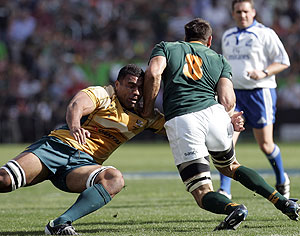
The Springboks destruction of the Wallabies was the sort of defeat that gives massacres a bad name. This was a thrashing, a walloping and a devastation.
Go through the thesaurus to find all the words for a massacre – a general slaughter, utter defeat, destruction and so on – and you get a feel for what happened at the citadel of Afrikaner rugby pride and power, Coca-Cola (formerly Ellis) Park in Johannesburg.
The Springboks were the ferocious mongols of Ghengis Khan: and the Wallabies were the hapless villagers put to the sword and fire with a vengeance and brutality.
In the manner of wiping away the blood from a victim, lets get some of the statistics out of the way.
This was the greatest margin of defeat for a Wallaby side, 45 points in arrears, since the team started playing Test rugby in 1899.
It was the second-largest points total conceded since that awful day in 1997 at Pretoria when the Springboks ran riot and scored a total of 61 points to 22.
The Wallabies have now won one of 9 Tests at Johannesburg. The one and only victory was in 1963 when John Thornett side, with the wonderful lineout leaping of Rob Heming, defeated the Springboks. This victory followed a victory in the Test before. Thornett’s side remains the Australian team to win two Tests in succession in South Africa against the Springboks.
When things go as badly wrong as this, it’s because everything goes wrong.
The five replacements to the winning team at Durban weakened the side, rather than strengthened it with new energy.
A couple of the replacements, for Daniel Vickerman and Berrick Barnes, were forced on Robbie Deans. The dropping of Stephen Moore as hooker, bringing in Matt Dunning to start in the front row and playing Phil Waugh ahead of George Smith were own goals scored by the Wallaby coach.
Dunning was substituted after 20 minutes and one would think that after Brisbane his Wallaby career is over.
Waugh showed once again that he is too small and just not a good enough player, especially at the linking game with his running and passing, to be a starter in Test rugby. Like Dunning, you would think that Waugh’s career as a Wallaby is coming to an end and some of the young loosies from the Western Force will be brought into the squad for the November tour.
The Wallaby lineout held up well, especially on the Springboks ball. Victor Matfield, usually so dominant, lost a number of lineouts.
And the Wallaby scrum, aside from a crucial scrum on its tryline when the side was leading 3 – 0 that the Springboks demolished, was adequate.
The Wallabies also did well enough in the rucks and mauls, especially when George Smith came on, to have enough ball to do well in general play.
The experiment with Timana Tahu, though, was a desperate failure. He started well with a long flat pass out to Lote Tuqiri’s wing but it was downhill all the way after that. He seemed to have no idea about defence and for the first time in years the Wallabies were being outflanked easily virtually every time the Springboks ran the ball through the backs.
Rugby league tragics are going to be angry at what I say next, so if you don’t want to read the truth drop down a couple of paragraphs. The truth is this: the days when rugby league greats like Rod Reddy could help the Wallabies win a Rugby World Cup (1991, in fact) by teaching them RL tackling methods and systems are long gone. The rugby league players of today just do not have the tackling nous of their rugby union counterparts, when they play rugby union.
We saw this with Wendell Sailor, often with Lote Tuqiri, always with Mat Rogers and now with Tahu. He reminded me of Andy Farrell’s efforts for England at inside centre a couple of years ago, especially when the Irish centres ran riot – rather like the Springboks on Saturday – with Farrell making all the wrong defensive choices (like Tahu).
Perhaps even more similiar was the case of Henry Paul who was hooked from the side on his debut at inside centre for England against Australia after about 20 minutes of being exposed defensively by the Wallaby centres. Tahu lasted 53 minutes, about half an hour too long.
Ryan Cross, a rugby league player admittedly but a former Australian Schoolboys rugby union player, made an immediate difference when he came on.
I think the Timana Tahu experiment is over for the time being and Deans will have to work out a centre combination of Stirling Mortlock-Ryan Cross for the crucial Brisbane Test against the All Blacks.
Also over, surely, is the fancy of playing Adam Ashley-Cooper ahead of Drew Mitchell at fullback. Ashley Cooper was too often out of position. His kicking was poor. His following up was even worse. There was a big improvement in the way the Wallabies handled the long kicking game of the Springboks when Mitchell came on. But by then, as Rex Mossop used to say: ‘Hang up your glasses. The horse has bolted.’
The Wallabies were tactically inept. Early on in the game they tried to run the ball in confused and confined circumstances from inside their own 22. The result was turnover after turnover, especially from bad handling, which got worse as the players tired rapidly. The Springboks exploited Tahu’s ineptitude at reading back plays, and the points piled on.
Of all the major rugby grounds in the world, with the exception of Loftus Versfeld in Pretoria, Coca-Cola Park at Johannsburg is the worst ground in the world to try and run the ball inside your 22. Because of the altitude of the high veldt the ball travels much further than at sea level. So you get field position very easily by belting the ball downfield, and you hope that the opposition is stupid enough to try to run it back at you – which the Wallabies did.
When they did try to counter-attack with the kick-and-chase game they kicked far too deep, and there was no chase, until Mitchell came on to replace Ashley-Cooper.
If you watch the All Blacks their kick-and-chase game in their last two Tests was very successful because the winger positioned himself beside the fullback and ran on as soon as the ball was kicked to put pressure on the catcher. The Wallabies did not do this. Tuqiri is actually very good in the air. But where was his chase? He’s always complaining about not getting enough ball and so on. But he is a lazy player. Forget about his handling mistakes. He does very little work off the ball, particularly on the kick-chase game, and the Wallabies are at a disadvantage because of this.
It seemed to me that the difficulties of playing at altitude got to the Wallabies very early on in the game. After one early long sequence of play you could hear Matfield in his high-pitched voice shouting as the referee NZer Bryce Lawrence, ‘The Wallabies are faking injuries.’ There was a leaden-footed aspect to the play of the Wallabies that suggested that they were feeling the pressure of the lack of oxygen to their lungs and couldn’t get their second wind.
This brings us to the matter of how visiting teams should deal with having to play at altitude. The theory that works best, according to people who should know, is that you spend as long as you can at the altitude and acclimatise to it, a week before the Test if possible: or you go up as late as possible, the day before the Test, if possible.
Several days at altitude, apparently, leaves you in the worst possible position of a long exposure to the thin air but not enough time to acclimatise. This is what the Wallabies did. And the result was the massacre.
Deans now has the record of the first win in South Africa by the Wallabies in 8 years, and the worst defeat (in terms of a points-margin) in 109 years. Rooster one day, it seems, feather duster the next.
The Test in Brisbane against the All Blacks for the 2008 Tri-Nations championship now looms as a huge challenge for the Wallabies. Two slightly hopeful aspects, one short term and the other long term, emerge from all the – justifiable – doom, gloom and recriminations.
First, the short term message is that a number of the players starting on Saturday can’t be starters against the All Blacks. So selection mistakes should not occur for the next Test. And you would think, too, that the game plan for the side would be more appropriate to the skill level of the side.
Second, the long term message is that teams can recover from massacres. The Springboks came back from two comprehensive losses to score some marvellous tries and win one of their great Test victories.
Also, Rod Macqueen, as the new coach, took 13 of the Wallabies involved in the massacre at Pretoria in 1997 to a famous RWC triumph in 1999.
Robbie Deans and the Wallabies trying together the body and soul of the Wallabies after the Johannesburg massacre should take note of this splendid mantra: ‘The main thing is to keep the main thing the main thing.’
Recommend this story.
Jim Beam Devil's Cut
As bourbon ages, a portion of liquid is lost from the barrel due to evaporation. This is known as the Angel's Share. When the bourbon is taken from the barrel, a certain amount is left trapped within the wood. It's that extracted liquid, and the rich flavours from deep within the barrel that are in Jim Beam's Devil's Cut.
Click here to learn more about Jim Beam's wicked new bourbon.
Do you have what it takes to become a sports writer? Write for the roar
Rugby Union articles
- Reds back in contention, but Waratahs need a cleanout (287)
- What Hansen’s first squad means for the Wallabies (191)
- ‘Campo’ too generous: Lord’s dream XV contains just two current Wallabies (161)
- Will Cooper and Mitchell be back in time for Wallaby selection? (156)
- CAMPO: Will Deans change the style of the Wallabies play? (128)
- Tahs out. Brumbies win ugly. And Quade’s back! (124)
- Who should partner Horwill in the second row? (111)
- Great clubs don’t decline so Munster will be back (0)
- Can the Brumbies win Super Rugby? (1)
- Who will be in the Wallabies’ backrow? (4)
- When should a game plan change and who makes the call? (1)
- Six lessons Robbie Deans must learn (Part 1) (1)
- Reviewing the Super Rugby action from round 13 (6)
- Why Cooper must be left out of Wallabies (107)
- Explore:
- Adam Ashley-Cooper, All Blacks, Berrick Barnes, Drew Mitchell, George Smith, Lote Tuqiri, robbie deans, rugby, Rugby Union, Ryan Cross, South Africa, Springboks, Stephen Moore, The Springboks, Timana Tahu, wallabies


September 1st 2008 @ 7:44am
Frank O'Keeffe said | September 1st 2008 @ 7:44am | Report comment
What more can somebody say?
I’ll only add that:
“The one and only victory was in 1963 when John Thornett side, with the wonderful lineout leaping of Rob Heming, defeated the Springboks.”
That’s the reason why I put Rob Heming in my all-time Wallabies side. Everybody picks Eales, but who to partner him in the second row? There’s about five other names that could be mentioned, but Heming gets it for me because he was so crucial for the Wallabies in such a significant series against a country that’s renowned for their dominance in the set pieces.
On reflection, when you consider the massacre that was last weekend’s game, the significance of what the ’63 Wallabies achieved shouldn’t be understated. The Wallabies effort last weekend illuminates the efforts of Rob Heming.
September 1st 2008 @ 7:46am
Benjamin said | September 1st 2008 @ 7:46am | Report comment
Spiro, the difference between Tahu and Cross is that Cross has two seasons of S14 under his belt. Tahu has a handful of games at inside centre. It was a bizarre decision for Deans to play him and frankly I feel sorry for him. It was also bizarre that Deans elected to play a gameplan that would suit the Boks down to the ground. If you have won your games by front-on aggression and clever, simple play why decide to forego that and pick a team, and also a bench, built for running in the environment least suited to it? I am perplexed that Deans decided against kicking reinforcements. Perplexed. In sport you are only as good as your last game and now Australia have an extended period to contend with their mental demons prior to the Brisbane meet. It is up to them to decide if they are on the up or not.
Regarding Dunning he can’t be dropped at this point. Who else is there? He has utility value and also experience. If Baxter were to get injured then Alexander or Robinson would have to contend with Woodock, and that’s no good for anyone… except perhaps Woodcock. Deans also faces the issue of dropping TPN. Until he can start regularly for NSW even his bench position is contentious. And what to do at fullback? Obviously the highveld offers a different kicking opportunity from Brisbane but AAC simply is not an international fullback. Latham would have had a field day on Saturday. At the moment I’m inclined to think that this is a more glass half-empty situation. Going into Australia’s most important test in years the front row is again under pressure, there are injury issues, there are no specialist full backs in the squad and the team has just got a shellacking. It will take a lot of work from Deans to ressurect this situation.
September 1st 2008 @ 8:05am
vincent said | September 1st 2008 @ 8:05am | Report comment
I can only hope this is a one off and heralds the start of a rebuild especially with some of the ‘old personell who were found to be inadequate. It was a woeful performance.
September 1st 2008 @ 8:18am
ohtani's jacket said | September 1st 2008 @ 8:18am | Report comment
The Wallabies have got to get better at backing up after a big win, particularly on the road, and even if they win in Brisbane, Deans will need to make some tough decisions about who has a future in a Wallabies jersey.
There was a lot of talk about Deans taking tired, jaded players and giving them a new lease on life, but I’m afraid the rugby man stuff has to be ditched and the hard decisions made. Deans is getting guys other people coached. He doesn’t have his own proteges like he did in Canterbury. And surprisingly, after years of watching Australian Super 14 sides and the Test side, overestimating the players he once coached against.
I doubt he wanted to step on any toes in his first six months, but here’s a guy who coached the Crusaders over the Waratahs in the Super 14 final and now he’s saying “here’s what I’d do if I was coaching the other guys” and it’s not really working.
They need a new game plan for Brisbane.
September 1st 2008 @ 8:20am
True Tah said | September 1st 2008 @ 8:20am | Report comment
Benjamin,
agree re: Cross and Tahu – I watched Tahu rip the NZ Maori a new one at the SFS, my question would be, are the Maori not that good?
I think you’re being a bit harsh on Ashely-Cooper, he played bad, but he wasn’t helped a lot, at times the Boks played as if they had 20 guys on the paddock.
I think Pocock needs to be included in the Wallaby tour, and Mitchell Chapman either…Waugh played well for the Tahs and led them well this year, but I don’t think he can take the step up to test match level.
Spiro,
agree 100% about the differences in defence between union and league, and in union, you need a far greater awareness of your position, something I think Wendell never got into his head, will Tahu be able to master this? He has the skills and the physique thats for sure.
September 1st 2008 @ 8:21am
Paul said | September 1st 2008 @ 8:21am | Report comment
One other factor that has to be considered in the post Eales years is that in big games, the Wallabies are the rugby world’s worst favourites.
Wallabies perform great without expectations or “nothing to lose”: examples being RWC 2003, and Sydney 2008, and Durban 2008 the perfect example since for the first time in ages they came to South Africa as true underdogs: playing a wounded World Champions. But every time a little bit of rightful expectation is mixed in: they turn to puffcakes. RWC 2007 Qf being on example, and Auckland and Jo’burg drumming home the fact. The first time this became obvious to me was just as bad… whichever year they played SA twice in Australia: 42-6 (or something) one week, the worst rugby test (17 something?) the week after.
And to fall over like that, to a record margin defeat, and be seen to giggle and laugh and shrug in the hotel afterwards just goes to prove what NZ and SA have always known, which is that there are only two truly proud rugby traditions in the world; and any periods of dignity from the “men of gold” – the Eales era being the greatest – are simply an anomaly.
Of course now they’ve lowered their standards to the basement, I expect a tough match in Brisbane, a la the 13-9 a few years back.
September 1st 2008 @ 8:28am
Jerry said | September 1st 2008 @ 8:28am | Report comment
“watched Tahu rip the NZ Maori a new one at the SFS, my question would be, are the Maori not that good?”
The mid-field for the NZ Maori in that game was Tamati Ellison (arguably the 3rd choice Hurricanes 2nd five) and Jason Kawau who hasn’t even been able to get a contract for the Highlanders the last couple of years – so yeah, the Maori were not that good.
September 1st 2008 @ 8:31am
Benjamin said | September 1st 2008 @ 8:31am | Report comment
Tah, I don’t think AAC is a bad player, but he is not an international 15.
That specific Maori team wasn’t that great,
Australia A: 1. Sekope Kepu 2. Sean Hardman* 3. Guy Shepherdson * 4. Al Campbell* 5. Peter Kimlin 6. Hugh McMeniman* 7. Julian Salvi 8. Richard Brown 9. Brett Sheehan* 10. Daniel Halangahu 11. Digby Ioane* 12. Timana Tahu 13. Morgan Turinui* (Captain) 14. Drew Mitchell* 15. Mark Gerrard*.
Replacements: 16. John Ulugia 17. Salesi Ma’afu 18. Van Humphries 19. Leroy Houston 20. Ben Lucas 21. Sam Norton-Knight* 22. Matt Carraro.
* denotes capped Wallaby
NZ Maori: 1. Jacob Ellison 2. Aled de Malmanche 3. Bronson Murray / Ben May, 4. Ross Filipo 5. Jason Eaton 6. Liam Messam (Co-captain) 7. Tanerau Latimer 8. Thomas Waldrom 9. Piri Weepu 10. Callum Bruce 11. Hosea Gear 12. Tamati Ellison (Co-captain) 13. Jason Kawau 14. Shannon Paku 15. Dwayne Sweeney.
Replacements: 16. Hikawera Elliot 17. Bronson Murray / Ben May 18. Hoani MacDonald 19. Scott Waldrom 20. Chris Smylie 21. Tim Bateman 22. Zar Lawrence.
September 1st 2008 @ 8:50am
Bob McGregor said | September 1st 2008 @ 8:50am | Report comment
Spiro,
I’m not about to give up on Waugh’s test career just yet. However, for some time I’ve thought he may cut the mustard as a hooker where his strength and courage could be useful. Any thoughts?
From your article it appears Walsh was not the Referee last Saturday – as I was advised by text. Is there a site one can check out such information prior to the game? I’m already shaking at the thought Kaplan will officiate in Brisbane.
September 1st 2008 @ 8:53am
Benjamin said | September 1st 2008 @ 8:53am | Report comment
Bob, I couldn’t see the logic in promoting a man of his age to a postion where he would be equally undersized. Moore has been in excellent form and TNP has promise. It takes years to gain intimate knowledge of hooking. The only other players to have made the switch in recent years have been Thompson and Servat and they dwarf Waugh.