JackJumpers' NBL title was special - but where does it sit among Tasmania’s top ten sporting moments?
It’s a pretty good time to be a Tasmanian sports fan right now. After years in the sporting wilderness with not much to celebrate,…

Hands up all those who have shouted at the television or snorted with derision from the stands when a footballer, or any athlete for that matter, fluffs a pass, lets in a goal or gets knocked out in the first round?
Thought so, pretty much everyone.
Now hands up those who’ve really taken any time to consider what it feels like to be on the receiving end of such pressure, how it can hurt those who don’t have thick skins?
Thought so, far fewer.
Demanding fans aren’t to blame for the suicide this week of Germany’s goalkeeper Robert Enke. But living in the public eye, subject to adulation one minute and scorn the next, can make depression harder for sports people to bear. In mourning Enke, football and the millions who follow it would be wise to examine their roles in such tragedies.
Because top class athletes seem so strong and blessed, it gets forgotten that they can be as fragile as the rest of us, that their winning outer persona can hide inner torment. Their physical skills don’t make them any less human, nor does their wealth and fame immunise them from the illness that affects an estimated 121 million people, making it one of the world’s leading causes of disability. Depression doesn’t care if someone has a powerful right foot or left hook or a bulging bank balance.
Among the highs and lows of Enke’s sporting life was an unhappy stop at Turkish side Fenerbahce in 2003. He left after playing just one match – a 3-0 defeat where Fenerbahce fans jeered at him. The team said Enke’s one-year deal was cancelled because he “didn’t fit in.” Enke, crippled by anxiety and fear of failure, first sought treatment for depression that year while at Spanish club Barcelona, where he struggled before being loaned to Fenerbahce.
How cruel that train of events seems now. Footballers can’t afford off days.
“They always have to perform under the eyes of hundreds or millions of people and this increases the psychological load,” notes FIFA’s medical chief, Michel D’Hooghe. “They are confronted by press comments that can take them from the highest mountains to the lowest valleys.”
The absolutes of competitive sport, where winning is everything and losing simply failure, make it a tough world. As Britain’s Queen Victoria was told when watching the yacht race in 1851 that spawned the America’s Cup, “Your Majesty, there is no second.”
Athletes can be their own worst enemies, binding their self-esteem to their on-field performances. Even after a good game, “they will remember the one errant pass or save that they make,” says Peter Kay, CEO of the Sporting Chance Clinic in England that treats footballers and other athletes for mental illnesses and behavioural problems.
Injury can factor in depression, too, as it takes sports people away from their life’s purpose, from teammates, from physical exercise and from the mental nourishment of competing and winning.
Nine-time Grand Slam winner Monica Seles binged in secret on junk food, becoming bloated and haunted, after a deranged fan of Steffi Graf’s stabbed her in the back with a boning knife. The year before winning the 800m and 1500m at the 2004 Athens Olympics, a depressed Kelly Holmes locked herself in a bathroom and hacked at her arm with a pair of scissors, “one cut for every day I had been injured.”
Athletes can be slow to seek help because they figure they should tough it out and that admitting to depression could be seen as a sign of weakness. Enke’s widow says her 32-year-old husband worried about the reaction, that he would lose “his sport, our private life,” if news of his illness became public. While sports psychology is now more mainstream than it used to be, athletes haven’t always had the help they need.
Stan Collymore, who was Britain’s most expensive footballer when Liverpool bought his goalscoring talents in 1995, says his depression went undiagnosed for three years. The illness was “like pulling the thread of a jumper,” Collymore told the BBC, “unravelling day by day by day.”
Later, after moving to Aston Villa, the striker spoke to a club doctor, “who said, ‘Well, you’ve got a game this afternoon, if you score a couple of goals, you might feel a bit better.”‘
So much for sympathy.
Strikers, in a way, are lucky, because they are at football’s glory end, scoring goals. ‘Keepers, in contrast, are the last line of defence, with fans breathing down their necks, often scrutinised more for the goals they let in than those they save. Psychologists in Norway who studied column inches devoted there to first division football last season say that ‘keepers got only two per cent of the coverage and that it is invariably negative.
So the next time a player shoots wide, misses the winning basket or lets in that goal that puts your team out, think a few moments before muttering, “Idiot.”
What’s your best bet? For great odds on all your favourite sports check out PlayUp. Chances are you’re about to lose. Set a deposit limit.
It’s a pretty good time to be a Tasmanian sports fan right now. After years in the sporting wilderness with not much to celebrate,…

Olympic swimming legend and Australian Sports Commission boss Kieren Perkins has warned that "someone will die" if a multi-sport event that allows athletes to…

In 2015 when heavyweight boxer Tyson Fury beat Wladimir Klitschko, the fighter regarded by many as the ‘Greatest of all time’ in the sport,…

Join Australia's most vibrant online sports community and you have the chance to win $1000. The Roar is the perfect blend of sports reporting,…

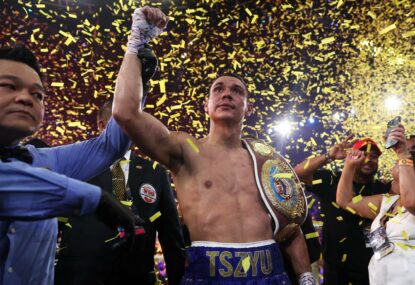
Here is a review of our boxers who made a splash in the world rankings over the past year.
After intense debate at Roar HQ, we’ve selected the 23 most controversial moments for 2023.