Give the coaches and players time to mature
By Todd Louden, 21 Apr 2009 Todd Louden is a Roar Rookie
- Tagged:
- Rugby Union, Super Rugby

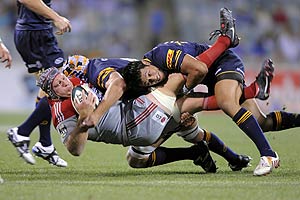
Crusaders' Thomas Waldrom is hammered into the ground by Brumbies players in the Super 14 rugby match at Canberra Stadium, Saturday, Feb. 21, 2009. AAP Image/Alan Porritt
With just four rounds remaining, the Super 14 round games are almost over. Yet, there is no clear favourites to win the title. The standard of this year’s competition is down and it is showing in the TV ratings.
In comments posted on the Roar, it seems that we have all been holding our breaths since the first round for the competition to kick into another gear of play and entertainment. No matter who we follow, it seems that our team has played more poor games than good.
Heyneke Meyer, an outstanding coach, has explained that the Super 14 has been diluted over the last two years by the number of players plying their trade in Europe. The New Zealand teams have been affected the most.
Eddie Jones has also commented that the standard has dropped away.
But why is this? Is it a product of the environment, the laws, or the coaching strategy?
Lets talk about the environment first.
Currently there are four new head coaches experiencing their first year at the helm. Add to this an additional five head coaches in their second year as head coach, and that is a lot of intellectual property that has walked away from the Southern Hemisphere’s premier rugby competition.
A good example of this is Ewen McKenzie’s departure from Waratahs.
He is smart coach who promoted a lot of young players into the backline last season. He has a wealth of Super 14 experience and, I dare say, given the standard of the competition this season, the Waratahs would have won it easily with Ewen in charge.
Money cannot buy experience, and it seems that unlike the player rosters at the various franchises, there is no succession planning of coaches.
This is a little silly given that the Super 14, I believe, is one of the hardest competitions to win on the sheer basis of the amount of travel involved.
Such is the nature of the business that new coaches, and those in their second year, need to establish themselves by getting results quickly. To do this, coaches will either consciously or subconsciously play for the win only.
And that is often conservative rugby, given their experience in the competition.
Reading many of the posts about the Australian teams, supporters are saying we have such great young talent but we are not performing. Look around the competition – the Waratahs, the Reds, the Brumbies, the Blues, the Crusaders, the Highlanders, the Bulls and the Cheetahs have all introduced a lot of young talent.
The exodus of players to Europe and retirement has left the competition poorer in mature skill, experience and game breakers.
If the young players can be retained, then the Super 14 in 2011, which also happens to be a World Cup year, will be a cracker.
There has been much debate about the ELV’s, but lets discuss their factual impact on the game.
Lineout quality possession has diminished considerably with less lineouts, a greater defensive contest focus, given the unlimited numbers in the lineout, and most teams are being forced to win the ball at number two in the lineout, which vastly limits the attacking options and ultimately gives the defence the upper hand.
There are a greater number of free kicks and penalties awarded against the attacking team and therefore some teams have conservatively stopped playing possession rugby and opted to play field position.
Add to this a subtle yet significant tactical increase in the defensive systems, which slow the ball up greatly at the tackle contest, and teams can play too much rugby with a young immature skill base giving the defence an advantage in tactics and in law.
Not being able to pass back into the 22 to kick into touch on the full has had a huge impact on the Australian teams, as generally we have not been a kicking nation.
Most of the Australian teams only have a one-kick strategy.
Most of the South African teams understand the concept of a three-kick strategy to manipulate the opposition to a point where they can attack. If you watched the Bulls against the Brumbies on Saturday night, they scored a classic try because they understood the three-kick strategy.
Kicks per game have risen to sixty and most are down the opposition’s throat. What has happened to the long kick and the weighted kick with good pressure?
It seems that the competition has gone contestable kick mad, which brought fair results early in the competition, but due to the defensive strategies applied by most teams, it has released more receivers to the backfield to play aerial ‘ping pong’.
Combine all of these points together, and a general conservative approach in this year’s competition to counter attack, and unfortunately supporters are turning away from the game disappointed with their team.
I read a lot about how good the Heineken Cup standard is, but like the Super 14, I have only seen a handful of great games so far.
My advice is to hang in there, give the coaches and the players time to mature their skills, strategy and confidence working towards the next World Cup, and we are going to see some great rugby.
Until then keep supporting your team – they need it! – and cherish the good games.
Enjoy sports? Enjoy a bargain? All Sports Online has your favourite sporting brands at up to 70% off. Online only, premium quality sporting goods and merchandise at discounted prices. Get a deal now.
- Explore:
- Rugby Union, Super Rugby

James Mortimer said | April 21st 2009 @ 2:43am | Report comment
Todd, based on your experience, you are an up and coming rugby coach.
Something I am not.
But you aren’t a rugby writer.
In the same way a rugby player irrespective of how good they were, can’t easily translate their skills to coaching, it seems the same applies from coaching to writing.
“With just four rounds remaining, the Super 14 round games are almost over. Yet, there is no clear favourites to win the title. The standard of this year’s competition is down and it is showing in the TV ratings.”
Right, we know the “round-robin” is almost over, but I would say that there is at least 2-3 clear favourites to win (chiefs, crusaders, bulls). But, what has the standard or TV ratings got to do with this??
“In comments posted on the Roar, it seems that we have all been holding our breaths since the first round for the competition to kick into another gear of play and entertainment. No matter who we follow, it seems that our team has played more poor games than good.”
Yes, we were holding our breath, but have you not watched the matches in the last couple of weeks. You would know Todd, more than most, that all seasons start slowly. Did you watch the Highlanders – Blues and the Crusaders – Sharks? These were solid games. Most kiwi supporters would agree that their teams are playing more “good” than poor.
“Heyneke Meyer, an outstanding coach, has explained that the Super 14 has been diluted over the last two years by the number of players plying their trade in Europe. The New Zealand teams have been affected the most.”
The New Zealand teams have been affected the most. I would argue most passionately that the New Zealand teams are affected the least, based on not only their table positions, but also their intuition to attack.
I do not mean to overly criticise Todd, but the lack of overall quality in both rugby commentating and writing really does frustrate me.
Editor’s note: James, Todd is a professional rugby coach who is sharing his insightful views on the game with our readers. Whether valid or not, focusing on writing style rather than substance is a bit petty. Let’s focus on the concepts at play guys.
Knives Out said | April 21st 2009 @ 3:26am | Report comment
Don’t throw stones in a glass house, James.
“With just four rounds remaining, the Super 14 round games are almost over. Yet, there is no clear favourites to win the title. The standard of this year’s competition is down and it is showing in the TV ratings.”
Mr. Louden is suggesting that the teams in the competition are uniformly bad, hence there are no clear favourites – which I would agree with. The bookmakers have the Sharks as clear favourites yet the losses they have experienced would suggest that they are far from unbeatable. Anyhow, the logic follows that if the compeition is continuously poor the interest will be reduced, especially as following the theory of Mr. Louden, the competition is nearly over and no team has yet stepped up to the plate as has occurred in previous tournaments.
“Heyneke Meyer, an outstanding coach, has explained that the Super 14 has been diluted over the last two years by the number of players plying their trade in Europe. The New Zealand teams have been affected the most.”
Clearly, what Louden is saying here is that the NZ teams have experienced the greatest playing losses. I’m not sure how you can come to the conclusion that there is a subtle criticism of the NZ brand of rugby in that statement?
Brendan said | April 21st 2009 @ 4:57am | Report comment
James
Are you a Pom? You seem overly precious about written English, something I noticed while living and working in England. I think Todd’s article is well written and explains better than anyone else, your columns included, what’s going on in this years S14 competition. He has explained succintly what he thinks the key issues are, which are clearly based on his former role as an assistant S14 coach and the article is well structured. In this sense he has clearly put some thought into it before putting pen to paper.
This is a rugby website mate not a Shakespearean forum so get of your high horse and try be a little less critical of people’s writing style next time.
Cheers,
pothale said | April 21st 2009 @ 6:55am | Report comment
Eh – that would be “get off your high horse”, Brendan. Tut, tut!
C’mon – James is perfectly entitled to criticise someone’s writing – I’ve done it often enough to him.
And he ain’t a Pom, Brendan. Couldn’t possibly be.
We’re just more picky about our language up here in the NH. We like sentences that are grammatical and make sense. Occasionally. Since anyone under the age of 40 doesn’t seem to know how to spell, you just have to live with it.
After that, it’s open season really.
(Your writing is very nice, by the way – you obviously sat at the front for Ms Markham’s English class and got gold stars every week.)
cosmos forever said | April 21st 2009 @ 7:45am | Report comment
Now that the grammar lessons are out of the way can I say that another factor Todd hasn’t mentioned (that compounds the pressure on players and coaches) is the length of the season.
Most other major competitions stretch to 25 rounds (even A-League is moving out to beyond 25 next season). 25 rounds allows a significant amount of time to build or lose momentum, try different patterns and build a culture within a team.
I mean – Todd played more games for the St Eddies First XV than these blokes do in a season!
Super 14 is over before you know it and only rewards the top 4. So any coach (especially young coach) who is looking for results actually has little alternative than to stick with the patterns the players have spent practicing in the off-season (longer than THE season) and hope they come off.
Not the only reason, but a significant one I think.
Becomes even more stark if you think of it in terms of the travel as well. Essentially each team has three or four mini-tours of only three or so games (Home, NZ, SA in the Aussie team’s case). Certainly no way to address significant failings in that kind to time of you are inexperienced.
stillmissit said | April 21st 2009 @ 8:41am | Report comment
Yes its an interesting article Todd particularly the 3 kick tactic.
I disagree with you about a couple of things.
Ewen Mckenzie would be in exactly the same spot as Chris Hickey due to the loss of Dan Vickerman and Rocky Elsom. I cant see much difference in tactics between both coaches.
If Eddie Jones thinks the standard has dropped in S14 then theres a good chance it is actually improving. This drop kick couldn’t manage or coach a bunch of 11 year olds. His insights into the game took Australian rugby to one of its lowest points and his disgusting treatment of the youngsters at the Reds should be a lesson to all Aussies about how NOT to act as a coach or a human being.
Our expectations of the Waratahs are high based on under performance by top (read expensive) players and coaches, lousy politics and poor administration in the past. As long suffering Waratahs supporters we have seen it all.
All we really want is one good season where we think that all the cogs are working in the right direction and the players live up to there hype.
stillmissit said | April 21st 2009 @ 8:44am | Report comment
Just one more point Todd.
If you turned up for a job that pays 400k a year and then tell the boss you need a couple of years before you can start to perform – I think I know which direction you would be headed in.
Sam Taulelei said | April 21st 2009 @ 8:59am | Report comment
I raised the exact same point before the season began that the biggest impact on the Super 14 wouldn’t be the ELV’s but the number of new coaches and how their teams would cope with making the transition from one regime to the next.
The competition has been diluted since RWC 2007 with so many players particularly from NZ emigrating to overseas clubs or retiring. James don’t be fooled by our teams placings on the ladder that we have been unaffected or affected the least by player migration. The overall standard of rugby played by all teams has dropped and it may not sway diehard fans from watching every week but for the fencesitters and casually interested the quality on offer isn’t going to hold their interest for long. For myself I pick and choose what games to watch instead of watching them all as I have in the past.
Historically the first half of the competition sees teams play more conservatively compared to the back end when teams begin to play more rugby and jostle for position in the playoffs and a critical home semifinal. Good analysis on the quality and quantity of ball from lineouts when opposition backlines are the furthest apart, the ELV where teams didn’t have to match numbers in the lineout has also limited the advantage of taking a 5 metre lineout to setup a drive to the tryline and that option isn’t taken as much as previously.
The 5 metre offside line from scrums was also intended to create more space for attacking backlines but that also hasn’t been realised as you’re running more at the space outside your opposite rather than at your man in the same way you attack from a lineout. This makes it easier for defences to drift or to rush up on the outsides and force the attacks back infield.
Enjoyed the insight and hope that this won’t be the last article from Mr Louden.
Yikes said | April 21st 2009 @ 9:14am | Report comment
Stillmissit – I think the (probably unintentional) subtext of Todd’s point might be that if Ewen McKenzie was still Waratahs coach, the attack coach would still be Todd Louden! Hence the Waratahs might be in a different place…
James Mortimer, if you are an aspiring rugby writer, one lesson you haven’t learned yet is not to be a wanker to the knowledgeable people in the game. Be critical of what happens on and off the field sure, but criticising Todd for contributing to “the lack of overall quality in both rugby commentating and writing” is a bit rich.
MikeN said | April 21st 2009 @ 9:45am | Report comment
Great to hear your point of view Todd, and it certainly gave me some very high level insights into the issues.
Where I am most frustrated is that presented with the issues you mention, most, and especially the Waratah’s, coaches seem to have decided on conservative strategies and options. But you can see in the Chiefs and now the Blues a realisation that the consertative strategies are not winning strategies and have turned their seasons around and are playing very entertaining rugby, solid and hard forward play mixed in with flair and an attacking mentality in the backs.
The other problem with the consertative strategy is that attacking flair, a very delicate thing, disappears very quickly when not used. The Waratah’s have gone so conservative, they now cannot get over the advantage line when they do get the ball, unless they kick.
The Red’s made the mistake of not ensuring they had that hard solid forward base in place before going on their attack at all cost crusade. At least the Waratah’s have the forward base in place, but we are all waiting to see some attacking flair, some thinking outside the box, some silky smooth skills that create confusion and stress in the opposition.
Most of us were aware of the Waratah’s coaching staff’s inexperience and were impressed with their early season approach especially as it got results. The issue most of us have had is they do not, after more than half the competition has been completed, seem to have any other strategies and the players are losing their skills and confidence when they have the ball.