Ignore Australian rugby history at your peril
By sheek, 19 Nov 2009 The Crowd is a Roar Pro
- Tagged:
- 1984 Wallabies, Australian rugby, Rugby Union, wallabies

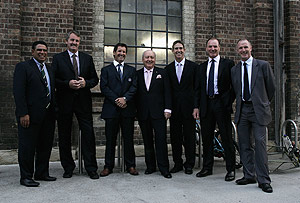
1984 Grand Slam Wallabies Mark Ella, Steve Williams, current coach Robbie Deans, Alan Jones, Roger Gould, Simon Poidevin and Andrew Slack arrive at the John Eales Medal Awards in Sydney, Thursday, Oct. 22, 2009. AAP Image/Sergio Dionisio
Some Roarers, most likely of the younger generation, have been exasperated and disparaging of older Wallabies fans dredging up former great players and teams.
Especially by comments that the 2009 Wallabies aren’t in the same league, errr make that union, as the 1984 Wallabies, who won the Grand Slam against England, Ireland, Scotland and Wales.
Fortunately, any thoughts of a comparison here are no longer relevant.
It’s a shame Australian rugby fans don’t pay more attention to their history. Ever wondered why New Zealand and South Africa continue to remain the consistently best rugby nations?
Part of the reason why Australia isn’t as consistently successful lies in poor national domestic structures that blight our progress to this day, but that’s another story for another day.
However, every time a new All Black or Springbok pulls on his country’s jersey, he is gripped by a fear of failure. A fear of failing to measure up to and maintaining the legacy of success of his predecessors.
Generally speaking, failure is not an option for the All Blacks and Springboks, and failure is seen as a great shame, even though rugby might only be a sport after all.
Australian rugby’s international record may not be of the same high standard, since we only began to be consistently successful from the 1980s onwards.
However, get away from the impersonal scorelines, and into the lives, characters and personalities of many of the individuals who have represented the Wallabies, and it’s a rich treasure-trove, believe me.
Although the Wallabies might not have been as historically successful as the All Blacks and Springboks on the scoreboard, quite often the individual stories of former Wallabies are far richer.
Read about the tragic Lonnie Spragg, or Snowy Baker, or Paddy Moran, or Tom Richards, or James Clarken, or Weary Dunlop, or Nicky Barr, or Stan Bissett, or Lloyd McDermott, or the Thornett brothers, or the Ella brothers, as just a few examples of this rich diversity.
We can ignore our history, in any field of endeavour, but only at our personal cost of knowledge, wisdom and enlightenment.
So who are our most successful Wallabies teams in history?
Usually, the 1984, 1991 and 1999 teams are put forward as the best three. The 1984 team won the Grand Slam, while the 1991 and 1999 combinations won the Rugby World Cup.
Realistically those three teams had a slightly longer reign: 1984-86, 1991-94 and 1998-2001. Personally, I prefer the 1984 team, not because they were necessarily the best, but they thrilled me the most with the breathtaking audacity of their backline play, and forward toughness.
The 1908/09 Wallabies to England and Wales, who also won the gold medal for rugby, were a good combination without being great. Britons rated them behind the 1905/06 ABs and 1906/07 Boks.
The 1927/28 Waratahs (so called because NSW was the only rugby union playing state from 1920-28) thrilled European fans with their breath-taking running rugby.
But they only won 3 out of 5 internationals.
The 1929/30 Wallabies were quite awesome, containing most of the 1927/28 mob. The beat the ABs 3-0 in 1929, and won a lone test against the Lions in 1930.
This team was led by the legendary flyhalf ‘galloping ghost’ Tom Lawton senior, whose grandson Tom Lawton junior, was hooker in the 1984 GS team.
This team also produced our first great front-row, comprising Wild Bill Cerutti at tight-head, Eddie Bonis at hooker and Eddie Thompson at loose-head.
The 1934 Wallabies won the Beldisloe Cup for the first time (inaugurated 1931) with the soon to be legendary war surgeon Weary Dunlop appearing in his second and unfortunately last test.
We didn’t win the BC again until 1949, but 30 of NZ’s best players were in South Africa. The 1947/48 Wallabies didn’t concede a try in the 4 internationals against the British and Irish teams, but overall only won 3 out of 5 internationals.
In 1963, under John Thornett’s leadership, the Wallabies split the series 2-2 with the Boks, and beat them again in both tests at home in 1965. The win at Pretoria in 1963 remains our last win at altitude in South Africa.
1975 saw a new attitude of aggression from the Wallaby pack, including famous (or infamous) names like Ray Price, Mark Loane, Tony Shaw and Steve Finnane.
Australia didn’t win the BC again until 1979 under the captaincy of the rugged Loane, and as 1980 came into view, a new generation of stars were about to build on the inconsistent but worthy success of their predecessors.
Like I said, we can ignore our history, but only at our personal cost. On the other hand, if you take the time and effort to read up on the old players and teams, there’s a rich treasure-trove waiting for you.
Us old-timers get frustrated because the current generation appear more interested in their bank balances than the rich personal history of the Wallabies jersey.
Enjoy sports? Enjoy a bargain? All Sports Online has your favourite sporting brands at up to 70% off. Online only, premium quality sporting goods and merchandise at discounted prices. Get a deal now.
Do you have what it takes to become a sports writer? Write for the roar
Rugby Union articles
- Will Super Rugby crowds continue their slide? (201)
- Will South African rugby force a Super 21 by 2018? (173)
- The real story of how John O’Neill turned Manchester City down (70)
- Dan Parks and the unsolved questions of expat rugby (65)
- Australian teams at Super disadvantage (58)
- Pocock set to be named new Force skipper (56)
- Can the ‘Tahs win the battle after losing the Waugh? (51)
- France turns to Parra and Trinh-Duc
- Rebels look to lift for formidable Blues in rugby trial
- Mr Fix-It Lucas wants to nail down No.10
- Force roost loses ‘Mother Hen’ Sharpe
- Victory beat Mariners with Kewell winner
- Waratahs romp to 83-5 trial win over Samoa A
- Quade Cooper’s return to the Reds goes up a gear
- Wales show Southern Hemisphere how to play running rugby (29)
- What opening matches of Six Nations taught us (19)
- Will Super Rugby crowds continue their slide? (202)
- Clinical Chiefs cost rusty Rebels in Corio (9)
- Six Nations shows rugby is a parochial game at heart (5)
- Goose’s Super Rugby up-and-comer XV for 2012 (29)
- What does the future hold for the Six Nations (50)
- Explore:
- 1984 Wallabies, Australian rugby, Rugby Union, wallabies

matt0931 said | November 19th 2009 @ 4:29am | Report comment
sheek that was one of the best write ups I’ve read on the roar and it really puts things into a bit of perspective and brings back some fond memories.
For me the greatest team was the 1999 world cup winning team. This is most likely not just because of the winning of the world cup but also because at the time I was living in South Africa.
I can still vividly remember sitting in a bar during the semi final when we beat them in extra time from that Larkham 48m drop kick. I was the only Aussie in the bar dressed in the green and gold (canary yellow) taking a verbal thrashing for the whole match right up to that kick…..Bliss
The amazing thing is that I rate that as one of the best rugby matches but there actually wasn’t a try awarded in that match. I say awarded because Greegan actually crossed thh line but the try was disallowed.
sheek said | November 19th 2009 @ 4:58am | Report comment
Matt0931,
Thanks for sharing your memories. Of course, the 1999 tryless SF is an example of how a game can occassionally be great without tries. But you wouldn’t want to see tryless matches too often!
matt0931 said | November 19th 2009 @ 5:06am | Report comment
agreed!
Rickety Knees said | November 19th 2009 @ 7:56am | Report comment
Great post Sheek – thanks for an outstanding contribution!
Personally – I stayed up and watched each game of the 84 series and just loved it. The demolition of the Welsh scrum and Campese turning Robert Ackerman inside out will stay with me forever.
Mate, have you read:
http://www.rugbyheaven.com.au/news/news/sos-to-irb-save-our-game/2009/11/18/1258219866531.html
matt0931 said | November 19th 2009 @ 7:09pm | Report comment
In came across this great footage this morning.
Mark Ella 1984 Grand Slam – 4 Tries in 4 Matches
http://www.youtube.com/watch?v=Z5FaS7JaHjU
sheek said | November 19th 2009 @ 8:18am | Report comment
RK,
Thanks for the link, very true. Has Mick Cleary been reading our Roar threads???
Rickety Knees said | November 19th 2009 @ 8:23am | Report comment
Probably – it would interesting to read what the NH Roarers have to say about his article
AndyS said | November 19th 2009 @ 4:56pm | Report comment
The line I particularly liked was:
“The decision to make the breakdown a fair contest for possession is killing rugby as a spectacle”.
I don’t know about you guys, but I get so sick of these folk from the NH constantly looking to turn the game into league…
LeftArmSpinner said | November 19th 2009 @ 8:39am | Report comment
Sheek, for a second there, i thought you were going into the third tier “argument” again, and I just hate that any any reference to a third tier. It will become the engine room of Australian rugby, eventually, but not it is positioned as third in line.
so, great post. I agree with it. specifically, the 1984-86 team, i was lucky enough to attend the 4 GS games in 84 and the Baa Baas. And to make it even better, I knew and had played with some of the players. So, I watched their progress intently. In 1984, they were rusty in the England and Irish games, hit it big in Wales and then cut loose in the scotland game.
They were not perfect. For example, Slack had never struck me as a great player, but seemed to have been a good leader. He seemed to lack foot speed, but it didnt really matter because the ball was the weapon that broke the defensive line and then it was a matter of using the over lap. Lynagh was playing out of position and in a different culture and style of play. That didn’t matter either.
The 1984 team played hard, the developed self belief. The same goes for the current team. they have to do the same and appear to be doing this now that the dead wood is gone. However, the current team can learn from the 1984 team about using and respecting possession.
Scotty iin Devon said | November 19th 2009 @ 9:15am | Report comment
Great article, and yes I think we are too quick to ignore our history compared to our 3N rivals. For me its a dead heat between the 1991 and 1984 teams – can’t choose between them. I have a supporters jersey from 1984 or so and to look at it always brings great memories flooding back.
sheek said | November 19th 2009 @ 9:19am | Report comment
Perceptive Leftie,
As you know, I am a great Ella fan, but taking the captaincy off him in 1984 was the RIGHT decision. This allowed him to concentrate on creating tries, without the leadership worries that went with the job of captaincy.
Slack was the Eisenhower of Australian rugby. Eisenhower wasn’t the best soldier-general, but he was the best at co-ordinating & delegating, of getting everyone to work as a team for the greater good. Ditto Slack.
I do disagree Lynagh was playing out of position (technical point, I know). He had all the skills to play inside-centre just as well as flyhalf, & it would have been lovely to see Ella at 10, & Lynagh at 12, from 1984 through to say 1987. Sadly, it didn’t happen.
Getting back to captaincy, I do think Elsom has the makings of a fine leader.
Spiro Zavos said | November 19th 2009 @ 9:37am | Report comment
Sheek, a terrific article. I’d also include the 1910 Wallabies in this list of great teams. They lost the first and third Tests at Sydney to the All Blacks. But won the second Test 11 – 0, one of the few occasions ever and the first when an All Blacks side has been held scoreless in a Test. It was also only the second Test the All Blacks had lost out of 16.
The Wallabies had been decimated by defections to rugby league. There were two Queenslanders in the side, P. Murphy and F.Timbury, both second-rowers. I always think that some tough Queenslanders are vital in Wallaby packs, and these two did their job well that day.
Australian rugby needed this victory to allow supporters the hope that the game could remain credible internationally despite the fact that most of the 1908 Wallabies were playing rugby league. In fact, ‘Dinny’ Campbell and Bert Gilbert, two of the better Wallabies in 1910 both went to England later on to play rugby league.
Hopefully the ARU will commemorate this victory next year with something special like a Bledisloe Cup Test at the SCG, the sacred site of the victory against the All Blacks.
Firestarter Bob said | November 19th 2009 @ 9:55am | Report comment
That 1910 match reads like it should have been subject to a match-fixing inquiry! Never trust game 2 of a 3 game series in any sport!
sheek said | November 19th 2009 @ 10:15am | Report comment
Yes Spiro,
I’ve read your books (one of them) where you thought the 1910 second test win was Australian rugby’s Thermopylae!
In context, it was a very perilous time for Australian rugby, but largely self-inflicted, I would hastily add.
In the preceding year we lost roughly half the 1908/09 Wallabies to league plus Messenger the year before that.
AC said | November 19th 2009 @ 3:24pm | Report comment
Speaking of history, how many people nowadays do you reckon know the relevance of Thermopylae?
Sam said | November 19th 2009 @ 12:44pm | Report comment
The All Blacks lost 3-0 to Wales in 1905 – although maybe you are forgetting they were scoreless because of Bob Deans’ no-try?
Jim Boyce said | November 19th 2009 @ 10:49am | Report comment
Sheek – A minor correction the 1963 wins were at Newlands and Ellis Park , not Pretoria. Good article . I agree with you re the 1984 team, while they won the Grand Slam, I think the non-international matches had a strong moulding influence.It was also an opportunity for Slack to put his mark on the captaincy.
Frank O'Keeffe said | November 19th 2009 @ 5:21pm | Report comment
Jim Boyce,
Can I ask: looking back at the 1963 Australian teams and the 1963 South African side, I noticed Frik du Preez wasn’t playing in the South African side for the 2nd, 3rd and 4th Tests. Do you know why he wasn’t playing? I’ve heard du Preez was occasionally dropped by conservative selectors who felt he didn’t do enough work in tight, because apparently du Preez liked to run with the ball in the open. Was he injured or dropped or what happened to him?
Can I also ask: what were your thoughts on how the referee performed in the 4th test, in particular with regard to the line-outs? I read that Danie Craven complained in newspapers after the historic 3rd Test that Australia were barging through in the line-out, and during the 4th Test Australia was being pinged alot.
The best footage the ABC contains of the 1963 Wallabies is 18 minutes from the famous third Test, so it seems all I’ll be able to know of that series is what former players recall of it.
Frank.
Jim Boyce said | November 19th 2009 @ 7:46pm | Report comment
Frank – Frik du Preez was on the outer. The second rowers were Avril Malan and Stompie Van der Merwe, the latter I cant visualise.De Preez did like to run with the ball but in the match against Northern Transvaal which we drew he did not have a good game.
The 4th Test was a strange game, we ran with a howling gale in the first half and Myburgh did take a different line to the other matches. I dont remember the lineouts being adjudicated in a different way. The ground had none of the atmosphere of Ellis Park and Newlands.
The Third Test was the greatest game I was involvedi in. There were so many small things that were done right by individual players. Nearly impossible to pick up in the 18 minutes footage available. We had played on that ground twice before and it had a really familiar feel. The dry hard surface really suited us and we were tuned up for the high altitude and the long carry of the ball. Certainly in the backs each of us were happy we had the measure of the person we were marking.
Frank , thanks for the memory.
sheek said | November 19th 2009 @ 8:25pm | Report comment
Jim/Frank,
There’s a wonderful site I came across some years ago called ‘Genslin rugby’, put together by a US domiciled Saffie. It’s an enormous effort of love where he has detailed every Bok team ever, including personal details, etc.
On a pen-portrait for du Preez, there’s a comment from Dr. Danie Craven who begins by saying, “frik was basically a lazy man by nature…..” Or words to that effect.
Jim,
if you’ll excuse the “what if, could’ve, would’ve” tone, the potential for that 1963 team was staggering, considering players absent due injury, study, work, defections to league, etc.
For starters your twin brother Stu was unavailable, I presume. Jim Lenehan was injured in Perth on the way to SA, so never toured. Rod Phelps retired the year before but at 28 would have been still young enough.
Big, tough Tony Miller was unavailable due work & also because I think he had a young family to look after. Des Connor, feeling unwanted, was feeding the scrums for the All Blacks!
Last but not least, the mighty Kangaroos left for England & France later that year with 6 ex-rugby union players – Ken & Dick Thornett, Mick Cleary, Jimmy Lisle, Kevin Ryan & Arthur Summons, who captained the Roos.
Only Ken Thornett didn’t hang around long enough out of this group of 6 to also play for the Wallabies. I perhaps can also mention goal-kicking flanker Geoff Chapman, who went on to become a leading race horse trainer many years later.
My by count, that’s an extra 12 players – 8 backs & 4 forwards – that would have made that 1963 Wallabies side even stronger. The only problem would have been deciding who to put into the final XV!
Frank O'Keeffe said | November 19th 2009 @ 9:00pm | Report comment
Jim,
Thank you for your response. Just in case you were wondering why I was asking about the refereeing performance of Piet Myburgh, this is a passage from Max Howell’s ‘Wallaby Legends’:
“Danie Craven, a master tactician, was quoted in the paper as saying that Australia was cheating in the set pieces, and this certainly seemed to have an effect on the referee, Captain Piet Myburgh. In the first half the Wallabies could not get any momentum through the tooting of his whistle. Catchpole said, “It was staggering. We would have the game otherwise.”‘ p.27
However, if you felt the refereeing towards the line-outs was fine, then that’s what I’ll accept.
The 1963 side sounds like a wonderfully balanced side between Rob Heming in the line-outs, breakaways like Davis and Guerassimoff, White-Johnson-Thornett in the front row, Hawthorne and Catchpole, and Beres Ellwood in the centres. I vaugely recall you once saying Ellwood set you up for a try in the second test. It’s a shame the ABC doesn’t have full footage of the 3d Test, sounds wonderful.
Sheek,
I love the website ‘Genslin rugby’. Recently I’ve been reading about Mannetjies Roux (who didn’t play in the 1963 Springbok side), but there isn’t a lot written on him. I logged onto Genslin and found a nice article about him and the things Danie Craven said of him. Roux sounds like a tremendous player. I’d have also liked to have seen the 1963 series to see what John Gainsford was like. I’ve heard Spiro speak highly of him, as well as others.
sheek said | November 19th 2009 @ 9:16pm | Report comment
Frank,
Saffies that I know (& I don’t know that many) always pick Gainsford & Gerber as their best-ever Bok centres, at least going back to the end of WW2.
For a second pairing, Mannetjies Roux & Joggie Jansen, who destroyed the ABs in 1970 with their ferocious tackling, would make an excellent backup. I also discovered from Genslin rugby that Mannetjies is Afrikaans for “little man”.
Jim Boyce said | November 20th 2009 @ 7:40am | Report comment
Sheek/Frank – A few points, taking last first. Mannetjies Roux did play in the 2nd Test but was erratic and subsequently dropped. He also toured in 1965. On his good days he was probably great but he often went missing.Gainsford was quality both in 1963 and 1965. The Boks now seem to play that kind of player in the loose forwards eg Spies.
Secondly, in the 2nd Test, Hawthorne hurdled a tackled Ellwood to pass inside to me. Engellbrecht remained on his right wing, which left me with an open run.
Thirdly , it wasn’t so much the lineouts but the inceesant whistle which meant you couldn’t build up pressure. To play against that wind in the second half you needed at least 10points start.
Lastly, there were a number of players like my twin brother ,Stewart , who were not available. Stew had medical exams.
I must have a look at ‘Genslin Rugby’, Frik Du Preez had enormous support from Northern Transvaal but he was a bit like Roux, who also came from there, his talent came too easily.