English football is awash with stars – and debt
By Mike Tuckerman, 19 Jan 2010 Mike Tuckerman is a Roar Expert
- Tagged:
- carling cup, EPL, football, World Football
Related coverage
- Football news
- World Football - EPL, Champions League & Europe news
- EPL - English Premier League news

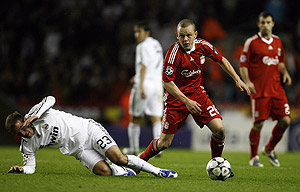
Liverpool's Jay Spearing during their Champions League second round, second leg, soccer match at Anfield Stadium, Liverpool, England, Tuesday, March 10, 2009. AP Photo/Paul Thomas
It’s not often that the Carling Cup semi-finals take on major significance in England, but then it’s not often that the world’s richest club takes on the world’s most indebted with a place in a knock-out final at stake.
That the two teams hail from one of world football’s traditional hotbeds makes tonight’s Carling Cup showdown between Sheikh Mansour’s Manchester City and the Glazer family’s Manchester United all the more intriguing, as the nouveau riche of Eastlands face off against their city rivals.
The match – postponed due to last week’s inclement weather – takes on added significance thanks to the growing alarm at plans by the Glazer family to sell and lease back Old Trafford and United’s Carrington training ground in a bid to refinance their mounting debts.
So incensed are some supporters that they’ve asked Sir Alex Ferguson to resign in protest, and whilst the vocal few might represent just a fraction of United’s global fanbase, there’s no doubt that a growing sense of unease is creeping across the English game.
It comes in part because UEFA has vowed to crack down on heavily indebted clubs – a decision that has reputedly earned the seal of approval from Chelsea’s billionaire benefactor Roman Abramovich.
Chelsea are just one of number of top flight English clubs that could see their spending reined in, but the move could come too late for Portsmouth – winners of the 2008 FA Cup final.
Faced with a winding up order and crippled by seemingly insurmountable debts, the troubled southern club have thrice failed to pay player’s wages this season and have now seen a transfer embargo slapped upon them.
They may have once paid top dollar for the likes of Glen Johnson, Sol Campbell, Sylvain Distin, Lassana Diarra, Niko Krancjar and strikers Peter Crouch and Jermain Defoe to call Pompey home, but they did so in the Premier League’s smallest stadium, with matchday revenues failing to cover the massive wage bill.
Former Portsmouth coach Harry Redknapp – who moved on to Tottenham and gutted the Pompey squad in the process – now oversees a Spurs side looking to move away from their own 36,000-capacity White Hart Lane home, as they too look to keep up with the big spenders of the English game.
It’s a similar story across the division as Liverpool supporters grapple with their bickering American owners, West Ham United search for new investment and Arsenal continue to pay off their Ashburton Grove home at the cost of the big-name signings fans crave.
English football may be awash with talent, but it’s also burdened by a mountain of debt, and things will only get worse if the next TV rights deal comes complete with a bargain-basement price tag.
Of course, it’s not just English clubs that are feeling the credit crunch, with plenty of sides in La Liga and Serie A poring nervously over their accounts.
But it’s the lure of the Premier League that continues to attract both sponsors and sheikhs alike, keen to cash in and generate funds or fame by association.
How much longer that continues is a question many fans in recession-hit England are now asking, with the bubble seemingly set to burst on the halcyon days of Premier League spending.
It’s often seen as a hindrance, but while the A-League’s salary cap might prevent clubs from signing global superstars, it also ensures that teams won’t disappear overnight.
I doubt there’ll be too many thinking about that when Roberto Mancini’s side run out at the City of Manchester Stadium, but perhaps it’s a point worth considering when the world’s latest “richest club” takes on one now heavily in debt.
Recommend this story.
Follow Mike on twitter @Mike_Tuckerman
The Turkey 10
The Turkey 10 teams have now been selected, as Wild Turkey Bourbon's sport sponsorship kicks into the next exciting phase.
Choose which side you're going to support and get in the running to win $2,500!
Simply visit Wild Turkey Australia on Facebook for your chance to win.
Find out more.
- Explore:
- carling cup, EPL, football, World Football


January 19th 2010 @ 7:31am
MV Dave said | January 19th 2010 @ 7:31am | Report comment
Some salient points raised. In ManUs defence l would point out that the owners have put the club into massive debt by putting the loan they used to buy the club back onto the club. The club itself is the most valuable sports franchise in the world (according to Forbes magazine) and has both a massive turn over and decent profit (42 million pounds last season from memory). They ave 75,000 per home game with well over 2 million spectators watching their home games alone each season. The new tv deal is only in the 1st of its 3 year contract (from memory) and all up tv money is aound $2.5 billion a year. Nevertheless the FA have plenty to do in stabilizing a difficult situation with several clubs struggling as a result of overstretching themselves trying to keep up with the rest. Overall attendances are holding up well and it is a WC year so interest is still very high.
It is not the first time the national game has faced huge issues (abolishment of minimum wage, hooliganism, crumbling stadia, lower attendances, clubs on the brink) and no doubt wont be the last. In a sense the game has become too big for its own good…the huge amounts of money coming into the game is going out just as fast. At some point the question of salary caps may well become very attractive to owners but l’m not sure that point has been reached yet. New UEFA regulations on debt may well have the desired effect, we will have to wait and see. Has this expotential growth surge been good for the game…you may well get a different opinion from supporters of Portsmouth vs those of Man City.
BTW for the record ManU to beat Man City 5-3 aggregate over the 2 legs (it was 4-3 to City back in 1970 when they last met in the semis) and l cant wait for tomorrow mornings 1st game at City of Manchester Stadium. Ahh the joys of Foxsports
January 19th 2010 @ 11:17am
Art Sapphire said | January 19th 2010 @ 11:17am | Report comment
MV Dave – “the Glazers bought the club for £810m. The Glazers paid £270m themselves, borrowing the other £540m from banks and hedge funds. In the four years up to the latest accounts to 30 June 2009, United became liable to pay more than £325m in interest alone, yet the interest they have not paid, plus fees, has increased the debt the Glazers loaded on to United to £700m”
Any profit Man U makes goes to servicing ever increasing debt. The profit they made last year was mainly due to the sale of Ronaldo. Who else is worth that sort of money at Old Trafford? The 500m pound bonds issue is just a way of replacing one type of debt with another – they are promising to pay investors a 9% annual return for 7 years. If you were a financial institution would you take the risk. Unless Man U find more ways to shaft their own supporters and find new revenue streams, I can’t see how the Glazers can keep a lid on things.
January 19th 2010 @ 12:21pm
Rhys said | January 19th 2010 @ 12:21pm | Report comment
The only reason the rags made 40m profit last year was because they sold Ronaldo.
Who will go this year to pay the bills?
January 19th 2010 @ 2:04pm
Simmo said | January 19th 2010 @ 2:04pm | Report comment
Roon-ay Roon-ay Roon-ay
January 19th 2010 @ 10:43pm
Colin N said | January 19th 2010 @ 10:43pm | Report comment
It’s interesting to note that the profit also includes the interest that has to be payed back, which still makes impressive reading. If the Glazers hadn’t have come in (which is of course hypothetical) and all the revenue streams were as they are now (so ticket sales etc) then Manchester United would have made a profit of £91m, even without the sale of Ronaldo.
Two years ago, Man Utd made an operating profit of £80m, but because of the interest, the debt increased by £16m.
January 19th 2010 @ 3:53pm
Jay said | January 19th 2010 @ 3:53pm | Report comment
I remember reading that the New England Patriots were the most valuable sporting franchise… there a fair chunk of american sporting teams in the top 10
January 19th 2010 @ 6:38pm
GC_Clint said | January 19th 2010 @ 6:38pm | Report comment
Hah, I havent even heard of the New England Patriots. Out of the American sports I would have guessed the Yankees or the Lakers
January 19th 2010 @ 9:11pm
MV Dave said | January 19th 2010 @ 9:11pm | Report comment
Sorry Jay Man Utd are the most valuable sports club in the world… Not bad for a club in a country of 50m vs the US over 300m.
http://www.forbes.com/2009/01/13/nfl-cowboys-yankees-biz-media-cx_tvr_0113values.html
1 ManU US$1.8b
2. Dallas Cowboys $1.6b
3. Washington Redskins $1.5b
January 19th 2010 @ 9:23pm
McLovin' said | January 19th 2010 @ 9:23pm | Report comment
These things change year to year.. and who hasnt heard of the patriots? Tom Brady and Gisele Bundchen ring a bell?
There generally more NFL teams over $1b and in the top 10 than football teams.. and from what i know, they dont have the debt problems that football clubs do/
January 19th 2010 @ 9:27pm
MV Dave said | January 19th 2010 @ 9:27pm | Report comment
So there should be more US teams in the top 10 as they have 6 times the population… and the people who put the debt on ManU are Americans…conspiracy!
January 19th 2010 @ 9:31pm
McLovin' said | January 19th 2010 @ 9:31pm | Report comment
But Man U have a more global reach, especially in Asia.. football is also the biggest game in the world.
Man U also play more games a year (the carling cup should be a cracke), with FA, Champions, EPL, World ClubChallenge
January 19th 2010 @ 8:48am
Gabriel Knowles said | January 19th 2010 @ 8:48am | Report comment
It’s definitely adds an extra element to Manchester derby these days which from a neutral perspective is great.
I wrote about this subject a little over a year ago for Inside Sport and I’ve followed it pretty closely ever since. It’s pretty fair to say there’s a bit more to it than English football being burdened by a mountain of debt. For starters it’s unlikely that EPL television rights are going to be undersold any time in the near future, in fact they’re still commanding even bigger sums as more and more countries around the world (particularly in Asia) jump aboard the bandwagon. Add to that the insatiable desire from multi-nationals to sponsor teams and the problem isn’t for lack of money coming in – the problem is with how that money is managed.
The problems faced by Portsmouth, Man United, Liverpool, West Ham and Leeds of years gone by are due to financial mismanagement at board level rather than outside forces such as the recession. Arsenal are not so much in a predicament that doesn’t allow them to sign big names as opposed to having made a clear decision some years back to build a new stadium that would ensure their long term viability. A decision vindicated by the fact that their match day revenue is the highest going, sure they’ve had a few trophy-less seasons but they aren’t saddled with leveraged debt and are widely considered to be looking good to become real force again, if they aren’t already. Everton are another case in point for solid financial planning. Rather than breaking the bank on expensive signings a la Spurs they’ve put together a decent and competitive squad while they prepare to build a new stadium. Obviously it’s a long bow to draw but which club would you rather was yours in a few years time?
In short there may well be some casualties but the EPL isn’t slowing down just yet, it’s just too popular. La Liga will keep going strong but they need to address the fact that clubs negotiate their own media deals as the difference between what Real and Barca command compared to the rest is disgusting (We’re talking nearly 100 million Euro difference here). If anything the German model is the one to follow, Bundesliga teams can be docked points for not meeting financial requirements and the club itself must keep a majority stake so as to stop it being completely sold and keeping the playing field relatively level.
That’s where the A-League should be looking towards for pointers.
January 19th 2010 @ 9:03am
Simmo said | January 19th 2010 @ 9:03am | Report comment
I agree with the notion that Arsenal is the only big club that has spent wisely by borrowing to invest in an income-generating asset (the much bigger stadium). Other clubs have borrowed and used the borrowings as if it was income to be spent on wages and transfers.
I think if the bubble bursts the Arse will be the best placed to profit.
January 19th 2010 @ 8:59am
Simmo said | January 19th 2010 @ 8:59am | Report comment
I don’t think this can be understated. The EPL is a bubble economy.
Here’s an artcile from a week ago on the Beeb:
Former Birmingham owner David Sullivan has revealed his shock at the state of Premier League clubs’ finances.
“The state of the finance of football is frightening, that’s all I can say,” Sullivan told BBC Radio 5 live.
“Many clubs have pre-sold their Premier League income and TV money, and have borrowed against season-ticket money.”
Sullivan, who sold his Birmingham stake to Hong Kong businessman Carson Yeung last October, says a Premier League club could go out of business soon.
Over the past three months Sullivan has been looking into the finances of 20 clubs, including West Ham, with a view to getting back into football.
He is unable to talk about his interest in West Ham after signing a confidentiality agreement.
But, having looked in greater detail at the way other clubs are run financially, Sullivan believes it is possible a Premier League club could go out of business.
“I think there’s a possibility one (Premier League) club could go and I think probably odds-on one club will go,” said Sullivan.
“There are several Championship sides absolutely on the line at the moment. It’s a question of whether they can sell players for sufficient money to stay alive.
“But there’s not a lot of money out there to buy players at the moment. Even some of the clubs who you think have got money really haven’t got much money to spend on players.”
http://news.bbc.co.uk/sport2/hi/football/eng_prem/8453337.stm
January 19th 2010 @ 9:08am
Gooner said | January 19th 2010 @ 9:08am | Report comment
Advice for Man Utd fans from a sypathetic Gooner:
The Glazers won’t be put off by any amount of chanting or banners – they cannot see or hear them from the USA.
Ferguson won’t quit the job that he has had and loved for so long either.
The only thing that will shift the Glazers is if they cannot get the bond issue off the ground and the only thing that will spook the bond investors is any uncertainty about ongoing revenue. These revenues come mainly from TV which the fans cannot impact, but which will fall next year anyway, and also from merchandising and ticket sales, which the fans can impact.
The best strategy therefore is:
1) boycot all official merchandise – try buying unofficial Gold and Green instead (the old colours)
2) start a petition warning that thousands will not renew season tickets next season – realistic given the probable increase in price and hatred of Glazers, as well as the lack of any waiting list any more.
3) Lobby all potential bond investors warning them of a massive imminent revenue blip if Glazers stay.
It is either this strategy or you follow Leeds, Portsmouth … oh and Liverpool .. down the drain.
January 19th 2010 @ 9:14am
Art Sapphire said | January 19th 2010 @ 9:14am | Report comment
A Tale of 2 Manchesters –
United bought out by greedy egomaniacal yanks with borrowed money.
700m pound of debt.
Interest payment last year to service debt – 67m pounds
Sale of Ronaldo – 80m pounds
Increase in ticket prices over the last 5 years – 40%
So in order to service the debt Man U have sold their most valuable asset and are shafting their supporters who have in the past paid somewhat affordable ticket prices (for the EPL) to fill up a 75K stadium.
They don’t have another Ronaldo to sell. Fergie’s hands are tied in regards to strenghthening the sqaud.
Meanwhile, the blue half of Manchester have a wealthy sheikh with bucketloads of money to spend on the team.
Man City’s trophy cabinet might be relatively empty but at the moment they don’t look like having to sell it anytime soon.
The same can not be said about Man Utd. The owners have already mooted selling the training ground and leasing it back to the club.
These 2 pieces from the Guardian are quite illuminating
http://www.guardian.co.uk/football/blog/2010/jan/12/manchester-united-glazers-debt
http://www.guardian.co.uk/football/blog/2010/jan/13/manchester-united-finances-glazer-family
January 19th 2010 @ 9:15am
True Tah said | January 19th 2010 @ 9:15am | Report comment
This whole situation is an example of the lack of patience people have these days. Previously people and businesses would build up capital/savings over time, living well within their means.
Nowadays, we seem to live in an era of consumption without patience, its too easy to get money under credit, and people these days do not have the patience to save money up.
Having said that, Chelsea is in not such a bad shape…I understand the majority of the debt is a loan from the shareholder (Abrahamovich), and is virtually quasi-equity. He is not going to call in his debt anytime soon, and one suspects this may be why he supports these changes.
January 19th 2010 @ 10:47pm
Colin N said | January 19th 2010 @ 10:47pm | Report comment
Chelsea aren’t actually in debt anymore, as Abramovich has converted those loans into shares.
Liverpool are (I believe) in £300m debt, but similarly to Chelsea, those are loans owed to Gillette and Hicks, but it remains to be seen if they convert them into shares.
January 19th 2010 @ 9:30am
Simmo said | January 19th 2010 @ 9:30am | Report comment
There’s a fan site dedicated to keeping an eye on the state of the football economy and the finances of individual clubs
http://www.footballeconomy.com/
January 19th 2010 @ 9:40am
Australian Football said | January 19th 2010 @ 9:40am | Report comment
Being a supporter of Chelsea FC since 1972 I don’t care what happens after we win the treble this year, that will fulfil my commitment to the club as a long time suffering Chelsea FC supporter when I once lived near by Stamford Bridge in 1972.. C’mon you Blues get over the line so I can concentrate on my Australian clubs SFC and GCU FC for the remaining years of my life…
~~~~~~
AF
January 19th 2010 @ 9:54am
Rellum said | January 19th 2010 @ 9:54am | Report comment
I look forward the new requirements for the Champions league, Michel Platini’s “Financial Fair Play” .
http://www.timesonline.co.uk/tol/sport/football/european_football/article6991138.ece#cid=OTC-RSS&attr=796995
I will be a good start to reduce the gap between the top and bottom clubs and hopefully reduce many clubs ballistic spending. The French and German leagues would suddenly become the power house of the UCL,
The interesting thing for me is how will clubs like Roma fit into these new rules. Roma actually runs at a profit but the owners, the Sensi family, have huge debts in their other business interests have to keep selling players to keep the Sensi’s empire afloat. I would assume Roma would fail the new rules because their situation is similar enough to United’s, but different enough for me to ask the question. Maybe these regulations will force wealthy benefactors out of the game.
January 19th 2010 @ 11:42am
Al said | January 19th 2010 @ 11:42am | Report comment
You’d be hard pressed to find a club suffering more than Stockport County right now. The club went into adminstration over half a year ago and still need to pay off 300,000 pounds worth of debt. Their training ground has been put up for sale and they are odds on certaintities to be going down a division next season. It doesn’t look like the club will actually survive that long.
January 19th 2010 @ 10:51pm
Colin N said | January 19th 2010 @ 10:51pm | Report comment
But that’s their own fault though. The Manchester United fans didn’t want Glazer and I’m not sure whether the board did either. The breakthrough for Glazer came when McManus and Magnier sold their shares to him, leaving the door open for a takeover.
I would do exactly the same thing though if I was in McManus’s and Magniers position as they got a £70m profit from it.