Dave Warner is right, batting right or left-handed
By Spiro Zavos, 26 Feb 2010 Spiro Zavos is a Roar Expert
- Tagged:
- Australian Cricket, Bruce Oxenford, Cricket, David Warner, Rod Tucker, Twenty20

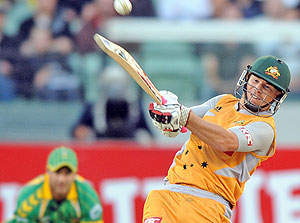
Australian batsman David Warner strikes the third of his 6's against South Africa during the KFC Twenty/20 match at the MCG in Melbourne, Sunday, Jan. 11, 2009. (AAP Image/Joe Castro)
The umpires were wrong to stop Dave Warner, generally a left-handed batsman, from shaping up right-handed in the last Twenty20 match against the West Indies and then belting the next delivery by switching to his left-hand stance.
The argument used by umpires Bruce Oxenford and Rod Tucker to stop this ploy was that the West Indies would have to chop and change the field all the time, and that this would waste time.
There is no actually law against what Warner proposed to do. The umpires resorted to that good old stand-by, “not in the spirit of the game.”
The fact is, what Warner did was exactly in the spirit of the game in that it was clever, put the bowlers at a disadvantage with their field placings and was effective in creating space on the ground for him to send the ball scuttling over the grass, and occasionally over the fence.
Warner pointed out that bowlers are allowed to decide whether they bowl over or around the wicket and that he was merely adopting the batting equivalent of this.
This is true, of course.
He could have made the further point that fast bowlers come in and sometimes bowl slower balls: legspinners have the googly, and some off-spinners bowl the doorsa, a leg-break with the off-spin action.
The point here is that these bowlers change what they are supposed to be doing. These changes are regarded as certainly within the spirit of the game, and the same tolerance should be allowed for Warner’s great gift of being able to switch hit from either side of the wicket.
For me, switch-hitting is no different from a bowler trying to deceive a batsman with a different type of delivery from his normal stock ball. Or bowling with a different hand.
I played some cricket many, many years ago with Bob Blair, a good fast bowler for Wellington and New Zealand.
Like many quickies of his day (Freddie Truman was another), Blair used to throw the ball in left-handed. Presumably this was done to preserve their bowling shoulder. Blair was so proficient with his left hand that occasionally in club matches he’d bowl an over or two of left-arm spinners.
This switch bowling, in my opinion, enhanced the game and was entirely within its spirit. Warner’s switch hitting similarly enhances the game. It produces problems for the bowlers and opportunities for batsmen who can make the switch hitting come off.
The umpire only needs to establish what side Warner or whoever is going to shape up. The batsman must hold this stance as the bowler comes into bat.
When he makes his switch he remains liable to dismissal LBW, say, if the ball is pitched correctly in terms of his original stance and hits him in line.
Mickey Mantle was one of baseball’s great switch-hitters, with great power from either side. Warner has the talent to become Twenty20s Mantle equivalent, as the Twenty20 game becomes increasingly like baseball, without the longeurs that baseball fans have to endure.
Enjoy sports? Enjoy a bargain? All Sports Online has your favourite sporting brands at up to 70% off. Online only, premium quality sporting goods and merchandise at discounted prices. Get a deal now.
- Explore:
- Australian Cricket, Bruce Oxenford, Cricket, David Warner, Rod Tucker, Twenty20

Matthew Maguire said | February 26th 2010 @ 4:59am | Report comment
Bowlers choosing to bowl over or around the wicket is not the equivalent of switch hitting, given a bowler must advise the umpire and in the turn the batsman, of his plan before the ball is delivered. The bowler should have a reasonable expectation of a fair contest between bat and ball and set a field accordingly.
Switch hitting is legal and Im not sure what the umps thought they would achieve on Tuesday in trying to stop Warner’s tactics. However, I hope before too long that a rule adjustment is made. It is not in the spirit of the game and if there is one sport left in the world where fair play should still exist, please let it be cricket.
Lee said | February 26th 2010 @ 5:47am | Report comment
Spiro’s other point is valid though…bowlers can change their delivery from leg spin to off spin, or from pace to spin without informing the batsman. The Batsman has to rely then, on his ability to read the delivery. Why can a batsman not make a similiar change, and force teh bowler to rely on his own ability?
Brett McKay said | February 26th 2010 @ 7:19am | Report comment
This is a really interesting little dilemna that Warner has created, for all parties actually. I can see the point he’s trying make about bowlers switching from over to around the wicket and so on, but then the umpires are also correct in that this switch has to be announced upfront. We’re to believe Warner then annouced that that he would take strike right handed, which he did.
The problem for me though is not so much with this move, but rather when he switches as the bowler is running in. A bowler can’t run in over the wicket, and then at the last minute switch to and deliver from around. Similarly, I’m not sure they can switch from right-arm to left-arm without announcement. I think the umpires in this case (and I’m happy to be corrected if need be) are obliged to call ‘dead ball’ at least, and possibly even ‘no-ball’.
Comparisons were made with what Kevin Pietersen started doing about 18 months ago, where he started reverse slog-sweeping spinners for 6 over point. The difference here though is that Pietersen essentially just played a reversed shot, but while still maintaining his right-handed grip, and going into the shot as the ball was bowled. This was what was ruled to be fine. Pietersen started and played his shot as a right-handed batsman. Warner changed everything: his stance, his grip, and the shot, from left- to right-handed, and this is where I think the umps might have it right.
Again, I’ve got no issues with the reverse shots, or even Waner announcing that he will take strike right-handed. But his over/around the wicket analogy falls over when he switches from left- to right-handed after the bowler has commenced his approach..
formeropenside said | February 26th 2010 @ 7:30am | Report comment
Does anyone remember the laws about no balls in relation to bodyline? Three fielders behind square on the legside I think it is. Thus a fielding side might HAVE to change the field just to deliver a legal delivery, whether they wish to or not.
It should be OK to change stance between balls though, provided you notify the umpire. And then there is the over rate issue.
I can see why the umpires acted as they did.
Brett McKay said | February 26th 2010 @ 7:37am | Report comment
FOS, the Nine commentators found the approriate law the other night, and it apparently said the left-hander’s off-stump does not change, so I’d imagine that would also be the case for the leg side fields. Admittedly though, this was before he then announced to the umps and bowling side he would take strike right-handed. Presumably then, the traditonal right-hander’s field and stumps would apply.
Interestingly, Daniel Vettorri has said Warner should be allowed to bat standing on his head if good enough, but then added ”I have no opposition at all to it as long as the white-line and lbw rules still apply”
Fivehole said | February 26th 2010 @ 8:00am | Report comment
Allow bowlers to bowl over or around the wicket, and left or right handed, without announcing it to the umpire, and all is fair.
But the 3 fielders behind leg rule then needs to be looked into in more detail
Placey said | February 26th 2010 @ 8:36am | Report comment
I agree that there’s potential issues regarding too many fielders behind square on the ‘new leg side’, the left handers offside when he originally faced up. An interesting note for the upcoming T20′s with NZ is that Jacob Oram has approached bat makers to develop a double sided bat so he can switch hit without having to use the back of hit bat. In a NZ cricket show during their domestic T20 tournament he hit 5 sixes in a row batting right handed, albeit off opening batsman Martin Guptil.
vas said | February 26th 2010 @ 9:05am | Report comment
The switch hit must be outlawed.
Lee, while Warner’s point about bowler’s changing the type of delivery they bowl (offie or leggie) is correct, the advantage the batsman has is that they can react to what is offered to them.
The switch hit often happens after the bowler releases the ball, leaving them no way to remedy the situation. Once the bowler lets go of the ball, it’s all up to the batsman. Changing hands and attempting a switch hit leaves no chance for the bowler to adjust his line.
If the switch hit law is kept, then I think the laws must change to relax the wide rule in ODIs and T20s. If batsmen can liberally change hands, then surely bowlers are allowed more leeway to bowl down the legside, because the batsman can at any moment change their line of attack?
Spiro Zavos said | February 26th 2010 @ 9:27am | Report comment
Vas, my understanding is that wides and LBWs stay in the same format as the original stance of the batsman. If he is batting right-handed and then switches, a ball landing outside his original off-stump can still be eligible for LBW, if it hits him in front, even though after the switch it has landed outside his leg stump. This is fair to the bowler and puts pressu re on the switch hitter to make contact, or else.
Brett McKay said | February 26th 2010 @ 9:42am | Report comment
Spiro, that’s in line with what the commentators told us the other night too. I would assume though, as I said above, that if Warner advises that he’s taking stike right handed, that the standard right-hander laws and field restrictions etc would apply…
Lee said | February 26th 2010 @ 11:04am | Report comment
Spiro’s point only applies if he changes his stance during the delivery, if he states before hand that he is changing from left to right hand then leg and off side change with him.
Vas – I think he is switching at the last minute but would be very surprised if he was changing after the delivery had left the bowlers hand – that would equate to very little time to do anything other than change.
Brett McKay said | February 26th 2010 @ 11:37am | Report comment
Lee, that’s right, the field and stumps and wide line don’t change for reverse shots.
Warner was trying to switch just prior to the ball being delivered, certainly not after it’s left the hand (try doing that to Shaun Tait!!).
There’s another element to this that I’ve just thought of. Once the bowler commences his approach, the fielders cannot change their position laterally. That is, mid-wicket couldn’t move to square-leg before the ball is bowled. The umpire should call dead ball, and the batsman would almost certainly pull away anyway.
This is what I think the umpires were right to pull Warner up for switching before the ball is bowled, and why also his over/around the wicket arguement falls over. He’s trying to change the conditions of the contest after the bowler has commenced for that delivery.
Again, I have no problem with him taking strike right-handed. That can be announced, and the conditions of the contest are defined. But he shouldn’t be allowed to switch mid-delivery. The two scenarios need to be viewed differently…
Tinnie said | February 26th 2010 @ 12:38pm | Report comment
I think you’ve summed it up very well there Brett, i agree with all the points you made in that post.
Just a question for you guys in regard to some of the previous discussion, as the rules stand now why was the delivery bowled to Warner not given a wide if the off-stump was still dictated from his left-handed stance?
The situation certainly has created some grey areas, it’s good to see some healthy debate on the subject. I’m surprised no-one has brought up the fact that Warner was almost dismissed employing this tactic. That is the main reason why it didnt bother me too much. I honestly believe that the more this tactic is employed, the more batsmen we’ll see throwing thier wicket away in an unnecessary and embarassing fashion, much like the reverse sweep.
Brett McKay said | February 26th 2010 @ 1:17pm | Report comment
cheers Tinnie, I think there’s a case of confusion about this whole thing too, where “switch” hitting is in some cases being interchanged for “reverse” hitting. To add to my points above, I’ll offer these definitions (and use Warner as the example):
Reverse shots/hitting: where Warner’s grip and stance is LH, but as the ball is bowled he laps sweep shots through point, instead of square-leg; the typical reverse-sweep. The off stump remains that of a LH. A colleague pointed out to me that at one point on Tues night, Warner stood as a leftie, but with a backwards grip, which them meant when he played the reverse sweep, he had the better grip. I don’t have too much problem with this either..
Switch hitting: where Warner’s grip and stance is RH. When he does this prior to the bowler commencing the approach to the wicket (and therefore when the ball becomes ‘live’), he is for all intents and purposes a RH batsman, and the off stump and LBW and wides should be adjudged as a RH bat. Switching before the bowler approaches would be announced, and this is fine; I’ve no problem with this.
Where I have the problem is when Warner switches after the ball has become live, and this is what I believe should be outlawed. The ‘spirit of cricket’ argument is a bit flimsy in my opinion, the umps just needed to have said that he was changing the contest…
Axel V said | February 26th 2010 @ 11:10am | Report comment
” For me, switch-hitting is no different from a bowler trying to deceive a batsman with a different type of delivery from his normal stock ball. “. This is where the arguement is lost.
Switch hitting ruins the game, as if the batsmen didn’t have everything else in their favour already?
ohtani's jacket said | February 26th 2010 @ 11:43am | Report comment
Correct me if I’m wrong, but in baseball a batter can’t switch sides once a pitcher is ready to pitch. If he switches from one batter’s box to the other during the pitcher’s wind-up, he’s called out. You’re allowed to switch between pitches but the entire point of a switch hitter is that you bat left handed to a right hand pitcher and vice versa, so in practice they only switch if there’s a pitching change.
In cricket terms, it would be switching to counter right and left armed bowlers or over and around the wicket deliveries, but if he’s doing it as a premeditated shot then it’s nonsense.
Jerry said | February 26th 2010 @ 11:59am | Report comment
As long as the original leg and off side remain for the purposes of determining an LBW, I don’t see a problem.
Fivehole said | February 26th 2010 @ 12:17pm | Report comment
But what if he faces the first ball right handed, and then switches to left for the remainder of his innings?
Jerry said | February 26th 2010 @ 8:34pm | Report comment
“Original” meaning stance prior to the bowler beginning his run-up as each ball is bowled rather than stance for the first delivery of an innings.
Mick of Newie said | February 26th 2010 @ 12:24pm | Report comment
I think the only issue is lbw, wide calls and no ball for 2 behind square.
I reckon if a player switches (or threatens to) whilst the bowler is running in, these rules should be read against the batter, ie a leg side wide is not called unless it is as wide as an off side wide. If the ball pitches outside leg and would have been lbw then it is out and the two behind square rule is not a no ball provided their was no more than 2 behind square on either side.
This wide rule should also apply to batsmen who threaten to back away, if the bowler follows him and the batsman steps back inside it should not a wide.