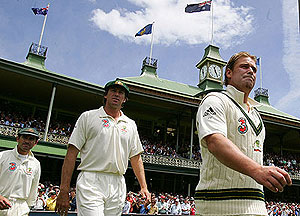
Myth of Australianism in sport: the have-a-go bravado
By Viscount Crouchback, 12 Oct 2010 Viscount Crouchback is a Roar Rookie
- Tagged:
- Australian sport, Australianism, Craig Johnston, Kim Hughes, wallabies
For many years, the first line that French school-children were to taught to recite at school was: “Our ancestors, the Gauls…” Children were taught that they, the modern French, were descended directly from the Gauls.
It was a splendid notion in every respect apart from one: it wasn’t really true. In fact, the Franks, a Germanic tribe, had much more influence on the formation of modern France than the Gauls. “Our ancestors, the Gauls…” was merely an invention of 19th century romanticism.
Now, every nation has its myths. Some are dangerous; some merely curious.
In the case of Australian sport, we have one of the best of the type – the myth of Australianism. Deep in the soul of every red-blooded Australian male lurks the belief that Australia’s splendid recent sporting record is testament to the unique virtues of his compatriots: mateship, resilience, and have-a-go bravado.
The bronzed Aussie warrior wins because he is tough and plays hard and sticks by his mates – and then, like any true Australian, he proves he is not only hard but also fair by going for a beer with his beaten foe after the game.
Now, one hates to be the shatterer of cherished myths, but I’m afraid these sentiments are the purest piffle. They might well satisfy the romantics amongst you, but they ought not for one moment to satisfy those of you possessed of more rigorous and inquiring minds.
The French eventually changed their text-books, and it is high time that Australians ditched their own sporting romanticism.
Let me elucidate.
Australia used to be rather rubbish at sport. Sure, you held your own in sports that were not widely played at the time, such as tennis and cricket. But this was vastly out-weighed by a litany of humiliations on the world stage: not a single gold medal at Montreal ’76; the Wallabies a complete irrelevance for much of their history; Kim Hughes bursting into tears in the 1980s; Craig Johnston preferring England ‘B’ to the Socceroos. Painful times.
But then a funny thing happened – suddenly Australia became rather good at sport. In fact, let’s be perfectly candid: you became very, very good indeed. Visiting Pommie cricketers were eaten up and spat out in the Tasman Sea, broken men. South African cricketers took refuge on the psychiatrist’s couch.
Athletes clad in green and gold stormed successive Olympics, easily beating much bigger and more powerful countries on the medal table.
For much of the 1990s, even the hitherto powderpuff Wallabies dished it out to the fearsome men in black. By 2000, and the Sydney Olympics, Australian athletes prowled the globe like Trojan warriors. In John Eales and Ian Thorpe and Steve Waugh, we had super men fit to give Hector himself a run for his money.
What on earth happened?
Had Australian sporting teams somehow rediscovered the virtues of mateship, resilience, and fierce will to win? Was there a collective Great Awakening of the dormant Aussie soul? Were the no-hopers of the 70s and 80s somehow un-Australian?
I think not. I think the real reasons are rather more prosaic. In truth, it’s perfectly easy to divine the root cause of Australia’s sporting transformation: you started to take sport awfully, awfully seriously. Indeed, Aussie sport became the Antipodean equivalent of the NASA space programme.
A vast, well-funded Institute of Sport was formed. This hothouse of sporting excellence took in promising young talents and, through the rigorous application of the latest sports science, turned them into lean, mean fighting machines. It churned out men like Justin Langer and Adam Gilchrist, sporting robots who combined superb technical proficiency in their chosen field with admirable levels of resilience and fortitude.
These sporting graduates at times came to resemble cult members – they would indulge in bizarre rituals such as the kissing of helmets on reaching a century, or the ostentatious refusal to wash their sweat-stained caps; one graduate, Mr Gilchrist, was so well programmed that even 20 years later, he was still proudly preaching the virtues of “Australianism”.
It was nothing less than a sporting revolution. Australia did to sport in the 1980s what England had done to industry in the 1780s. And the Australian public, like the Greeks after the sacking of Troy, lapped it up.
Soon it became possible for otherwise rational and intelligent human beings to ascribe the sporting success of their nation to “Australianism” – every medal, every trophy, every urn was seen to be yet another validation of Australia and its values. A collective madness set in.
By 2004, an exhausted rower was being denounced as “un-Australian” for collapsing during her race. By 2010, the head of the Australian IOC, was denouncing as “un-Australian” any suggestion that sporting funds be cut. And in the same year, Lucas Neill, the doughty captain of the Socceroos, was accused of being “un-Australian” when he dared to assert that – horror! – the three-times world cup winners Germany perhaps boasted better footballers than Australia.
Hubris had indeed set in – and after hubris, as any schoolboy knows, comes nemesis.
For the thing about revolutions is that they tend to be imitated. No sooner had England industrialised in the 1780s than half of Europe was in on the act. Men imitate what works for other men. Australia’s sports programme worked, and so the rest of the world, not least the English, set to work copying it.
Australian swimming coaches were imported lock, stock and barrel. Cricket coaches, likewise. Vast new laboratories of sport were built in the English shires to mould a new generation of sporting robots – these fellows possessed of pastier skin, but equally monomaniacal in their desire to win at games. The French, the Germans and even the Spanish followed suit.
For what the Australians took to be Australianism was in fact simply professionalism – and professionalism knows no national boundaries.
And remarkably enough, these nations found that chucking money at sport and taking it awfully seriously – in other words, professionalism – began to pay dividends on the field. By 2003, the English had won a rugby world cup.
By 2005, the Ashes were back in English hands. By 2008, Great Britain was dishing the Aussies at the Beijing Olympics and The Sun newspaper was driving a billboard van around Sydney emblazoned with the words “Is That All You’ve Got?” (Yes, truly, Orwell was right to say that sport was “war minus the shooting” – just rather more absurd) And by 2010, English golfers were flooding the upper echelons of the world game.
But all this paled in comparison to the Spanish, whose superb sporting academies had produced a breed of super athletes who made Australia’s earlier heroes look positively feeble.
World and European soccer champions; F1 champions; tennis champions; golfing champions: in 2010, it can justly be said that Spain is the sporting capital of the world.
Now, this newfound success has been too novel to have quite gone to English or Spanish heads just yet. Few Spaniards are yet proclaiming the superiority of “Spanishism”. It takes a while for popular sentiment to catch up with the facts on the ground. Likewise, and conversely, Australia’s recent sporting trough has been too novel to have quite dampened the Aussie enthusiasm for their self-flattering mythology.
Like Germans after the siege of Stalingrad, Australians wander through a fog of doubt, their intellects telling them that perpetual sporting dominance is no longer possible, but their hearts not quite believing it. Some Roarers, indeed, still hold by the Aussie Superman theory like it’s 1999.
So what does the future hold for Australianism?
Will it vanish, or will the Aussies sell it off to the English or Spanish?
Could it be that, in 2012, when Great Britain will almost certainly finish third or fourth on the Olympics medal table; when England might well have knocked the Australians out of the rugby world cup for the third time in succession; and when England might have won three of the last four Ashes series – could it be that the Fleet Street tabloids will ascribe their nation’s success not to money, organisation and rigorous planning – boring old professionalism – but rather to the cardinal English virtues of “the stiff upper lip, bulldog mentality and Blitz spirit”?
To, dare I say it, “Englishism”?
Funnier things have happened. After all, national self-flattery is by no means a solely Australian phenomenon.
Recommend this story.
The Turkey 10
The Turkey 10 teams have now been selected, as Wild Turkey Bourbon's sport sponsorship kicks into the next exciting phase.
Choose which side you're going to support and get in the running to win $2,500!
Simply visit Wild Turkey Australia on Facebook for your chance to win.
Find out more.
Do you have what it takes to become a sports writer? Write for the roar
Other Sports articles
- My top 10 Australian sporting stars over 50 years (75)
- Frankel, 2012 Lockinge Stakes: Live race updates, blog (70)
- Miami Heat level NBA playoffs with Pacers at 2-2 (43)
- Frankel sounds warning to Black Caviar with resounding win (26)
- How to like LeBron James, despite it all (26)
- Black Caviar ready to travel after celebrating her 21st (16)
- Will health risks in NFL and NHL change the US/Oz sporting landscape? (15)
- Frank Mir out to cement his place amongst the greats at UFC 146 (3)
- Sixers claw their way back into NBA series
- The great UFC 146 shake up: who has missed out?
- Heat roll over Pacers to lead NBA series
- UFC 146: Heavyweight main card should pack a punch
- Federer back in game to grab world’s number one spot (3)
- UFC 146 Junior Dos Santos’ first test as champion (5)
- Frank Mir out to cement his place amongst the greats at UFC 146 (3)
- The great UFC 146 shake up: who has missed out? (1)
- UFC 146: Heavyweight main card should pack a punch (1)
- Federer back in game to grab world’s number one spot (3)
- UFC 146 Junior Dos Santos’ first test as champion (5)
- It’s showtime in the NBA: Spurs v Thunder (11)
- How to like LeBron James, despite it all (26)
- Explore:
- Australian sport, Australianism, Craig Johnston, Kim Hughes, wallabies


October 12th 2010 @ 1:43am
ThelmaWrites said | October 12th 2010 @ 1:43am | Report comment
M’Lord
It’s 2:30 am by my clock; I’m reading “High Blood Pressure for Dummies”; I ran across your heartily amusing essay (above); and I’m having a good laugh.
I would be grateful if you would add Steve Waugh’s red-kerchief ritual of wiping his brows to your list of bizarre rituals conducted by Aussie sportpersons.
Cheers from the Antipodes.
October 12th 2010 @ 3:35am
Tom said | October 12th 2010 @ 3:35am | Report comment
Just a quick correction, Sally Robbins did not faint during the race, she simply lay down. Hence the widespread criticism of her – certainly no rowers I know support her in any way, shape or form. That she got a newspaper column as a result of the notoriety she developed is a shame, whilst her other team mates got nothing but the knowledge that their years of effort training had been flushed down the toilet as a result of Ms. Robbins’ actions.
And it is also nice you didn’t mention Contador as a part of that Spanish sporting dynasty in the wake of his positive drugs test…
On topic though, myth making is an important part of nationalism and the formation of the nation state. Pretty much every country has some mythical basis to its creation, such as the Viking myth of Norway. I don’t think the myth of the tough but fair Aussie is a particularly harmful one; in fact it is an ideal we should aspire to.
October 12th 2010 @ 12:21pm
mattamkII said | October 12th 2010 @ 12:21pm | Report comment
Incorrect – Sally Robbins suffered a black out.
October 13th 2010 @ 12:16pm
Tom said | October 13th 2010 @ 12:16pm | Report comment
http://www.heraldsun.com.au/sport/sally-robbins-and-slapper-hit-water/story-e6frf9if-1111115594305
http://www.smh.com.au/olympics/articles/2004/08/23/1093246445579.html
In the second article she claimed she ‘…just hit the wall’, which is very different to blacking out. Do you really think she would have copped the public flaying she did if she had blacked out? You cannot control blacking out. Sally Robbins certainly could have controlled what she did.
October 12th 2010 @ 4:12am
Kurt said | October 12th 2010 @ 4:12am | Report comment
Nice article, very funny but also quite interesting. However I do think you let the English off the hook a little. Generations of English sportsmen took to the field believing that little more than a stiff upper-lip and a rousing Churchillian speech was necessary to ensure victory. I suspect the English soccer team still do – hence their consistent under achievement.
October 12th 2010 @ 4:37am
Ben S said | October 12th 2010 @ 4:37am | Report comment
‘I suspect the English soccer team still do – hence their consistent under achievement.’
I don’t… not in the slightest, and I’m English. I doubt if most international English footballers of the past decade know a single fact about Churchill.
October 12th 2010 @ 6:13am
Kurt said | October 12th 2010 @ 6:13am | Report comment
I’m not sure the adjective ‘Churchillian’ assumes historical knowledge of the man himself. It’s more of a reference to those ‘c’mon lads, we’re English, we beat them in the war!’ type speeches.
October 12th 2010 @ 6:36pm
Ben S said | October 12th 2010 @ 6:36pm | Report comment
Well… again, I don’t think that’s the case, and I don’t think the parallel is apt. In any case, what you seem to be referring to is a cross between arrogance and ignorance, which surely all sportsmen suffer from. If you don’t think you’re the best then why bother? Equally, I suspect most nations indulge in jingoism, although far less than in previous years (certainly in the case of England anyhow). If we are talking about the English football team then I suspect their idols pre-match would be Paul Ince or Terry Butcher, who epitomised the notion that what you lack in talent you make up for in application, which is actually quite different to what you’re suggesting, Kurt. That said, there is probably a lack of science and nous, which is the huge problem with the English football team. Contrast that with the England rugby team of 2003.
October 12th 2010 @ 5:31am
Darwin Stubbie said | October 12th 2010 @ 5:31am | Report comment
top stuff VC you really should contribute more often – I look forward to reading the masses deriding this over the coming days all to that unique little ditty – aussie, aussie, aussie, oi, oi, oi
October 12th 2010 @ 5:52am
Timmypig said | October 12th 2010 @ 5:52am | Report comment
The truth often confuses and angers the bogan, particularly when holy shibboleths are torn to shreds. An enjoyable contribution Your Lordship. Prepare for a flood of poorly written rebuttals!
The only point I would question is your assertion that “… and after hubris, as any schoolboy knows, comes nemesis”. I would contend that no schoolboy in this country would know that – the classics aren’t taken seriously here.
October 12th 2010 @ 11:14am
JohnB said | October 12th 2010 @ 11:14am | Report comment
And, judging by how you’ve used “shibboleths”, biblical studies aren’t taken too seriously either! A “shibboleth” is (per dictionary.com) a peculiarity of pronunciation, behavior, mode of dress, etc., that distinguishes a particular class or set of persons – not a type of myth or tenet of belief that might be regarded as “holy” or able to be torn to shreds.
October 12th 2010 @ 12:41pm
Timmypig said | October 12th 2010 @ 12:41pm | Report comment
Touché
Indeed, I suffered a 1970s-1980s education, full of cultural indoctrination but light on rigour. Certainly light on learning the Western canon. Thanks for picking me up on that JohnB.
October 12th 2010 @ 2:20pm
JohnB said | October 12th 2010 @ 2:20pm | Report comment
I should confess that I always thought that a shibboleth was something like a belief that was not allowed to be challenged until seeing a West Wing episode that explained it’s correct meaning, so I’m somewhat light on in the rigour department also if the truth be known!
October 12th 2010 @ 4:03pm
JohnB said | October 12th 2010 @ 4:03pm | Report comment
or even its correct meaning
October 12th 2010 @ 5:15pm
JVGO said | October 12th 2010 @ 5:15pm | Report comment
I don’t know why you guys would believe West Wing or Dictionary.com, over the Oxford dictionary. I think TP’s original usage was fair enough actually and the article is pretty much identifying a shibboleth. But heaven forbid that bogans might actually express themselves clearly with words they understand eh?
October 12th 2010 @ 5:59am
spiro zavos said | October 12th 2010 @ 5:59am | Report comment
Viscount, Australia was so good at sport in the late 1800s and early 1900s (cricket, tennis, rugby, boxing , rowing,swimming etc) and onwards that British doctors used to come to Australia to find out what the secret was.
Answer:nutrition (lots of protein) and lots of space for young to run around. I would add too the egalitarian nature of Australian society in comparison with more class-bound societies.
I agree with the rest of the analysis, though.
October 12th 2010 @ 6:20am
Redb said | October 12th 2010 @ 6:20am | Report comment
1976 Olympics? Hmmm… when drug lords ruled the sporting universe.
October 12th 2010 @ 9:52am
AndyRoo said | October 12th 2010 @ 9:52am | Report comment
Redb’s still got his pre 1999 history text book on him I see
October 12th 2010 @ 6:28am
Tortion said | October 12th 2010 @ 6:28am | Report comment
Top article. I might even suggest that another Australian myth that comes about every April and starts with the letter A might also do with a bit of a once over.
October 12th 2010 @ 7:07am
Vinay Verma said | October 12th 2010 @ 7:07am | Report comment
VC,For an extraordinarily long time,right upto the Whitlam era,Australian society was predicated on the British system of entitlement and privileged worth. It was more important who you knew and what school you went to. So the myth of mateship was the same pigs in the same trough.
It ook Germaine Greer to finally call breasts by their rightful name of tits. Australian sporting success can therefore be traced back to the burning of the bra and its symbolic dismantling of hierarchy and constant criticism of the “entitled class”
Australian sport discovered its inherent “marxism” and shed its colonial “old boy’s club” mentality. This is what struck me when I arrived in 1970. There were still vestiges of “preferential selections” in the first grade club I tried out for. I played second grade because the incumbent in Firsts was the club president,selector and a recently retired First Class cricketer.
The more Australian sport distances itself from “Englishism” the better off it will be.
October 12th 2010 @ 9:03am
Tortion said | October 12th 2010 @ 9:03am | Report comment
Rather dated assessment of English society.
October 12th 2010 @ 11:02am
Mushi said | October 12th 2010 @ 11:02am | Report comment
I don’t know I still see it every single day at work.
October 12th 2010 @ 4:57pm
Tortion said | October 12th 2010 @ 4:57pm | Report comment
Living in England I don’t find it to be any problem at all. No worse than the class divisions that exist in Sydney.
October 12th 2010 @ 4:59pm
DERBY COUNTY FC said | October 12th 2010 @ 4:59pm | Report comment
Tortion
Agree mate.
October 12th 2010 @ 7:51am
Brett McKay said | October 12th 2010 @ 7:51am | Report comment
Your Lordship, I fear that a comment I made about Andrew Flintoff several weeks ago may have awoken this sleeping giant within…
Anyhoo, of course everything that we Australians think is uniquely Australian about the way we rip into the contest is evident almost everywhere around the world, and of course we made the improvements in sport because of the abject failure that was the Munich Olympics (memo ARU: is that what it’s going to take to see rapid change, being the laughing stock of world rugby?!?), but the fact remains that we made those changes, dammit, and we made them bloody worthwhile. And if that means we can have our sponge cake and eat it when it comes to our sporting prowess, then we’ve earned that right to do so, because we said we have!!
Sorry, I got a little worked up there. Cracking write-up though, old boy.
A lot of what you so makes perfect sense. But it remains the case that suggesting that our “Australianism” in spot is a myth is frankly, sir, un-Australian…..
October 12th 2010 @ 7:49pm
apaway said | October 12th 2010 @ 7:49pm | Report comment
Brett, I think you’ll find the “abject failure” occurred at the Montreal Olympics: Shane Gould won 3 gold medals on her own in Munich: 3 more than the entire team managed in Canada.
October 12th 2010 @ 10:08pm
Brett McKay said | October 12th 2010 @ 10:08pm | Report comment
Apa, yes of course, I always interchange Montreal and Munich, for no obvious reason. Thanks though..