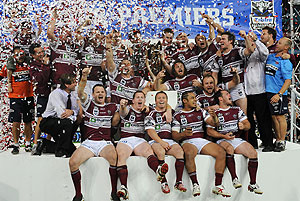
Memo David Gallop: it’s time to Scrap the Cap
By Ryan O'Connell, 16 Feb 2011 Ryan O'Connell is a Roar Expert
- Tagged:
- Luke O’Donnell, Melbourne Storm, NRL, Rugby League, Ryan Hoffman, salary cap rorts, South Sydney Rabbitohs, Willie Mason
Related coverage
The salary cap is always a hot topic in the NRL, particularly last year when the Melbourne Storm were revealed to have systematically rorted the NRL cap, and thereby ruled to have cheated their way to two titles over four years.
The subject was once again in the headlines in the off season, as many pundits (especially NRL salary cap auditor Ian Schubert) wondered how the South Sydney Rabbitohs could afford to sign superstar Greg Inglis and still remain under the cap.
I don’t think I need to explain what a salary cap is, but I will point out the NRL’s two key motivations behind implementing it:
1. To prevent teams from going bankrupt, curtailing costs, and thereby saving clubs from themselves (ie: stopping them from spending more money than they can actually afford).
2. To ensure parity between teams, thus preventing a wealthy club from simply signing more top level players than its rivals, which ensures the competition is a level playing field.
In essence, the theory is that the salary cap exists to make the game better. This is ironic, because the biggest issue that critics of the cap have is that it actually harms the game overall.
So who’s right and who’s wrong?
I guess it all depends on your perspective. If you look at it from the NRL’s point of view, their previously mentioned salary cap objectives have been met.
Despite a few clubs experiencing financial difficulties, it’s been a long time since a club went bankrupt. And in terms of parity, we’ve had 9 different premiers in 13 years. So the NRL claims a moral victory for the salary cap, believing it has done its job.
The other side of the argument has critics asking how the cap could ever possibly be perceived as making the game better when it’s responsible for the constant flow of talented players leaving the game due to them receiving a more attractive financial offer elsewhere, and thereby diluting the overall quality of the sport.
In this regard, the most devastating player drain has always been the English Super League.
Shockingly, there are close to a hundred players with NRL experience playing in England this season, many who have played representative rugby league – including ex-Australian captain Danny Buderus.
This season he’ll be joined by players the caliber of Ryan Hoffman, Willie Mason and Luke O’Donnell. Whilst England has always been a lucrative lure for ageing players coming to the end of their careers, of late, younger players in their prime have also been a part of the yearly exodus.
This should be ringing alarm bells for the NRL.
The NRL has also lost a small, albeit elite, contingent of players to rugby union.
Wendell Sailor, Matt Rogers, Lote Tuquri and Ryan Cross have all represented the Wallabies, while rugby league internationals Mark Gasnier, Sonny Bill Williams, Luke Rooney and Craig Gower, to name a few, fled to Europe. Whilst some of these players returned to rugby league, the fact is, the sport lost them during the prime of their career.
As if all those losses weren’t enough to deal with, the game is also suffering at the hands of AFL poaching, losing young stars Israel Folau and Karmichael Hunt to AFL.
If all those losses can be attributed to the salary cap, can it honestly be making the game better? And is it really working as designed anyway?
It’s true that we haven’t lost a club to bankruptcy for a while, but the NRL’s proclamation about parity is a little misleading.
Yes, it is a fact that in 13 years, we’ve had nine different premiers. But those 13 seasons include: three premierships by proven salary cap cheaters the Melbourne Storm; a premiership by the Canterbury-Bankstown Bulldogs, with the exact same squad that was ruled way over the cap the year before; a premiership by the Sydney Roosters in the same year they were fined for not disclosing third party payments to players; and a premiership by the Newcastle Knights, who were fined one year later for being over the cap.
In fact, in all, there have been a whopping 68 separate breaches of the salary cap since 2000, ranging from minor to very serious.
And three premierships were won by the Brisbane Broncos, who have the distinct and unfair advantage of being a one team town.
Therefore, the NRL should be careful about banging on too loudly about parity. In 13 seasons, there have only been two real underdog winners: the Penrith Panthers in 2003, and the Wests Tigers in 2005.
Other than that, a fairly cashed-up club, or one that cheated, has won every year, or 85 percent of the time.
Which means we can dismiss the notion that parity is vital to the success of the sport. After all, every year, everyone knows that only Manchester United, Chelsea, Liverpool or Arsenal are likely to win the English Premier League.
Yet that doesn’t seem to have a negative effect on crowds, sponsorship, TV rights, media coverage, and so on.
Therefore, it’s time to remove the salary cap. And whilst there will be opinions that doing so will simply see the rich clubs just get stronger, I have four counter arguments:
1. The rich clubs already are stronger, and have won 85 percent of the premierships.
Don’t fool yourself into believing anything else. Even if the rich clubs don’t currently spend more money on players than opposition clubs, they spend more money on buying the best coaches, having the best resources, the best training facilities, better travel arrangements, access to more sponsors, more corporate connections, and so on.
And dare I say it, they’re also better equipped to circumvent the cap. Trust me, the stronger clubs are already stronger.
2. Don’t we want the best competition possible, rather than the most even competition possible?
Surely we want the best players playing in the NRL, regardless of what club they play for? Fans would be inclined to watch more than just the games their team is playing in, because the standard would be so high.
Quite simply, with a higher overall standard of competition comes bigger crowds, more sponsors and higher TV ratings – which equates to more money for everyone.
3. When it comes to evening out the competition, it’s important to remember that you can only have 13 players on the field at one time.
And more importantly, they play in specialised positions.
Yes, a rich club might be able to afford Jarrod Hayne, Billy Slater, Karmichael Hunt, Kurt Gidley, Josh Dugan, Preston Campbell, Matt Bowen, Darius Boyd …
But they’re ALL fullbacks.
If rugby league is able to entice the talent back from English Super League and rugby union (and AFL), the entire competition will achieve evenness through the amazing depth, overflowing to all clubs, at all positions.
4. Every sport is littered with examples of teams that tried to ‘buy a premiership’ by simply purchasing all the best players – and then didn’t win.
Sport, and rugby league, isn’t about having the best players, it’s about having the best team.
It’s time for the salary cap to go, thus allowing the sport to reach its full potential.
Recommend this story.
Follow Ryan O'Connell on Twitter: @RyanOak
The Turkey 10
The Turkey 10 teams have now been selected, as Wild Turkey Bourbon's sport sponsorship kicks into the next exciting phase.
Choose which side you're going to support and get in the running to win $2,500!
Simply visit Wild Turkey Australia on Facebook for your chance to win.
Find out more.
Do you have what it takes to become a sports writer? Write for the roar
Rugby League articles
- NSW State of Origin 2012 team announced; expert reaction (223)
- Five hit ups: the talking points from State of Origin one (223)
- That Origin try: Did Inglis score or did the refs get it wrong? (198)
- Make this the last Origin in Melbourne (181)
- League and Union: we should embrace the different codes (143)
- NSW should stop whinging and ask why they couldn’t score points (123)
- An answer to Sydney NRL crowd problems? (120)
- Whingers Gallen and Stuart deserve the sack (0)
- Origin period to test Sharks credentials (2)
- Who’s wrong, the video ref or the rules? (0)
- Melbourne Storm vs Brisbane Broncos: NRL live scores, blog (91)
- South Sydney Rabbitohs vs Canberra Raiders: NRL live scores, blog (107)
- NSW should stop whinging and ask why they couldn’t score points (123)
- A Ray of sunshine in modern sports commentary (37)
- Explore:
- Luke O’Donnell, Melbourne Storm, NRL, Rugby League, Ryan Hoffman, salary cap rorts, South Sydney Rabbitohs, Willie Mason


February 16th 2011 @ 6:27am
Football United said | February 16th 2011 @ 6:27am | Report comment
Completely agree. i hate seeing players lost to oversees and other codes or even players who have been at a club for all their life told they have to go just because the nrl wants to squeeze a few extra $$$ out of the tv deal. even super rugby doesn’t have a salary cap!
February 16th 2011 @ 6:55am
CraigB said | February 16th 2011 @ 6:55am | Report comment
uhh yes they do. Each player is only allowed to be paid a certain amount (around 80K I think) by there province. The ARU make up the rest.
February 16th 2011 @ 3:33pm
lopati said | February 16th 2011 @ 3:33pm | Report comment
One fundamental flaw: If we remove the caps, how sure are you the [possibly] higher amounts offered here are still not as good as what the Poms and Frogs offer?
In considering that make sure it hss to be across the entire player roster, not just for the top ranked players. Hanging on to an overpaid “star” (even if underperforming) could hurt the lower ranks (both directly or in distribution over the league) , particularly in some of the less well off clubs, i.e. Sharks, Warriors.
February 16th 2011 @ 6:32am
Ken said | February 16th 2011 @ 6:32am | Report comment
Let’s say there wasn’t a cap, could anybody really have justified matching the ridiculous offers that Folau and Hunt were offered? They weren’t being hired as players, they were being hired as a marketing exercise. The same goes for Tuqiri, Sailor and Rogers, albeit at not quite the same level, in both cases the outside entity came in and offered them more than their playing worth for marketing value. They were cheap stunts and even without a cap, it would have been silly for RL to get into a bidding war over these guys.
If there wasn’t a cap, how many teams could actually afford to spend much more than they are doing now? Not many I wouldn’t think. Cronulla are a good example, as the only team in the comp that can’t currently afford to spend to the cap, anchored to the bottom of the table over the last couple of years. When they do have a bright junior coming through like Ferguson he is poached almost immediately. Crowds dropping off, sponsors looking elsewhere for better opportunities.
I support St George, a fairly well off team with a constant supply of good juniors coming through, it pains when each year we lose a few young potential stars – we’d probably thrive in a salary cap-less environment. But I don’t want to see 2/3rds of the clubs struggling like Cronulla just to enable that.
February 16th 2011 @ 11:19am
Danny_Mac said | February 16th 2011 @ 11:19am | Report comment
One of my major beefs with the salary cap is that there is a gap between what the NRL provides to the club and the cap. If the NRL grant was 100% of the cap, then no club has an excuse… It gives the wealthier clubs a significant advantage over the clubs that cant afford the gap
February 16th 2011 @ 6:52am
Stu said | February 16th 2011 @ 6:52am | Report comment
I don’t understand how Brisbane is at an advantage playerwise being in a one team town. Most NRL clubs have feeder clubs in Brisbane and draw from their own U20 side. If anything, clubs outside Sydney are at a disadvantage when it comes to player trading. They have to pay more than a player is worth to move him and family away from his current location. This problem doesn’t exist in Sydney where players don’t have to sell their house and up and move to change clubs.
–
Comment left via The Roar’s iPhone app. Download The Roar’s iPhone App in the App Store here.
February 16th 2011 @ 7:50am
Ken said | February 16th 2011 @ 7:50am | Report comment
You’ve answered your own question, ‘They have to pay more than a player is worth to move him and family away from his current location.’
Even though some (although far from most) other clubs have feeder clubs in Brisbane, to many Brisbane-based players it’s going to be a more attractive proposition to go to the Broncos than move to Sydney (or elsewhere)
February 16th 2011 @ 11:21am
Andrew said | February 16th 2011 @ 11:21am | Report comment
The other advantage is 3rd parties deals which are much easier to come by when you are the only team in town. Especially in a larger market like Brisbane (as compared to newcastle/canberra etc)
February 16th 2011 @ 6:54am
CraigB said | February 16th 2011 @ 6:54am | Report comment
Ridiculous article. You honestly think that without the cap all the players mentioned would stay? I think you’ll find many of them left for sums far superior to anything any side could pay with or without the cap. If the money is an only thing a player is looking for do you really want them in your team, or is it better to have someone who has a more balanced value system? Many players who leave for Europe/UK are looking for a fresh start and a new challenge.
1. The rich clubs already are stronger, and have won 85 percent of the premierships. – That maybe true but the cap at least limits this. They may afford beter coaches and facilities, you think giving them unfettered access to the best players will weaken them?
2. Don’t we want the best competition possible, rather than the most even competition possible? – IS having the best talents spread among only 3 teams a better or worse comp? You talk about getting more spectators and TV revenue. If only 8 games a year are close and the rest a blow outs you think people are going to go or watch on TV? Are people going to buy memberships to watch their team get flogged in 80% of their games?
3. When it comes to evening out the competition, it’s important to remember that you can only have 13 players on the field at one time. And more importantly, they play in specialised positions. – Again true but by that definition I can get a local Adelaide side to win the NRL because we have equal players… You mention som egreat players and them all being fullbacks. You think they cannot play anywhere else? Wing maybe, centre? Even if they cannot a team may see value in simplay buying these players so the opposition cant have them.
4. Every sport is littered with examples of teams that tried to ‘buy a premiership’ by simply purchasing all the best players – and then didn’t win. Sport, and rugby league, isn’t about having the best players, it’s about having the best team. – This may be so, but you won’t find too many examples where a club of no names won a top flight comp. Its possible but unlikely in a knock out comp, but near on impossible in a league situation. Look at EPL and Liga for example of where a lack of a cap makes every year a 3-4 horse race before the season even starts.
February 16th 2011 @ 9:16am
BennO said | February 16th 2011 @ 9:16am | Report comment
“I think you’ll find many of them left for sums far superior to anything any side could pay with or without the cap. ”
Exactly. The primary limitation is not the cap, it’s the amount of money available to pay NRL players in Australia. I very much doubt that removing the cap will increase this amount to the point that all these players come back.
And just what does NRL experience mean. 100 guys with NRL experience sounds a lot, but crikey playing 2 games and then getting shafted gives you NRL experience.
I was going to try and deal with all the assumptions in the article but you’ve done it for me. Nice one.
February 16th 2011 @ 11:11am
Jeff said | February 16th 2011 @ 11:11am | Report comment
4. Melbourne were a team of No name players, coached into a great team and destroyed by the need to try keep the young team together.
This original article has more good points than most of its critics!.
My kids wanted to see Inglis stay in Melbourne colours, it’s where he belonged. one kid has been lost to the game because of player/s leaving each year.
February 16th 2011 @ 11:32am
CraigB said | February 16th 2011 @ 11:32am | Report comment
If they were such no names why was the capped systematically breached to keep them?
February 16th 2011 @ 4:16pm
r Cool said | February 16th 2011 @ 4:16pm | Report comment
because they deserved better pay! and the Salary capwas much too restrictive to keep a great team together!! – that’s what is wrong with it as it stands.
February 16th 2011 @ 12:38pm
Ken said | February 16th 2011 @ 12:38pm | Report comment
This differentiation is a nitpicking point. Yes, it’s true that Melbourne did not simply go out and buy 5 of the current top 10 players in the game. They brought a lot of these guys, like Inglis, into first grade. +1 for their scouting team
It doesn’t make their crime any less though, do you think they were the only ones that noticed that Inglis, Folau etc coming through the ranks? They offered them more as rookies than other teams and then overpaid them so they’d stay. They then went out and bought more promising players. Yes, they seem to have had a professional setup, good structure etc, but they still ripped off the rest of the competition.
It’s disappointing to hear that your kids are disillusioned, hopefully they re-gain the spark, but the Storm’s problems were of their own making.
February 16th 2011 @ 7:17pm
Jeff said | February 16th 2011 @ 7:17pm | Report comment
Those are the facts Ken. it is a pity that the cap isn’t good enough to keep teams together and YEP, once the season kicks off the kids will adopt someone else, they just had a bad year!! lol. and thanks Cool
February 16th 2011 @ 6:57am
Mals said | February 16th 2011 @ 6:57am | Report comment
Hey Ryan, enjoyed the article. I would argue you have missed out Manly’s “underdog” GF win in 2008. Storm were favourites that year with their super star squad that was over the cap & having wrapped up the minor premiership. Manly hadn’t beaten them in the regular season either.
February 16th 2011 @ 7:55am
Ken said | February 16th 2011 @ 7:55am | Report comment
Even though Manly weren’t favourites on GF day, they had been consistent contenders for a couple of years, they were the runners up the year before. Not quite the same as the Tigers or Panthers, neither of whom had even made the finals for a few years before their premierships (and pretty much disappeared back the same way in the years afterwards)
February 16th 2011 @ 6:59am
Stevo said | February 16th 2011 @ 6:59am | Report comment
Rich clubs won 85% of the premierships. If we had no cap – that would be 100%. And that wouldn’t just be the premiers, 100% of the top 4 teams every year would be the rich clubs.
Support in Canberra, Auckland, Newcastle, Townsville and Melbourne (now they have no money backing) would drop off almost entirely. Cronulla, Wests, Manly and Penrith would be also-rans. You’re writing off a large chunk of the competition to keep a few players who want a bigger slice of money. Not to mention how much money would be taken out of the junior setup.
League was always more socialist than the other games, and I think it’s served it well.
February 16th 2011 @ 1:02pm
Roy said | February 16th 2011 @ 1:02pm | Report comment
Agree Stevo, and it’s not just about premierships and finals.
Week to week in the NRL any side can beat any other side. Even if a side isn’t really a premiership contender, it will win it’s fair share of matches throughout the season. No game is a foregone conclusion. This is what keeps fans engaged, showing up to games, turning on the tele and forking out for merchandise.
An even spread of talent is the only way to achieve this, whether through a salary cap, draft system or some combination.
It’s not fair, but it does the job.
February 16th 2011 @ 7:04am
jamesb said | February 16th 2011 @ 7:04am | Report comment
Hey Ryan its more like:
The NRL should CHANGE the salary cap system, not scrap it.
February 16th 2011 @ 7:00pm
macavity said | February 16th 2011 @ 7:00pm | Report comment
you are right.
the third party loopholes should be closed.
February 16th 2011 @ 7:04am
Willy said | February 16th 2011 @ 7:04am | Report comment
I don’t think it’s practical to get rid of the salary cap. How long would it be until we saw the first club or clubs get into serious financial trouble?
But I do think it needs tweaking – particularly in relation to local juniors. I would do two things:
1) Provide much bigger and broader salary cap concessions for local juniors; and
2) Force clubs to pay a “transfer fee” (maybe for 10% of the total player salary) for players signed from the club that developed them as juniors (eg: Souths pay Melbourne for Inglis).
This would allow clubs to keep more of their local players, would create many more one club players, would increase the level that fans identify with their clubs and players, and would help clubs finance all their players (more room under the cap for non-junior players).
And, importantly, it would encourage clubs to put far more time and effort into developing local juniors, which would have the extra effect of promoting the game to kids in a more effective fashion, and work as a defence against the AFL moving into heartland areas.
Looks a no-brainer to me.
February 16th 2011 @ 8:05am
Ken said | February 16th 2011 @ 8:05am | Report comment
Inglis was a Melbourne junior? And here I was thinking he was a Bowraville junior, no wait he’s a Queenslander right… oh I give up!
It would be good to look at further concessions but we need to look carefully at the implications. The Dragons for example have a lot of juniors, each year we lose a few to the market. If we got concessions for them all, teams without such lush reserves are going to have to pay more to fill their team sheets with competitive players. So the Dragons wages bill gets smaller and the Dogs (for example) gets bigger. The Dragons then have the pick of their juniors at concessioned rates + more money to spend on buying a couple of big names from other clubs, the Dogs are paying overs for young players and can’t match what the Dragons can offer for any big names on the market.
I’m not sure that there’s a way to do this without unbalancing the comp
February 16th 2011 @ 8:22am
Willy said | February 16th 2011 @ 8:22am | Report comment
I know what you’re saying Ken, but the idea is to encourage the Bulldogs (and other clubs) to improve their junior development, rather than just poach players from other clubs who can no longer afford them under the salary cap.
You could even divide up the various junior regions so every club has a reasonable share, so things are not too unbalanced.
(Oh, and Inglis is a Melbourne junior regardless of where he was born etc. Just as Benji Marshall is clearly a Tigers junior despite being a Kiwi. The question should be about development, not birth place.)
February 16th 2011 @ 8:53am
Ken said | February 16th 2011 @ 8:53am | Report comment
I understand the aim that you are promoting and I think it’s great in concept, I’m just not sure that in reality it’s going to work. Developing juniors is already the most effective way to get a good team, you get them for the default price and other teams need to outbid you to poach them. If the Dogs (and I’m not picking on them here, they’re just the example being used) could develop a team full of juniors, I’m sure they would.
Inglis’s junior club was Bowraville Tigers so his junior status is pretty well cut and dried, he followed that up by playing his first senior footy in Newcastle for Hunter. Melbourne brought him into first grade and can be credited for some of his development but he is not a Melbourne junior
February 16th 2011 @ 9:54am
soapit said | February 16th 2011 @ 9:54am | Report comment
yes the game could never expand under this system as any club outside traditional league areas would be at a huge disadvantage.
melbourne might have a couple of juniors that have worked out now (inglis aside) but law of averages says that if they have less juniors to choose from then they’ll have less quailty local seniors then other clubs and they’ll have to get them from somehwere else to be competitive year in year out.
February 16th 2011 @ 11:26am
Andrew said | February 16th 2011 @ 11:26am | Report comment
Depends on how you class a junior player. Lets say you class a junior as someone who has played in the U20′s (and anything under that), for 2 seasons. Then a club like Melbourne with fewer juniors to pick from, wouldn’t be as disadvantaged as they would just need to have better scouts to fill those aged based teams with players who they can hopefully develop into NRL quality players.
February 16th 2011 @ 11:54am
soapit said | February 16th 2011 @ 11:54am | Report comment
true andrew
still gotta find a way to pay for them though so doesnt help clubs that can’t afford to go over the cap before you apply the discount.
February 16th 2011 @ 11:46am
The Barry said | February 16th 2011 @ 11:46am | Report comment
I think that system could work but based on the number of years that a player has spent at a club (including in the junior set up) after the age of 16. When a player reaches 5 years they get 5% of their salary not included in the cap, 10% at 6 years and so on based on a sliding scale. This still puts an onus on identification and development of players without disadvantaging teams with smaller juniors.
On that basis Inglis after having spent 10 years in the Storm set up might be elligible for a 25% discount under the cap and the Storm have a chance of keeping him, not allowing for the difference of opinion between Inglis and the Storm over legal fees. This is more than fair considering the amount of coin that Melbourne put into Inglis’ development before he became a ‘superstar’.
Currently the NRL allows one off payments for players that have been in first grade for one club for 10 years – how realistic is that and how does it allow clubs to keep players like Inglis, Ferguson, Dugan, etc when they’re in their prime.
February 16th 2011 @ 7:27am
Tyler said | February 16th 2011 @ 7:27am | Report comment
This article is not that well thought out. Look what happened before the cap – busted financial wrecks left right an centre. UK, Rugby & now AFL will always come in for talent. I’d rather see League fight back and poach some players as a tick for tack method – then again who cares jnrs will come on each yr. Manly will have the youngest halves combo for second yr running.
Arsenal, Chelsea, Manchester United & who will win the league every year… Liverpool are a has been club.
–
Comment left via The Roar’s iPhone app. Download The Roar’s iPhone App in the App Store here.
February 16th 2011 @ 7:45am
M1tch said | February 16th 2011 @ 7:45am | Report comment
Change not scrap…
Ryan, watch teams fold, fans go away if its just 4 teams every year who are a chance to win it..