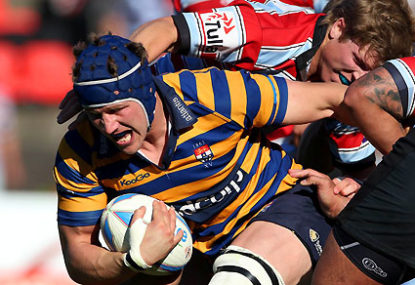
2012 Shute Shield: Sydney University crowned premiers
Shute Shield Grand Final was won by the Students (Image supplied)
Related coverage
Sydney University have taken out the 2012 Shute Shield title after defeating Southern Districts in a 15-14 thriller at Concord Oval.
The Students trailed by 11 points early in the second half, running in two late tries to steal the match by just a one-point margin.
The Shute Shield win capped off a perfect day for the club, who also won second and third grade titles, and marked an impressive personal milestone for captain Tim Davidson, who has now led the first grade side to seven Shute Shield finals and five titles.
“I think it’s definitely the hardest,” said Davidson of today’s battle with Southern Districts.
“It’s fantastic and a huge relief to know that all the hard work that’s gone in has paid off,” he added.
“Full credit to Souths, they were absolutely exceptional. They put us under so much pressure, I think it (the victory) rates up there highly because of what we went through last year.”
The Students opened the scoring with a penalty goal to fullback Angus Roberts. But Southern Districts hit back in style after inside centre Apo Latunipulu set up his midfield partner Nic Cummins for the first try of the match.
Dominating the first period, the Rebels’ running rugby mentality helped them pile the pressure on Sydney University, leaving the Students unable to create any opportunities.
Winger Atieli Pakalani was a stand out in the first half, breaking first up tackles with ease while the physicality of big No.8 Lopeti Timani ensured the Rebels crossed the advantage line with every ball carry.
That attacking pressure was too much for the Students and Rebels’ fullback Ben Volavola made them pay, knocking over two penalties to take his side to an 11-3 half time lead in the club’s first ever premiership Grand Final.
But after the break, the experience of seasoned finalists and 22-time champions Sydney University began to show, as they put in a serious fight back. When hooker Nathan Charles crashed over for a great try on the back of an immense rolling maul the momentum looked to be shifting. Despite missing the conversion, fullback Angus Roberts soon made amends, crossing for a converted try of his own soon after to give the Students the lead for the first time in the match.
With ten minutes to play the Rebels pushed the Students to the brink and almost took back the lead but calling on all their experience, the Students forced the ball deep into the Rebels’ half and held out to seal their 23rd Shute Shield title and their fifth victory in six years.
Shute Shield Grand Final:
Sydney University 15 (Nathan Charles, Angus Roberts tries; Angus Roberts con, pen) d Southern Districts 14 (Nic Cummins try; Ben Volavola 3 pens)
Sydney University:
1. Jeremy Tilse, 2. Nathan Charles, 3. Paddy Ryan; 4. Liam Winton, 5. Ollie Atkins; 6. Trent Dyer, 7. David Hickey, 8. Tim Davidson [c]; 9. Nic Stirzaker, 10. Dan Kelly; 11. Michael Hodge, 12. Tom Carter, 13. Mitch Inman, 14. Tom Kingston; 15. Angus Roberts.
Southern Districts:
1. Tetera Faulkner, 2. John Ulugia [c], 3. Tim Metcher; 4. Jed Holloway, 5. Andrew Leota; 6. Matt Swann, 7. Jono Hayes, 8. Lopeti Timani; 9. Grayson Hart, 10. Rohan Saifolio; 11. Ben Connolly, 12. Apo Latunipulu, 13. Nic Cummins, 14. Atieli Pakalani; 15. Ben Volalvola.
Looking to join The Roar team? We're searching for an experienced Group Sales Manager to lead our team in Sydney. Yes, this does mean you get to work with the site all day long! If you're a digital media sales star, we want to hear from you. Apply now.
![]()
Passionate about your union? Then sign up to The Roar's brand new daily union email, delivering Roaring articles directly to you day-in, day-out. You'll love it!
Click here to join now!
- Explore:
- Rugby Union


September 15th 2012 @ 9:55pm
heart of sydney said | September 15th 2012 @ 9:55pm | Report comment
Crowd?
September 15th 2012 @ 9:55pm
heart of sydney said | September 15th 2012 @ 9:55pm | Report comment
Ah – not many.
September 15th 2012 @ 9:56pm
heart of sydney said | September 15th 2012 @ 9:56pm | Report comment
Shame really. Twas a great game.
September 15th 2012 @ 11:48pm
Broady said | September 15th 2012 @ 11:48pm | Report comment
Crowd: 2,500 approx.
It was a good day. Nice atmosphere. The 2,500 on hand made plenty of noice. The Southern Districts crew certainly know how to cheer for their side.
September 16th 2012 @ 9:24am
Harry said | September 16th 2012 @ 9:24am | Report comment
Good game and the professionalism and excellent coaching of SU got them home. At this level SU are the AllBlacks and yesterday was a classic example, featuring Tommy Carter as SBW. Though I was cheering for SD and indeed do for any SU opponent , Australian rugby is very lucky to have a setup like Sydney uni that strives for excellence and consistently develops players and maximises their potential.
September 16th 2012 @ 11:46am
Glenn Condell said | September 16th 2012 @ 11:46am | Report comment
I’m not so sure about that. Will you be saying the same if they win the next 5 or 6 in a row?
September 17th 2012 @ 9:22am
Harry said | September 17th 2012 @ 9:22am | Report comment
Glenn I hope they lose every game they watch them. But I’m a transplanted Queenslander and have no real link to any Sydney club. ANd you just have to admire Sydney Uni’s professionalism and coimmitment to excellence. They clealry have superb programs and structures in place that allow players and teams to maximise their potential. Sadly, thats not the case elsewhere – several SuperRubgy “franchises”, the Wallabies, most clubs.
Other clubs should aim up and beat them … well done to SOuthern Districts for doing just that, and just falling short.
September 17th 2012 @ 10:39am
Galvanometer said | September 17th 2012 @ 10:39am | Report comment
This season Norttern Suburbs in colts and norths and Souths in grade showed the benefit of their development programmes. The 1st colts grand final was the toughest in 10 years. Little things turned the momentum of the game continuously through the game. On team would be marginally dominant for ten minutesj and the on one play would swing it the other way. I and others at Uni. would love to see more clubs playing this quality rugby every week. I’m not being patronizing. To take genuine satisfaction in winning a game let alone a grand final, you need to have beaten a quality opposition. Even losing to a tough opponent can be satisfying. The day when all final games swing on a couple of points will be the day that we are graduating talented players into the professional ranks.
September 16th 2012 @ 12:20pm
Fatty said | September 16th 2012 @ 12:20pm | Report comment
I will! Sydney club rugby is basically ‘the’ rugby comp in Australia and more clubs need to adopt the SU approach – fit, fast, tough, skilful. May not be poetry in motion but it is effective. In the absence of a national comp similar to NZ’s, Australia needs to improve its club rugby and if more clubs start perfroming like / being competitive to SU – all the better.
September 16th 2012 @ 12:50pm
Galgano said | September 16th 2012 @ 12:50pm | Report comment
I have been a grass roots rugby man for the past 55 years. With an uncle as a waratah in the 50’s, I began playing rugby at the age of ten, became a referee at the age of 16, played U18’s colts with Eastern Suburbs, moved to Melbourne and played with Monash University in the 60’s, to Brisbane and played with Redcliffe in the 70’s, completed the ARU coaching programme in the first year it was offered and did a refresher course in the 80’s, started the first mini-rugby comp in Australia at Redcliffe and was on the management committee that began the first major 7’s tournament (flying the Ella brothers up to participate). I retired to coach at Barra Brui juniors in Sydney, was President of the Hornsby Kuring-gai J.R.U. and coached and managed several state carnivals. Coached both grade and juniors for St Ives Rugby Club, 2nd Grade Gordon Colts for two years and for the last 15 years have coached and managed in the Sydney University Colts programme.
That’s 55 continuous years in grass roots rugby and I hope for another 15 or so. That’s provided the code survives that long.
I’m concerned for the future of the game in New South Wales because of the disconnect between an elite professional code at Super 15 level and Club Rugby. I am writing this article in the hope that enough people will apply some serious thought to the future development of the code in Sydney and actually do something about it.
Now I don’t claim to know exactly what has been happening in the administration of the game at state or even the wider Sydney club level over the last ten years, so what I am about to write is no more that my observations and hopefully a starting point for a constructive discussion about the future direction the code might take.
It seems to me that with the advent of professionalism in rugby, the ARU focused its attention and finances on securing players and ensuring that we retained players that might have otherwise gone to League or off to Europe to play. It meant that the starting point was setting player payments at the highest level and the money could only go so far in supplementing Super 12 teams and now super 15 teams. Revenue probably hasn’t increased that much over the last ten years however there are now two additional Super teams and therefore another 60 players to pay.
At no point has the administration at national or state levels addressed building of a solid foundation at club level to develop players to progress into the fully professional ranks. My observation has been that the administrators have focused on identifying talent at the junior or schoolboy level and believed that if they provided these players with occasional training programmes and selected them in the representative teams, they would progress through to the elite level and bypass club rugby on the way. The problem with this is that those who identify and select these players have a vested interest in ensuring that they do progress. They fail to consider the players with less natural ability but greater motivation and commitment who develop later.
My experience is that there have been more schoolboy stars who have fallen by the wayside and failed to progress even into 1st Grade at club level. When natural talent isn’t enough to carry them into the Super ranks immediately, they don’t have the drive to work on their game and take the two or three years to earn a spot. I have seen more players with little profile work on their game at colts and grade level and earn a contract than I have those who made the step up from schoolboy star to Super 15.
This time last year, a very proud father wrote an article here about the perfect season achieved by the Sydney University 2nd Grade Colts team. The vast majority of people responded with all sorts of wild accusations and claims that the success was due to S.U. attracting all the schoolboy stars and having an unfair advantage over other clubs. If anyone cares to respond to this article, would you please either make statements of fact that you have proof positive are fact, or at least acknowledge that they are assumptions.
I have been a part of the Sydney University colts programme for the last 15 years. Yes, in the early years, we did recruit numerous schoolboy stars and they were offered both university sports scholarships as well as college scholarships. This didn’t produce immediate success. In fact, for five years we only had moderate success with a few teams (In those days there were three grades and under 19’s in the colts competitions). During those five years however, we were building a player development programme. It wasn’t a case of throwing all the resources at the colts. It was a case of being consistent year in and year out in building the player development programme at colts and grade level. It was as much about building a culture as it was about coaching. Players had to buy into the culture, commit to their team mates, coaches, trainers and themselves and to work hard at developing their game.
For the last ten years, we have been consistent. Our progammes have continued to evolve, but we have never changed direction. We offer a culture and programme that young players want to buy into. At least, self-motivated, high achieving guys do. By doing so, we have graduated more players to Super 15 and European rugby than any other club in Australia, and most of them have been players that were never identified by State or National talent scouts. They are players who worked hard through the colts programme, earned a 1st grade spot and were then identified. Actually, some were even identified while still in the colts teams.
If you doubt my claim, and want to perpetuate the nonsense trotted out last year such as “I would like to see the number of Australian/State Schoolboys representative in those three teams, my educated guess would be that there is upward of 20. Whilst other clubs settle for 3,2 or none” let’s look at the actual numbers. The S.R.U. introduced a points system some years ago in the erroneous belief that we had recruited large numbers of schoolboys and that the points would spread the talent among all clubs. 1st colts are allowed 40 points and 2nd colts 35 points. Australian schoolboys are worth 6 points, NSW schoolboys 4 points. This year, the Sydney University 1st colts rarely fielded more than 32 points and 2nds 28. In the grand finals won by both 1sts and 2nds again this year, our 1sts fielded 32 points. We had 2 NSW schoolboys (4 points) and 4 players on 3 points (last years returning players). We had another 4 point player who had approached the club from Auckland because he wanted to join our development programme. In 2nd Grade, we had one 6 point player, playing only half the season due to injury, and two 4 point players. The Under 19’s who lost the grand final had just one 4 point player and he was a convert from Aussie Rules.
So, in answer to John Connelly, whose “guess” last year wasn’t anywhere near “educated”, we had 4 NSW schoolboys last year and 4 this year and just one Australian schoolboy. On the other hand, Randwick 1st colts were penalised in the first round for exceeding the 40 points and struggled all year to keep under the numbers. I’d suggest some other clubs also played at close to the 40 points all season.
I’ve only raked over these old coals from last year to once and for all put to rest the myth that Sydney University buys its players. Yes we have sports and college scholarships, but not as many as you would think and they don’t boost our numbers of Australian and NSW schoolboys.
We have a significant number of players who have come through the Canterbury juniors programme and we have been providing coaches for the local representative teams and therefore attracting players from the inner west of Sydney. Our 3rd Colts team (U19s) which lost the Grand Final was largely made up of 17 year olds from this programme.
Then there was “bozo” who wrote “Uni would say they are helping the Parramatta and Penrith juniors … by snaring them to play at Uni and all their resources. (Sic)” At the beginning of the 2010 season, I arranged for the then outgoing S.U. Colts Coaching Director (Nick Ryan) and 1st Colts Forwards Coach (Al Kanar), to conduct training sessions for the Penrith colts. At the end of the 2010 season, Nick spent many days providing a Penrith coach with advice on how to establish a player development programme over the off season.
To return to the main point, what’s lacking in Sydney club rugby is development programmes at each club. As a few noted last year, instead of trying to drag S.U. down to everyone else’s level, we need all clubs to provide professional player development programmes. There are many talented and motivated juniors joining the other clubs however there isn’t the development programme in place to allow them to reach their full potential.
Several clubs introduced their own player development programmes this year and the performance of all their teams in grade and colts reflected this. They need to maintain these programmes for a number of years before they will reap all the benefits. It’s the long term consistency of these programmes that instil a culture that becomes self perpetuating and successful.
I believe that unless the ARU and NSW Rugby Union can find the money to support a Grade and Colts Coaching Director for each club, provide them with a development programme model and manage the process, then the supply of players for the elite level of the game is going to suffer.
Football, Rugby League and AFL devote considerable resources to developing their codes at grass root level. The ARU and NSWRU cannot maintain an elite level of the code without a professional grade competition in both Brisbane and Sydney. A major business wouldn’t establish 12 subsidiary companies, allow them to sell their product but provide them with no funding or direction. Nor would they ignore product development and innovation to maintain their market position. Why then aren’t the ARU and NSWRU conducting themselves in a professional business like manner?
September 16th 2012 @ 9:12pm
p.Tah said | September 16th 2012 @ 9:12pm | Report comment
Thanks for posting Galgano. I agree rather than complaining about Syd Uni’s perceived advantages, look at the model as a guide in how to succeed and try to replicate it. I’d say a good development path is more attractive to young players than a scholarship. A scholarship to a Uni where you can defer payments isn’t as an attractive offer in Australia as it is in places such as the US.
Posting your thoughts here regarding the ARU and NSWRU is important in getting the message out to the wider community. What can be done to get the powers to be to listen and act? Nick Farr-Jones (NSWRU Chairman) and Roger Davis (Waratah’s Chairman) are both alumni and formers Sydney Uni players. They should be acutely aware of the reasons why Syd Uni is so successful and they have a vested interest in Sydney Club rugby doing well further than Camperdown.
I would hope they are aware of the situation you have outlined and this acts as a timely reminder. Anyone reading this who has direct contact with them should bring it to their attention. They are in a position to do something about it. Let’s hope, for the sake of Rugby that they do.
For what it is worth, I went to the GF yesterday with my son. Those who didn’t attend missed a great day out at the rugby. Im not a regular club rugby attendee unfortunately, but I thoroughly enjoyed myself. I enjoyed the atmosphere at Concord more than most of the Tahs games in 2012. Who said Sydney rugby fans are quiet and non supportive?!
September 17th 2012 @ 9:28am
Harry said | September 17th 2012 @ 9:28am | Report comment
Fascinating and well informed post Galgano and should be widely read by all – as I say above, Australian rugby should be mighty thankful for Sydney Uni as they re the best at developing rugby talent in this country by a country mile … I am pleased that Queensland Uni has also made an extensive investment and put in place good structures for developing players to maximise this potential.
NOTE TO ROAR – This should be a stand alone post
September 17th 2012 @ 4:18pm
sheek said | September 17th 2012 @ 4:18pm | Report comment
Galgano,
Yours is a most heartfelt article, & I acknowledge this.
You say the main point of your article is for all the Shute Shield clubs to emulate Sydney University by adopting development programs.
However, there is a historical problem here in that Australian rugby has rarely been played out (politically or practically) on a level playing field.
I will put my hand up & say I have often been one of those attacking SU’s “privileged” position in Australian rugby. Some times I haven’t even explained myself properly to myself. It’s not SU itself that is the problem, but the ‘protected species’ position it enjoys in Australian rugby. So let me try to explain.
You will notice that there are two uni teams – Sydney & NSW – in the 20 team Sydney cricket comp. You will notice also there are two Uni teams – Melbourne & Hawthorn-Monash – in the 18 team Melbourne cricket comp. While Adelaide Uni, WA Uni, Qld Uni, Tas Uni, Newcastle Uni & ANU all thrive in the cricket comps within their major cities.
The presence of Uni teams in these comps is not a problem because cricket has permeated all levels, all stratas, of Australian cricket. Not so rugby, & herein lies the problem.
The major impediment to your proposal is that Australian rugby, as mentioned above, has rarely been played on a level playing field. Sydney University, & to a lesser extent, Queensland University, have both enjoyed a privilege not extended to most other clubs in most other states.
In 1900 for example, the Metropolitan (Sydney) RU, in a sensible decision to broaden rugby’s appeal, decided to move to a district club system. The original 8 teams comprised 7 district clubs – (Norths, Souths, Easts, Wests, Balmain, Glebe & Newtown) – plus SU.
Right from the early days, SU were often given ‘exemptions’ not available to other clubs. Whether it is the continuation of the private schools to university direct route, or other factors, SU has always enjoyed a privileged existence at the highest level.
Today the “Friends of Penrith rugby” & “Friends of Parramatta rugby” simply cannot compete with the “Friends of Sydney University rugby” in terms of networking ex-alumni, influential captains of industry, wealthy benefactors or even in the handing out of scholarships.
Rather than follow the SU path, the ARU, NSWRU & other unions need to come up with entirely new structures & pathways that are more inclusive of society than is presently evident.
In my humble opinion, Australian rugby won’t be consistently strong, or be able to fulfill its potential, until it widens its net to make all stratas of society more inclusive in rugby. Just like cricket, for example.
This can be a highly emotive topic, but I trust I have explained it better than I have perhaps done so in the past.
September 17th 2012 @ 4:41pm
Mike said | September 17th 2012 @ 4:41pm | Report comment
I do not see the relevance of “privilege” supposedly granted to SUFC in 1900.
Your suggestion that there is a “continuation of the private schools to university direct route” has already been dealt with above.
So has handing out of scholarships.
As for “networking ex-alumni, influential captains of industry, wealthy benefactors” – why can’t existing teams take advantage of such things?
You seem to be working on the basis that every alumnus of Sydney Uni supports Rugby (or cares in the least about it). You have no idea.
“Rather than follow the SU path, the ARU, NSWRU & other unions need to come up with entirely new structures & pathways that are more inclusive of society than is presently evident.”
Could you be any more non-specific?
September 18th 2012 @ 10:13am
sheek said | September 18th 2012 @ 10:13am | Report comment
Mike,
I’m not looking for arguments, & you appear over-defensive. Rugby’s heartland, especially in Sydney, remains the exclusive conclave of the north shore & eastern suburbs. That’s the overwhelming reality.
I’m from a private school background, & I attended uni (not Sydney) briefly, & I live in the east, & I played for a Shute Shield club, so I don’t feel disenfranchised in any way, or with an axe to grind.
I just think there is a better way to do things that remains untapped. Of course, you’re entitled to disagree, that’s your prerogative.
September 18th 2012 @ 11:18am
Mike said | September 18th 2012 @ 11:18am | Report comment
Is cool
September 18th 2012 @ 8:49am
Galgano said | September 18th 2012 @ 8:49am | Report comment
I understand the history of the code in Sydney and appreciate how some of us can be extremely committed to its traditions and heritage. I for one, am proud of the fact that I played for the Wallaroos, one of the first rugby clubs in NSW which until the late 60′s was the name of Eastern Suburbs colts and we played in the original black and gold strip. How dare the Australian women’s team use our name! I will also be very proud to be involved again with Uni. Colts next year in our 150 anniversary year.
I also appreciate the historic place of the “district” in our code and my involvement with Subbies for many years was a fantastic one. The reality however is that Sydney has grown geographically, to the point that the district is almost irrelevant when it comes to providing a core for quality and ambitious players. Today’s generation is far more mobile than was my generation and particularly when it comes to grade, many players would find it easier to attend training close to work rather than close to home.
The point is that the are now 12 District clubs, and given the population and traffic congestion of the Inner West, Sydney University also mets this criteria; particularly given that so many players in the colts programme aren’t Uni students but kids from the local area including the Canterbury, Petersham and Balmain juniors. These twelve clubs are fairly well geographically spread, and can cater for both those who live locally (colts) and work locally.
That said, there are still transport issues for some. Penriths ground is so far removed from the residential areas of the west and so poorly served by public transport that it is the main obstacle to their colts programme. Not as many kids have cars and as I said, public transport so poor that for many it would involve train and bus each way to attend training. They would be better served by training at a ground close to a railway station. I don’t know what the issues are for other clubs, however in the more affluent areas of Sydney, I would assume public transport and access to their own or family cars make it easier.
As for Development Programmes, I have never been so presumptuous or arrogant as to suggest that other clubs duplicate our programme. All I have ever encouraged is the implementation of a development plan by every club. The dynamics are going to be different at every one and each has to work on a plan and execute it consistently. Despite what many people seem to think, even today’s young generation appreciate structure, discipline and consistency. If you have a development programme that is followed consistently and it’s objective is high achievement, the players will buy into that culture. In fact my experience has been that the players themselves (particularly those after a year or so in the club), will enforce the discipline. They let the new guys know what is acceptable commitment and behavior.
This past season we saw Norhts and Manly colts produce much more consistent performance across all three colts teams. We also witnessed cultures that were positive and respectful of their opponents. Unfortunately we also saw several clubs display antisocial behavior that has become institutionalised. Their culture is a negative one and will never produce positive disciplined athletes but ones who will always believe that their lack of success is due to not being given a fair go or the right opportunities. That adults can’t take responsibility for building the right culture let alone a structured development programme will limit the quality of players graduating to grade and hopefully super rugby.
September 18th 2012 @ 10:29am
sheek said | September 18th 2012 @ 10:29am | Report comment
Galgano,
Thanks for your thoughtful & measured response.
I guess if you think the district system is less relevant these days due to the mobility of young people, then perhaps we should do away with it, & return to the pre-1900 days of calling teams by exotic & non-locality specific names such as Wallaroos, Pirates, Waratahs, Barbarians, Warrigals, Harlequins, Wasps, Saracens, University this, University that, Old Boys this, Old Boys that, Past Grammar, Past Brothers, etc.
Although an interesting counterpoint is provided by Australian football. Nine current clubs in the AFL began in the VFL in 1897 (although their existence predated this comp). Another 3 current clubs joined the VFL in 1925 (again, their existence predated joining).
Since the VFL became the AFL in 1990, two of these clubs have relocated – Souths Swans to Sydney (1982) & Fitzroy Lions to Brisbane – but the nicknames, logos & colours live on. As does the history & tradition by association.
With the exception of Geelong, which is a regional city on the cusp of metropolitan Melbourne, what is fascinating about the remaining 9 clubs is that they are mostly inner-city, or very close to inner-city clubs.
Despite future generations moving to the outer suburbs, kids continue to follow (& are members) the same club as did their parents, grandparents & great grandparents.
There is much I admire about the way Australian football has gone about things in their history.
September 18th 2012 @ 11:54am
Mike said | September 18th 2012 @ 11:54am | Report comment
Which reminds me, those swine at Melbourne Football Club (AFL) are older than Uni. They trace their history back to 1859, I think, and we are only 1863.
September 18th 2012 @ 12:45pm
sheek said | September 18th 2012 @ 12:45pm | Report comment
Mike,
If I do have a bugbear, it’s this insistence by SU that their rugby club began in 1863.
It seems to have been proven by historians such as Sean Fagan, & even SU’s own Tom Hickie, that it’s unlikely there were even enough male students to form a rugby club in 1863.
The most likely date is 1865, when the Sydney FC came to life just before the SUFC. The documentation supports 1865, but not 1863, or even 1864. But while SU(R)FC has survived, S(R)FC has long since departed.
But yes, Australian football started very, very early. Before the football association (FA) began in 1863, & before rugby union played its first international in 1871.
September 18th 2012 @ 1:01pm
Mike said | September 18th 2012 @ 1:01pm | Report comment
I thought the issue was more whether what the club played in 1863 could be termed “rugby” – not easy at a time when “codes” in the modern sense didn’t exist (but I have to concede that the rules written down by Melbourne FC in 1859 resemble modern AFL in just about every respect) If 1865 makes you happier, go with 1865. I’ll ask my daughter to unpick the embroidery on my hat and scarf and re-do the numbers!
September 18th 2012 @ 8:09pm
sheek said | September 18th 2012 @ 8:09pm | Report comment
Thanks Mike,
That would be great. I would like to see ALL SU jerseys rebranded with 1865. Just change the 3 to a 5, that’s all they need to do.
September 16th 2012 @ 8:16pm
Mike said | September 16th 2012 @ 8:16pm | Report comment
Well said Galgano. Especially your final point that this comes back to the ARU and NSWRU to provide the guidance and encouragement to all the Sydney clubs to lift their management and sponsorship skills.
Sydney Uni had a strong base of tradition to build on – the oldest rugby football club in Australia, and one of the oldest in the world. But they were still headed for extinction at one point. The way they turned that around should be a model for other clubs.
September 17th 2012 @ 9:52pm
Sandy B said | September 17th 2012 @ 9:52pm | Report comment
I played in those days where extinction loomed large for Uni.
As a club we were belted in 1982 and as a result demoted to second division in 1983. In those days Randwick were unassailable in most grades, with Warringah the main competition to them.
We regrouped in 1983 and managed to win all second division grand finals except one – promotion back to first division in 1984. And I think that most of our opponents in the grand finals were Norths – who have trodden a similar path to ours.
Things went a little better for the next few years and we managed to stay up in first division.
I think that first grade made it into the semis in 86 or 87, and a Tony Abbott captain coached side won the 4th grade title in 87.
But they were hard days – getting belted each week – I was never in a team that beat Randwick.
Now the circle has turned. Randwick and Warringah have struggled, Uni and Norths are doing well.
September 17th 2012 @ 11:50am
Pete said | September 17th 2012 @ 11:50am | Report comment
Thanks for not mentioning the blatant forward pass – was it one or two yards forward – that secured the win for University. If you want to know what’s wrong with rugby in Australia look no further than the unmitigated bias that was evident on the field from the referee and off the field from the ABC commentary team. It was all about Sydney University as it used to be all about Randwick.
As much it must displease the rugby hierarchy, the future of Australian rugby is in the hands of clubs like Southern Districts who, although labelled as “unfashionable” since their inception, are pouring money and commitment into grass roots, local players. They don’t appear to be all private school boys nor do they “toff their caps” to the gentry who inhabit Sydney and NSW Rugby Officialdom – surely the very epicentre of all that is wrong with Australian rugby.
It’s time the attitudes on display from the likes of Brett Papworth who questioned nearly everything that favoured Southern and defended anything dubious for Uni, must be wiped out of rugby for it to survive.
Rugby needs a “Kerry Packer-style” revolution or it is doomed.
September 19th 2012 @ 3:22pm
Jimbo said | September 19th 2012 @ 3:22pm | Report comment
Agreed Pete. I also noted that Uni were constantly putting dummy runners through, often going very close to obstruction, and they only drew one penalty against them (and that one was actually dubious). The Uni dummy running would have done Des Hasler and the Bulldogs proud.
September 19th 2012 @ 3:49pm
Pete said | September 19th 2012 @ 3:49pm | Report comment
Good observations Jimbo.
I know I my comments must sound harsh and probably nuts to some readers, but rugby was the game I played and loved growing up. I remember it as fast paced, all about getting the ball to beat the man, the running game as it came to be known. And players did run! Whether in attack or defence, there was little time to catch your breathe. And the rules by and large enabled running rugby to happen.
I can go back to players like Catchpole and Hawthorn, or the Ella brothers or Campese, Little and Horan – players who were given space by forwards who stayed in the forward structure and out of the backs so they could move the ball with skill and speed. Today you might see two or three passes along a back line only to find the ball in the hand of a massive front rower who can only run forward and apparently in a downward direction – these guys are falling when they get the ball. What’s the point in that?
We used to treasure the ball OFF the ground. Keep it moving quickly until the defence just couldn’t cover any longer and the gaps or overlaps appeared.
Sadly today’s rules favour the likes of McCaw who prefers to play on any side of the ruck he likes because there are so many more rucks in a game to play in. Perhaps it should be renamed “Ruckby”. Or by recent standards “Kickby”.
And I think this is why AFL has appealed to me. The game is fast and it is highly skilful. While It is about kicking it is about running and kicking at speed. Going back to the old rugby days, the strategy of AFL is about creating gaps and overlaps and getting the ball into space. There’s no time for too many stoppages.
Sorry for the long reply. It’s all about passion.
September 17th 2012 @ 11:55am
MickM (aka Jack Thompson) said | September 17th 2012 @ 11:55am | Report comment
I was at the GF on Saturday, high quality game, SD were the better team until the last fifteen minutes and played with strength in the forwards and flair in the backs. Most enjoyable, passion and good cheer. I have an administrative role inthe Uni, and started to watch, support and follow the team about ten years back. Growing up on the Norh Shore our family team was Norths but I converted. Sydney University as an institution is about excellence, and so is the Rugby team. Any funding from the University, and it has been massivelty reduced in recent years, is provided to all sports, not just rugby. The Rugby program is in large part self funding, as are the scholarhips, club finances are separte from University funding, where that is also under continuing pressure and scrutiny.
From the players to the coaches, to the gym and program development, the club oozes excellence, and the staff work hard on data analysis, coaching and feedback, staying on program, and personal development to achieve. The club works extremely hard, focused, for this success. There have been dynasties at other clubs, such as at Randwick and Eastwood, Uni turned it around when the were at risk of demotion, their success was planned, just as it was at Randwick. From the ashes of demise, a plan to succed was hatched and the outcome has borne fruit. it is not a given, it is due to tireless hard work and the pursuit of excellence.
It still bears fruit.
The Uni plan should be seen as a blueprint for rthe way forward, provide scholarships and traineeships through foundation programs to other aspiring talented players who aspire to deleop to the highset levels in rugby.
September 17th 2012 @ 2:46pm
Pablo said | September 17th 2012 @ 2:46pm | Report comment
Don’t have time to read all the posts, I think i have the gist, so here is my twopenneth-worth…
Back in 1989, the grand final between Randwick & Eastwood saw a packed Concord Oval. When I had more time (BC – before children) I would go to the Grand Final every year, regardless of who was playing, now only if Eastwood are. Since the Grand Final moved to the SFS, the crowds declined in each successive year – I read somewhere that this years GF attracted 2,500, and watching it on TV would problably confirm that. How miserably disappointing. Also, once upon a time, the 6.00pm Saturday night news bulletins would always carry the Shute Shield scores from that day, regardless of network… no longer. The local rag gives more coverage to club footy that the metro press. The match day program threatening to close. Coverage on ABC TV in doubt. Club rugby is in disarray.
This is an absolute tragedy. The standard of the club game in Sydney is pretty bloody good, IMO. There is nothing quite as enjoyable as a nice afternoon at TG Millner. Marketers talk about the 4 P’s. I reckon we have a good Product. It is delivered at a fair Price. I think most of the clubs, but not all, have got the People part right. Where it seems to have fallen down is with the Promotion.
I’m no expert in this field and i am happy to defer to those that know more about this. Different (better???) promotion may see a change to the other P’s in the marketing equation, but perhaps that is what is needed.
There has been plenty of talk on The Roar about a third tier etc, with people like The Shiek championing its cause. But here is my take on it…
Ignoring injury, Brumby rules, Wallaby selection et al, Sydney Uni could have had Mumm, Dennis, Phibbs, Foley; Southern could have had Douglas, Timani, Horne, Palmer, in the grand final. That is to say, eight Wallabies in the Grand Final. Eastwood could have fielded Robinson, Alexander, Turner, White if circumstances allowed. This is before we added non-Wallaby Super players.
Although this arguement might seem a bit disjointed, my point is that we have good product, that could be made better, without the need for expensive third tier competitions, if only someone with some nous, clout and balls took up the challenge. It would be a sad day if club rugger met an untimely end.