O’Neill’s parting shot at rugby’s refs
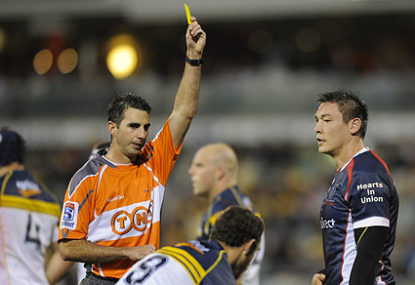
Referee Craig Joubert (left) shows the yellow card to Rebels' Gareth Delve. AAP Image/Lukas Coch
Related coverage
John O’Neill is shortly to leave the ARU and as a parting shot, he had a dig at referees.
Fox Sports quotes him as saying:
“It is one of my pet peeves that referees do not see themselves as part of the game.
“They have to see themselves as part of the entertainment package, and they have to understand who they work for.”
Nearly all refs are ex-players. Having enjoyed the game, they do not want to leave it when age or injuries creep up on them. Alain Rolland, for example, played Test rugby. Of course refs see themselves as part of the game. They always have been.
It is not a question of being part of an entertainment package. If administrators, like O’Neill, around the world can’t organise laws which are easy to apply, don’t blame a lack of entertainment (and I don’t accept for a moment the game is not entertaining) on the refs.
Remember this – a game is never full of penalties, it is full of infringements. That is not the refs’ fault, in the main. It is the fault of the laws, which provide for so many possible infringements.
Lastly, refs have no need whatsoever to understand for whom they work. Refs are first and foremost independent. They are there to apply the laws consistently and fairly.
With one eye on the ARU, another on the game at hand and yet another on the laws, a ref is sure to make a fool of both himself and his employer.
What has always been one of my pet peeves is rugby administrators, who have never reffed a game in their lives at any decent level, becoming self-appointed referee assessors.
The last thing our game needs is a control freak like O’Neill telling refs what to do.
Looking to join The Roar team? We're searching for an experienced Group Sales Manager to lead our team in Sydney. Yes, this does mean you get to work with the site all day long! If you're a digital media sales star, we want to hear from you. Apply now.
![]()
Passionate about your union? Then sign up to The Roar's brand new daily union email, delivering Roaring articles directly to you day-in, day-out. You'll love it!
Click here to join now!
Do you have what it takes to become a sports writer? Write for the roar
Rugby Union articles
- Where is Deans in the pecking order of rugby coaches? (404)
- Wallabies squad announced: Folau in, no Quade Cooper – yet (267)
- Deans: Should he stay or should he go? (245)
- SPIRO’s Lions Diary: Deans goes for experience, plus Folau (242)
- Australia, time to get behind the Wallabies (229)
- Wallabies 25-man Lions squad: analysis (214)
- Quade Cooper misses Wallaby squad selection (209)
- What happened to all the rugby enforcers? (15)
- With Quade, Deans faces a real dilemma (35)
- Wallabies coaching job poisoned chalice (3)
- Manu Samoa squad to tour South Africa for June Tests (2)
- Looking at the weekend’s Super Rugby games (2)
- Reds set to unleash veteran Samo
- IRB Law 12: The forward pass (4)
- What happened to all the rugby enforcers? (15)
- Manu Samoa squad to tour South Africa for June Tests (2)
- Looking at the weekend’s Super Rugby games (2)
- IRB Law 12: The forward pass (4)
- Australia, time to get behind the Wallabies (229)
- Who can still win the Super Rugby title? (45)
- ‘Lucky 29′ journey into despair (part one) (10)
Recommend this story.
- Explore:
- ARU, John ONeill, Rugby Union


October 29th 2012 @ 8:41am
biltongbek said | October 29th 2012 @ 8:41am | Report comment
The last thing our game needs is a control freak like O’Neill telling refs what to do.
……………………..
I wish you told him that before the Australia vs Ireland match last year.
October 29th 2012 @ 8:45am
sheek said | October 29th 2012 @ 8:45am | Report comment
Wally,
I’m with you, front & centre.
Far too often when I watch a game of rugby, I’m dismayed to learn that rather than watch the players ‘do their stuff,’ the central theme seems to be how well & often the ref can blow his whistle.
Honestly, you have to wonder about Mark Twain’s saying, when he observed whether the people purporting to lead us really know what they’re doing, or whether they’re just having us on.
October 29th 2012 @ 11:30am
Dave said | October 29th 2012 @ 11:30am | Report comment
First off, I’d suggest to most who criticize refs, get a L1 ticket and ref a game, say a U16 game, and you will find that it is probably the most difficult game to adjudicate on.
And don’t blame the refs for enforcing the Laws of the game, which are ridiculously complex.
There was a chance to simplify the Laws with the ELVs (Experimental Law Variations) but the big Northern Hemisphere Unions had a fit and wouldn’t / couldn’t play the simpler game which was quite a deal faster.
They ELVs simplified the understanding of the game: There were only 2 ways to be penalized. Offside and Foul Play — All the rest were infringements, ie a Free Kick. Keep infringing then Ref can escalate to a penalty or card. Easy to understand for Refs, Players, Coaches and spectators.
I recall back when free kicks — bent arm penalties — were first introduced. It was to stop games being lost by penalty kicks — scrum penalties in particular. The original reason has been lost in the complex maze orugby laws.
Now we have the ridiculous scenario where a knock on becomes a penalty try. How?
~ Defending team loses ball forward 5 metres from their line and attacking team fails to take an advantage.
~ Scrum ensues and collapses (Possibly defending team but who really knows — why wouldn’t the attacking team collapse a scrum if they are 15 meters from the side lineif they thought the could get a Penalty Try under the posts)
~ Reset and collapse Again. (Ref cautions teams and wags the finger at front row.)
~ reset and Collapse Again…
~ Ref runs to goal posts and awards Penalty Try.
Hence, a knock on becomes a penalty try.
The solution is simple — after any scrum reset (ie 2nd scrum) if the ball does not emerge cleanly, the team that did not knock on originally gets a free kick that must be taken behind the mark. Why? It’s the equivalent or an extension of “the advantage rule”. Scrums are there to restart play, not the main focus of the game (sorry forwards and Northern Hemisphere Teams, some really do want to watch running rugby)
And if there is a free kick after a scrum — you cannot call to reset the scrum. You’ve got the ball, DO SOMETHING WITH IT!
And a reason so many scrums collapse is because the front row has nothing to grip. the jerseys are skin tight.
A consideration instead of (which is changing to in 2013) Crouch Touch, Set (NB it used to be Crouch, Touch, Pause, Enage,) would be Crouch, BIND, Set — get them in close, — almost engaged — get a grip on the opponents jersey, and then engage. (If you hadn’t noticed refs are moving packs closer and closer to take out “the hit” anyway). On Set the teams take up the weight and push…
Also, the Laws are inconsistent. If lineouts require the backs to be 10 metres from the Line of Touch, why not do the same thing for scrums (which was an ELV that was adopted by modifying the last foot rule for being back 5 metres.) Wouldn’t it be easier to enforce, for example if a kick off goes out on the full and a scrum centre field has the backs back on /behind the 10 metre lines…
On the other hand, I am astounded at the amount of “coaching” of International players that goes on, week after week after week.. “Back on side No.1″ Last man’s feet No.2″ Blah, Blah, Blah… ad nauseum
I’m sick of hearing Referees gas-bag during the game. All I want to hear a ref is when he makes a decision, what the decision is — and usually hand signals do that — not carry on a conversation with every player trying to take an advantage (ie cheat) when he thinks the ref is not looking.
In fact, the ref could penalize a team at every breakdown as there is ALWAYS at least one player in front of the last man’s feet (Personally I would have all players back 5m from the ruck — except those actually bound in a ruck or maul and 1 half (or dummy half). This could be enforced by the Assistant Referees and would open up the game around the breakdown.
FerCrySake these are professional players. If they are in the wrong, ie infringing award the free immediately, (and make them get onside ie 10 meteres or penalize them) If offside PENALIZE THEM first, tell them later.. If they don’t “learn”, CARD them. They’ll soon get the message, and stop “feeling” the ref out week after week.
I don’t have a problem with Refs coaching U12s, but International players. Seriously has anything really changed from last week? There is absolutely no reasin to pander to international level players.
Finally, how about commentators & journalists– generally often ex-players — get off their arses and go an get a L1 Ref Ticket and go and ref a few Under 16 games. As a rugby professional it would make sense for them to actually know the Laws.
1. They might actually stop making up rules (“Downward pressure” and “double movement” don’t exist) and ‘
2. have an appreciation of how tough Rugby Union is to referee.
At the start of it all Rugby Union should have the at the forefront of what makes Rugby Union:
“William Webb Ellis took the ball and ran with it.”
He didn’t kick the cover of it, he didn’t scrum the crap out of it — he took the ball and ran with it and all laws should be considered with that outcome in mind.
If you don’t like the laws change them, Don’t blame the ref for enforcing them. It’s not his fault. It’s the IRB’s.
October 29th 2012 @ 2:05pm
Jerry said | October 29th 2012 @ 2:05pm | Report comment
“Defending team loses ball forward 5 metres from their line and attacking team fails to take an advantage.
~ Scrum ensues and collapses (Possibly defending team but who really knows — why wouldn’t the attacking team collapse a scrum if they are 15 meters from the side lineif they thought the could get a Penalty Try under the posts)
~ Reset and collapse Again. (Ref cautions teams and wags the finger at front row.)
~ reset and Collapse Again…
~ Ref runs to goal posts and awards Penalty Try.”
In that scenario you’ve outlined, the ref has simply made a mistake in law.
Penalty tries aren’t awarded for repeat infringements – the only time a scrum collapse should lead to a penalty try is when the attacking team would probably have gotten a push-over but for the infringement.
Repeat infringements are punished by cards, not penalty tries.
October 29th 2012 @ 2:46pm
PeterK said | October 29th 2012 @ 2:46pm | Report comment
I do not agree that scrums are only a means of a restart.
A scrum is a contest and as such should be allowed to be a weapon. If a team has a dominant scrum and is pushing the weak team backwards and the weaker scrum collapses or other illegality then it should be punished hence a deserved penalty try IF it was likely a try was going to be scored.
A push over try is a legitimate and to me an exciting way to score. As is a good driving maul.
That said I would eliminate a lot of the technical penalties in scrums and replace them with free kicks.
Actually a lot of the penalties in this and other areas I would keep but take away the choice of kicking for goal, so they can still kick for the line and get territory. Yellow cards would be used to stop exploiting this for repeat infringements or cynical infringements.
October 29th 2012 @ 4:27pm
MattyP said | October 29th 2012 @ 4:27pm | Report comment
For what it’s worth, IRB Law 19 opens as follows: “The purpose of the scrum is to restart play quickly, safely and fairly, after a minor infringement or a stoppage.”
October 29th 2012 @ 1:59pm
PeterK said | October 29th 2012 @ 1:59pm | Report comment
I agree with Dave that the confusion with the laws is the IRB’s fault.
However all the infringing (mostly intentional cheating) is the players fault.
There are a lot of apologists for players saying it is accidental, interpretation, etc.
That is total BS. Notice that at the end of a close game like AB’s Wallaby draw NEITHER team gave away a penalty at the end within kicking distance that would of lost them the game. The players EASILY have the discipline at that level not to cheat.
It is a joke that refs are blames and not players and coaches for the constant cheating and then blame the ref for penalising so often.
October 29th 2012 @ 2:06pm
Jerry said | October 29th 2012 @ 2:06pm | Report comment
You should also notice what was happening while neither team was infringing – endless pick and goes.
If you eliminate the contest at the breakdown, it won’t be much of a spectacle either.
October 29th 2012 @ 2:19pm
PeterK said | October 29th 2012 @ 2:19pm | Report comment
fair point. However it is possible to contest at the breakdown without infringing / cheating. The laws do allow a fair contest, it is just players want to illegally slow the ball down / pilfer the ball in the name of a contest or whatever when the reality is a penalty as punishment if caught AND punished is prefered to allowing quick ball or a possible try.
I maintain adjuciating the laws strictly would eventually lead to a better game but most stakeholders could not stand the short term pain. It should be cheating (or infringing) does not give you a benefit as it does now.
October 29th 2012 @ 2:41pm
Jerry said | October 29th 2012 @ 2:41pm | Report comment
Yeah, I’m just not sure that the laws as they stand allow a fair contest without a fairly big risk of conceding a penalty even if you’re not deliberately cheating (and I agree that loads of people are doing that). There’s just too much interpretation required (when does the ruck start/did player x come through the gate/is player x a tackler etc).
October 29th 2012 @ 2:59pm
PeterK said | October 29th 2012 @ 2:59pm | Report comment
agree with that.
Not so much intepretation ie it is well defined when a ruck starts and what a gate is, the issue is it happens so fast and the ref cannot see everything nor can a player so it becomes a ruck when the refs says so.
To me though it is a joke that the laws cannot be applied in a strict sequence / order and laid out like that.
This is cause of a lot of issues between north and south ie North they look at the tackled player first before defenders rolling away, etc.
If it was laid down in the law book the strict order AND referee assesments were judged by this order this would help matter a lot. Sure ref would still miss some things but this would be a big improvement.
October 29th 2012 @ 3:29pm
Ross said | October 29th 2012 @ 3:29pm | Report comment
Agree with sentiments that players infringe and ref calls it. I’d rather that anyway. If we bemoan the opposition forwards cheating at the breakdown, then we should applaud the whistling. IMHO we need to modernise and help officials. Just like NFL, NRL, AFL, cricket, basketball, water polo and other sports, it is high time for multiple refs in professional Rugby. Multiple refs and strict interpretations will see many more penalties at first, but players and coaches are savvy. They will bend the rules less if they know they will be consistently pinged and, importantly, that the opposition will be pinged. It won’t take long for the flow of the game to improve.
The key thing is a 2nd ref on the field. A strict protocol needs to be worked out. I would up power the assistant refs too. One ref neds to worry solely about offside and entry to breakdowns. The other ref can follow the ball and focus on the rest.
Ross
October 29th 2012 @ 6:00pm
Alex said | October 29th 2012 @ 6:00pm | Report comment
Ross,
As a young referee (17) currently doing all types of games from u12′s up to 1stXV matches, and having done over 100 games it’s my opinion that a second referee would only complicate matters. Referee’s are not clairvoyant and so there is no guarantee of agreement between the referee’s on certain calls which would cause havoc to a referee’s decisiveness. The introduction of two referee would also confuse and diminish a referee’s sense of control over the game, not in a power hungry way, but a degree of a sense of control is needed to establish and maintain confidence which is essential to doing a good job, you would want all doubt to be eradicated or severely limited while refereeing a game. While I acknowledge that my complete absence of experience in the professional game could hinder the legitimacy of my arguments, I feel that the points raised above are valid and relatable to top flight referees.
Alex
October 29th 2012 @ 9:21pm
Ross said | October 29th 2012 @ 9:21pm | Report comment
I see your point Alex. But Rugby is at least as complicated at Rugby League, Basketball and Water Polo. A clear protocol needs to be in place between referees. I referee water polo and there is a protocol and it works. There are areas, zones if you like, of responsibility that alternate as you go up and down the field. While this is something that would need to be trialled for Rugby and fine tuned, once in place, it will alleviate you of the burden of trying to watch everything at once. I think it can be made to be quite effective.
October 30th 2012 @ 4:10am
Shop said | October 30th 2012 @ 4:10am | Report comment
I reffed for a few years and agree with Alex. However I think it would be good to allow the video ref make more calls in pro rugby, not just on judging tries. There are often glaring mistakes made by a ref because he simply can’t see everything. With the benefit of replays and different camera angles I don’t think it would be too hard to let the video ref point out infringements, errors etc.
October 30th 2012 @ 11:12pm
PeterK said | October 30th 2012 @ 11:12pm | Report comment
I have reffed for many years and believe 2 referees could work at professional level.
They are miked up. They divide the responsibilities but only 1 ref makes the calls so he can arbitrate when necessary which offence takes precedence. The junior ref informs the senior ref of offences and lets the senior ref be the one to blow the whistle or continue.
This is an extension of what miked up assitant refs do, by having him on the field and focusing on certain aspects.
At professional level it is so much faster and the players systematically cheat and wait for the ref not to be looking and a second ref on the field makes that a lot harder.
October 31st 2012 @ 11:05am
Mike said | October 31st 2012 @ 11:05am | Report comment
O’Neill’s comments are sensible and restrained.
Referees are part of the whole entertainment package, whether they like it or not. While there are exceptions, the general standard of international refereeing lags behind that of the players, and they need to catch up.