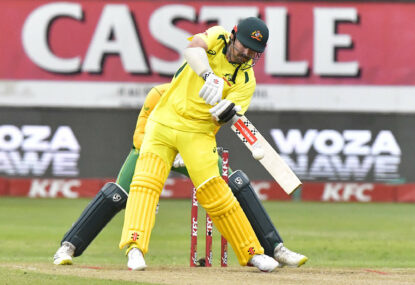
WATCH: Glenn Maxwell's amusing reaction to first-ball wicket with 'very tame' half-tracker
RCB were initially questioned after bringing Maxi on with the new rock. It worked a treat as he dismissed Ruturaj Gaikwad first ball.

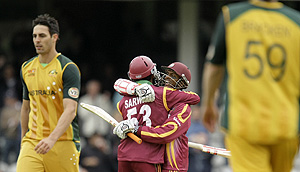
West Indies' Shivnarine Chanderpaul, center right, celebrates winning the match with his teammate Ramnaresh Sarwan, center left, beside Australia's Mitchell Johnson, left, during the Group C Twenty20 World Cup cricket match between Australia and the West Indies at The Oval cricket ground in London, Saturday June 6, 2009. AP Photo/Matt Dunham
Discussion over the future of cricket is looking more like the global warming debate everyday. Nearly everyone agrees there’s a problem. Nearly everyone agrees something should be done about it. And everyone has met up to agree to meet up again.
In the meantime, half of Australia’s best eleven cricketers are at home nursing injuries while a very exciting – yet, to many, meaningless – series against India thunders along in front of a never-ending supply of Indian cricket fans, reaping the zillions of dollars they generate.
The Australian summer starts in 18 days. The West Indies this time, isn’t it?
‘‘…the sheer disorganisation of cricket’s calendar is now itself fatiguing, and cannot but bring cynicism and contempt in its train,’’ cricket writer Gideon Haigh declared eloquently on cricinfo.com recently.
Haigh’s column argued that burnout is no longer a problem solely afflicting players, it is now wearing down fans and even the media.
Cynicism and contempt? It is growing. But there is another ‘C’ word being bandied about as a key to cricket’s future. Context.
‘‘The answer to the whole problem is to give cricket context,’’ Federation of International Cricketers’ Associations chief executive Tim May said last week.
May, the former Australian spinner-turned players’ advocate, was en route to the meeting of minds in Dubai on Thursday, where a who’s who of cricket royalty gathered to conclude such penetrating insights as ‘‘rebranding the concept of Test cricket’’ and the need for one day cricket ‘‘to remain viable and popular’’.
May is one of the few left in cricket these days who tells it like it is. Not everyone likes him for it, but he couldn’t care less.
May said that, within a context of Test championships and annual one day championships, the players can play less and earn more. Everyone’s happy. Even the fans.
‘‘It really is simple and we have been saying it for a long time – but no one country wants to lose the power of steering its own course and therefore the Future Tour Program is just full of greed and self interest.’’
Here’s some context: in the 10 years that Alan Davidson played international cricket, between 1953 and 1963, he spent about 220 days representing Australia.
Michael Clarke has been playing for just five years, yet has already played eight more Tests than Davidson – as well as 163 one day internationals and 19 Twenty20 matches. The world is very different to Davidson’s day, but the ramifications of the current excess is not in cricket’s interest.
Clarke is at home in Sydney, resting his dodgy back. Others who’s bodies have given out are Brett Lee, Tim Paine, James Hopes, Peter Siddle, Callum Ferguson and Nathan Bracken.
Moises Henriques came and went. Brad Haddin has just started playing again. Good luck for Burt Cockley and Clint McKay.
In April, Australian Cricketers’ Association chief executive Paul Marsh discussed the reality that there was no longer THE Australian cricket team, but AN Australian cricket team.
As of last Friday, 32 people had played one day cricket for Australia in the past 12 months. That’s one short of three full cricket teams.
‘‘The ACA has said for many years that international sport should always be the best against the best,’’ Marsh said.
‘‘Unfortunately, for workload reasons, a high proportion of one-day internationals and Twenty20 games now don’t provide this contest.
‘‘If the volume of cricket played was at a more reasonable level, I don’t think we’d see anything but our best available teams selected.’’
The danger now is that fans are losing sympathy for the players.
Fans can see the irony in the players pushing for less cricket (by the way, Australia’s contracted cricketers just got a pay pool increase of 13.1 per cent each year for the next two years), while nearly all have jumped at the chance to play an extra month and a half each year at the Indian Premier League, which is like winning Lotto.
An ACA survey of state and national players early this year found that less than half believed representing their country would be the ultimate achievement 10 years from now. Chris Gayle said it and everyone was aghast. But Gayle might just be regarded as a pioneer in a few years’ time.
James Sutherland’s right hand man, Peter Young, said recently ‘‘We’re conscious of the impact the workload has on players and the broader impact it has on fans because there’s only so much cricket a fan can consume. It’s an ongoing debate. We’re concerned to get the balance right.’’ Let’s have a meeting.
Certainly, for some fans – wherever they live – too much is never enough.
And, certainly, many in Australia, players and administrators alike, are enjoying the short term financial rewards of an overkill that is now cricket’s equivalent of global warming – it’s no longer a threat, it is actually happening.
Build your own fantasy cricket team and put it to the test with Draftstars daily fantasy competitions. Pick your match, pick your team and watch the points roll in to take out cash prizes on each match. What are you really gambling with? Set a deposit limit.
RCB were initially questioned after bringing Maxi on with the new rock. It worked a treat as he dismissed Ruturaj Gaikwad first ball.
Faf du Plessis took one of the catches of the tournament as Royal Challengers Bengaluru qualified for the IPL playoffs with a 27-run win.…
Jonny Bairstow wants to never mention it again and Alex Carey got sick of hearing about it but the firestorm surrounding their dramatic incident…
Arjun Tendulkar fell victim to the humidity as he cramped up, but he wished he had taken himself off as he delivered two gifts…

New Zealand took 28 years to win a Test match, finally triumphing in 1956. There were plenty of skilled individuals before that but not a complete team.

In just under three weeks, the 2024 Men’s T20 World Cup will commence in Texas as the United States face off against Canada in…